










Questions before you book a demo?
Why should we trust Hackuity?


Hackuity was founded in 2020 by former executives of Lexsi and Orange Cyber Defense practitioners who built and ran vulnerability management programs for large enterprises before building a platform to fix what was broken.
Market recognition:
- Recognized in the Forrester Unified Vulnerability Management Landscape (Q1 2025) and The Proactive Security Platforms Landscape, (Q1 2026)
- SC Awards Europe: Best Vulnerability Management Solution nominee (2024)
- PwC Luxembourg: Cybersecurity & Privacy Solution of the Year (2023)
- Grand Défi (French Government Innovation Program): Winner (2021, 2023)
Customer base:
- Powers organizations from 1,000 to 500,000 - 1,000,000 assets
- 80% large enterprises across Finance, Energy, Telecom, Defense, and Public Sector
- Certifications: SOC 2 Type II certified, IMDA accredited.
What results have Hackuity customers actually achieved?
Hackuity customers consistently report three measurable outcomes:
- ÷10,000 on critical vulnerabilities: Average reduction in the number of critical vulnerabilities requiring immediate remediation (CVSS-based noise → TRS-based prioritization).
- 3x faster MTTR: Mean Time to Remediate for critical patches
- 70% automation of end-to-end vulnerability management operations
Beyond metrics: security teams stop managing spreadsheets and start driving risk decisions. CISOs gain a unified, audit-ready view of cyber exposure from SecOps to board level
We already have Tenable / Qualys / Rapid7. Why do we need Hackuity?
Hackuity is not a scanner, it makes yours more powerful.
The problem isn't detection. It's the volume, noise, and fragmentation that comes after. Security teams today manage findings from 5 to 15+ tools, with duplicates, conflicting severities, and no clear remediation ownership.
Hackuity sits above your existing scanners to:
- Aggregate & normalize findings from 130+ tools (network, application, cloud, EDR, pentests, bug bounty)
- Deduplicate across sources - one vulnerability, one record, regardless of how many tools flagged it
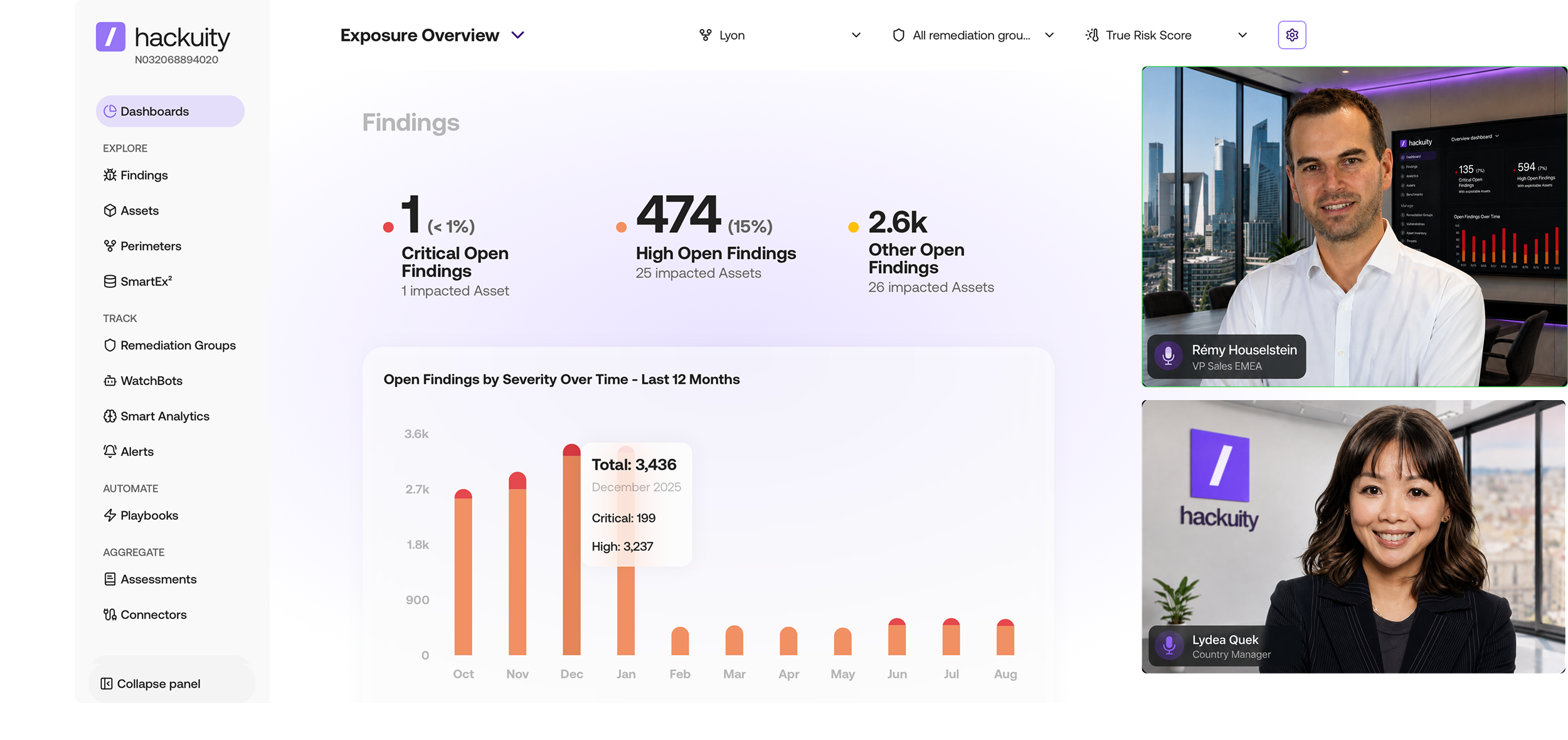
- Prioritize with context using the True Risk Score (TRS): CVSS + threat intelligence + your business environment
- Orchestrate remediation via native ITSM integrations (ServiceNow, Jira, Azure DevOps)
Key differentiator: True vendor agnosticism. Hackuity doesn't sell scanners; every source is treated equally, with no proprietary data bias.
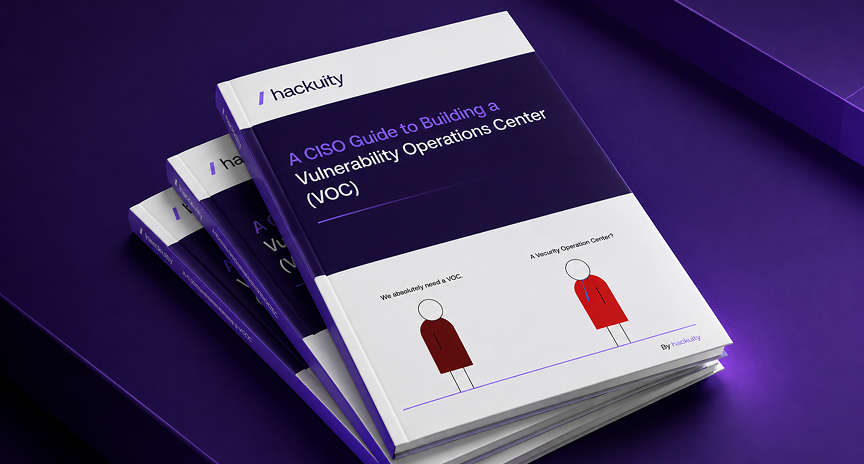
What's the difference between a SOC and a VOC, and how does Hackuity help build one?
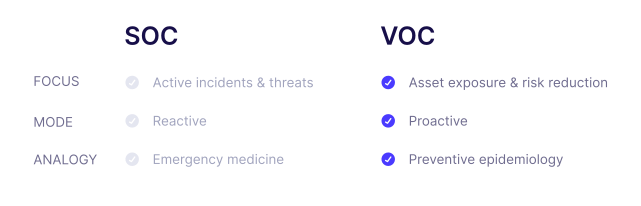
Your SOC detects and contains breaches. A Vulnerability Operations Center (VOC) systematically reduces your attack surface before exploitation happens. Both are necessary but they require different operating models and different platforms.
Hackuity is the VOC enabler: the equivalent of what Splunk is to the SOC:
- Centralized intelligence: Single source of truth across 130+ detection sources
- Risk-driven prioritization: From 10,000 findings to 50 actions that matter
- Cross-team orchestration: Remediation delegated to asset owners, DevOps, IT ops
- Measurable outcomes: Track attack surface reduction, not just patch counts
We have thousands of vulnerabilities flagged every week. How does Hackuity help us focus on what actually matters?
The volume problem has two distinct causes and Hackuity addresses both.
1. Data quality: consolidate before you prioritize
Multiple scanners scanning the same assets create duplicates, conflicting severities, and fragmented records. Hackuity normalizes and deduplicates findings across all your sources: one vulnerability, one record, one score regardless of how many tools flagged it.
2. Risk-based prioritization: not all vulnerabilities are equal
Once your data is clean, Hackuity's True Risk Score (TRS) determines which vulnerabilities actually threaten your business, by combining:
- CVSS base metrics
- Your asset criticality and exposure
- Real-world exploitability (EPSS, CISA KEV, threat intelligence)
Result: From tens of thousands of findings to the handful of remediation actions that actually reduce your risk exposure.
What is the True Risk Score (TRS), and why is it better than CVSS?
The problem with CVSS: A CVSS 9.8 vulnerability may not be exploitable in your environment. A CVSS 6.5 issue may already be weaponized in active campaigns. CVSS was designed to characterize vulnerabilities not to drive remediation decisions.
TRS goes further. It integrates:
- Base CVSS (severity, impact, exploitability vectors)
- Environmental context: asset criticality, exposure, protection measures specific to your organization
- Temporal factors: exploit maturity, patch availability
- Cyber Threat Intelligence (CTI): EPSS scores, CISA KEV catalog, MITRE ATT&CK TTP mappings (AI-powered), dark/deep web threat monitoring
Transparency by design: Every TRS component is visible and auditable. No black box. You can explain every score to your team, your auditors, and your board.
Result: Average 99.99% less in critical vulnerabilities requiring immediate action.
How does Hackuity automate vulnerability remediation, from detection to fix?
Hackuity automates 70% of end-to-end vulnerability management operations through:
1. Bidirectional ITSM integration Automatically create and sync tickets in ServiceNow, Jira, or Azure DevOps based on risk thresholds with real-time status feedback (In Progress, Remediated, Won't Fix).
2. Rule-based playbooks Define automated actions triggered by conditions:
- "If TRS > 8.5 AND asset is in Production → Create ServiceNow ticket + Notify CISO"
- "If CVE in CISA KEV → Escalate to priority queue"
3. RBAC-based delegation Each team (DevOps, IT ops, asset owners) sees only their perimeter and assigned vulnerabilities no information overload, clear ownership.
4. AI Remediation Advisor (new) Converts vulnerability lists into step-by-step remediation guidance:
- Smart patch bundling reduces patch workload by 18x through intelligent consolidation
- Recommendations grounded in vendor advisories (Microsoft, Red Hat, Debian...) via RAG not generic AI output
- Auto-populated ITSM tickets with execution steps and post-fix verification
Result: Non-security teams act independently. VOC analysts track velocity and bottlenecks not spreadsheets.
How does Hackuity use AI and how do I explain it to my board?
Hackuity is building specialized AI agents to help security teams move from exposure to resolution:
- Remediation Advisor: turns vulnerability data into prioritized, actionable patch recommendations. Feature Preview planned for September 2026, with Patch Insights beta in October 2026 and GA in January 2027.
- Probe: validates whether critical, internet-exposed vulnerabilities are genuinely exploitable. Demo planned for September 2026, Feature Preview in October 2026, and GA by the end of 2026.
- Scout: converts unstructured pentest reports into structured Hackuity findings. Its MCP proof of concept is available today, with the native agent planned for H2 2026.
- VOC Copilot: the next step, designed to brief analysts, surface relevant risks, and coordinate actions across Hackuity’s agents. Timing to be announced.
What tools does Hackuity integrate with? What if ours isn't on the list?
Hackuity integrates natively with 130+ market-leading tools:
- Vulnerability Scanners: Tenable, Qualys, Rapid7, Nessus, OpenVAS...
- Application Security: Checkmarx, Fortify, Veracode, Snyk...
- Cloud Security: Wiz, Orca, Prisma Cloud, AWS Security Hub...
- EDR/XDR: CrowdStrike, Microsoft Defender, SentinelOne...
- ITSM/Ticketing: ServiceNow, Jira, Azure DevOps...
- Identity Security: Semperis, Ping Identity...
- Bug Bounty: YesWeHack, Yogosha, HackerOne...
If your tool isn't listed:
- Market connectors are built by Hackuity at no additional cost, typically delivered within 2 to 3 months
- Proprietary in-house tools can be integrated via Hackuity's open API or the Universal CMDB connector
How does Hackuity support NIS2, DORA, and ISO 27001 compliance?
Hackuity provides the operational and audit infrastructure required by major regulatory frameworks:
- Centralized evidence repository: All vulnerability assessments, remediation actions, and audit trails in one place
- Compliance-ready reporting: Export standardized reports for auditors (NIS2, DORA, ISO 27001, PCI-DSS, SOC 2...)
- Historical tracking: Up to 3 years of data retention (extended retention available as a paid option) to demonstrate continuous improvement
- Executive dashboards: Risk posture trends and remediation velocity, from CISO to board level
- Read-only auditor access: External auditors get a clean, structured view without touching operational data
What security certifications does Hackuity hold?
Hackuity maintains the following certifications and accreditations:
- SOC 2 Type II: Independently audited security controls covering availability, confidentiality, and processing integrity
- IMDA accredited: Singapore's Infocomm Media Development Authority accreditation for regulated markets in Asia-Pacific
Does Hackuity work with MSSPs and resellers?
Hackuity operates a structured partner ecosystem with five distinct tracks:
- MSSPs: Deliver Hackuity as a managed vulnerability service, with multi-tenant architecture, perimeter-based access control, and white-label reporting options.
- System Integrators: Implement and maximize the value of the Hackuity platform for enterprise customers, combining organizational and technical expertise in vulnerability management.
- Resellers: Resell Hackuity licenses with competitive, volume-based margins and co-selling support from Hackuity's sales team.
- Local Distributors: Provide regional distribution and market coverage, primarily in APAC and the Middle East.
- Technology Partners: Integrate their security product with Hackuity via API, with featured placement in the connector catalog and joint go-to-market opportunities.
See Hackuity in action