









What Changed
AI-driven vulnerability discovery represents a fundamental shift in how security flaws are found. Mythos doesn't just scan faster, it reasons, chains vulnerabilities together, and discovers exploits that neither humans nor traditional automated tools would conceive. On Firefox alone, it found 90 times more exploits than the previous best model. On industry benchmarks, it scored 83.1% compared to 66.6% for its predecessor.
This isn't incremental improvement. It's a category shift in discovery capability.
Anthropic deemed the model too dangerous for public release. Instead, they deployed it through Glasswing a controlled coalition including AWS, Apple, Microsoft, Google, CrowdStrike, Cisco, and more than 40 organizations. The mission: find and fix vulnerabilities in critical infrastructure before malicious actors develop similar capabilities.
The race is on. And according to Alex Stamos, former CISO of Facebook and Yahoo, we have roughly six months before comparable models proliferate to threat actors.
The Illusion
The natural assumption is that better vulnerability discovery leads to better security. Find more flaws, fix more flaws, reduce risk.
But that assumption breaks at scale.Here's what the data shows: According to early analysis, less than 1% of vulnerabilities discovered by Claude Mythos have been patched. Industry research confirms only 7.6% of organizations remediate critical vulnerabilities within 24 hours while attackers can weaponize them in 24 to 48 hours. The mean time to remediate for critical vulnerabilities sits at 65 days. Sixty-five days while AI discovers thousands of flaws in hours.
More discovery doesn't equal better security. It equals operational overload.
The Paradox: Discovery Outpacing Operations
We've largely solved visibility. What we've created instead is overload.
Security didn't become easier with AI. It became a resource allocation problem.
This creates a structural paradox: The more efficient vulnerability discovery becomes, the more impossible complete remediation becomes. Every organization has finite security teams, finite IT capacity, finite testing environments, finite change windows. When AI can surface thousands of high-severity findings across complex environments in hours, those finite resources become breaking points.
The real challenge is prioritization at scale.
If an AI surfaces 10,000 vulnerabilities across your infrastructure overnight, the bottleneck isn't "what are our vulnerabilities?" It's "which ones actually threaten us, what do we fix first, who owns the remediation, and how do we prove it's closed?"
Discovery is solved. The unsolved problem is remediation operationalization.
The Missing Layer
Glasswing solves vulnerability discovery brilliantly. But discovery is only the first step in a much longer operational chain.
What Glasswing provides: vulnerability discovery at scale, proof of exploitability, zero-day identification, CVE feed enrichment.
What Glasswing doesn't provide: asset context and criticality mapping, risk-based prioritization across your specific environment, assignment to the right owners, workflow orchestration, SLA enforcement, remediation verification, or audit-ready compliance proof.
In other words: Glasswing tells you what's broken. It doesn't tell you what matters most to your business, who should fix it, when, or how to prove it's done.
At small scale, that gap can be managed manually. At the scale AI-driven discovery creates, manual processes collapse entirely. Organizations break, not because they lack visibility, but because they lack the operational infrastructure to translate visibility into verified risk reduction.
What's required is not just prioritization, but a full operational loop from ingestion to verified closure.
The Emergence of CTEM
This shift has created a new category requirement: Continuous Threat Exposure Management.
CTEM platforms don't discover vulnerabilities they operationalize vulnerability intelligence at scale. They sit between discovery tools and remediation execution, bridging the gap that AI-driven discovery has widened.
The CTEM layer provides what AI-driven discovery demands: continuous ingestion from hundreds of vulnerability sources, contextual prioritization based on asset criticality and business risk, automated orchestration routing issues to the right owners, remediation tracking through verified closure, and audit-ready proof of risk reduction.
This is the missing layer. And after April 7, 2026, it's no longer optional.
The New Requirement
Before Glasswing, reducing mean time to remediate was a competitive advantage. After Glasswing, MTTR reduction is a survival requirement.
What used to be a competitive advantage (reducing MTTR) is now the minimum viable response speed.
The window between vulnerability discovery and exploitation has collapsed. What once took months now happens in minutes when AI is involved on both sides.
The organizations that survive the next phase won't be the ones with the most sophisticated discovery tools. They'll be the ones who can operationalize remediation at the speed of AI-driven discovery.
According to recent analysis, MTTR reduction of 70% isn't aspirational anymore. It's the baseline requirement in a world where AI discovers and weaponizes vulnerabilities faster than traditional security operations can process them.
The Necessary Layer
Glasswing made the firehose inevitable. The question now is whether you can control it. Without that layer, more discovery doesn't reduce risk. It amplifies it.
At Glasswing-scale volumes, manual triage breaks. This requires automation systems that can ingest, prioritize, assign, and track remediation autonomously, without human bottlenecks.
This is where platforms like Hackuity become essential, not as another vulnerability scanner, but as the orchestration and automation layer the new paradigm demands.
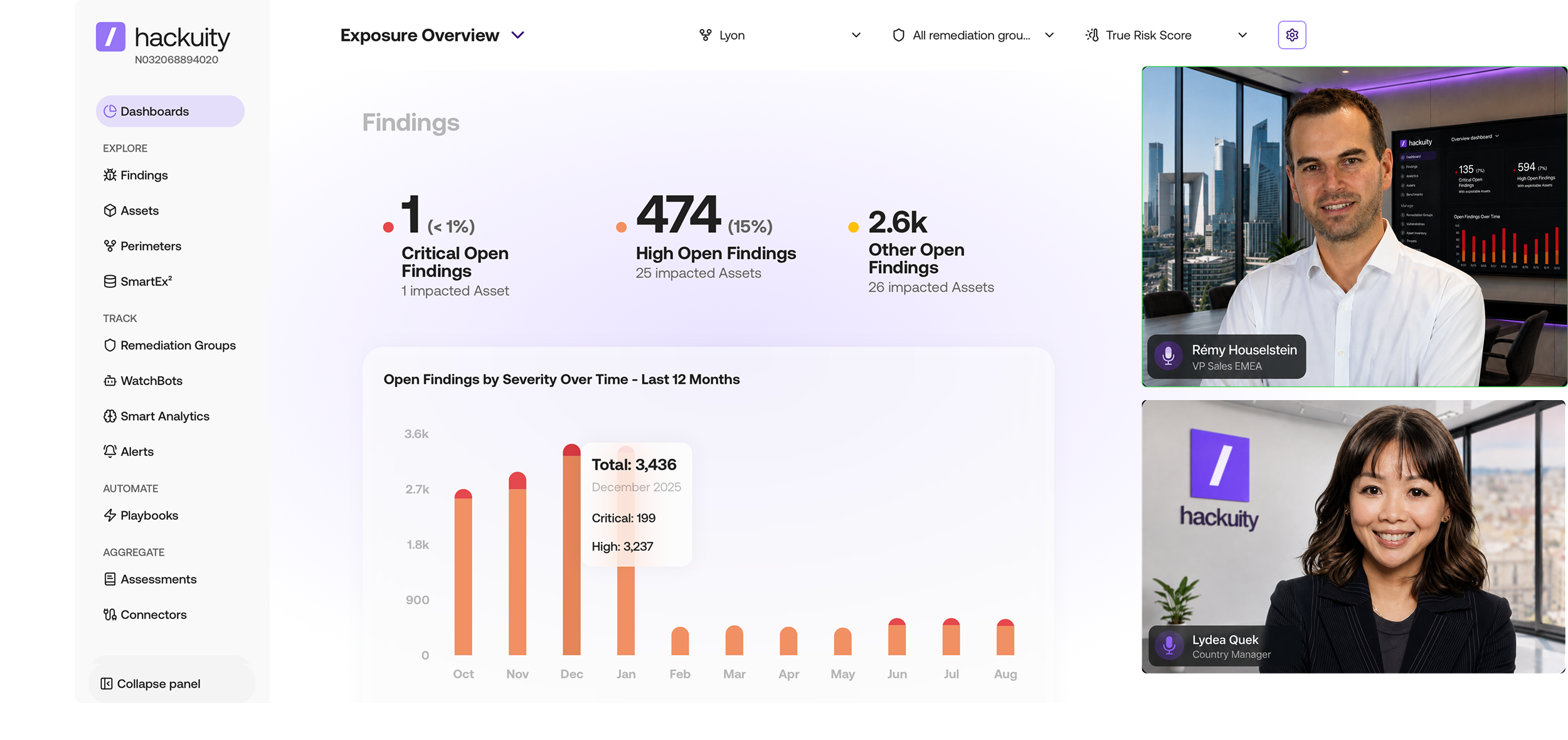
Hackuity operates as the bridge between discovery and remediation, delivering a full operational cycle from ingestion to verified closure: aggregating vulnerability intelligence from over 100 sources including the Glasswing ecosystem, contextualizing findings against actual asset inventory and criticality, prioritizing based on real risk rather than CVSS scores alone, orchestrating automated workflows that assign, track, and close issues without manual triage, integrating with ITSM systems to route remediation at scale, and verifying closure with audit-ready proof of risk reduction.
It's not about finding more vulnerabilities. It's about deciding what actually matters and ensuring it gets fixed autonomously, at scale before attackers exploit it.
What This Means
AI-driven vulnerability discovery didn't make exposure management platforms obsolete. It made their role impossible to ignore.
In a world where AI discovers vulnerabilities at light speed but humans remediate at human speed, the organizations that survive won't be the ones with perfect visibility.
They'll be the ones who can answer one question faster than everyone else: "What actually threatens us, and what do we fix first?".
The gap between discovery and decision just became the defining challenge of modern cybersecurity. And the only way to close it is with the infrastructure to operationalize remediation at the scale AI has created.
In the age of AI-driven discovery, security isn't defined by what you find. It's defined by what you can fix before it's too late.



VR-1 | Property |
|---|---|
Model type | Post-trained cyber reasoning model |
Primary specialization | Multi-domain enterprise attack-chain discovery |
Starting condition | A scoped foothold and a concrete objective |
Operating surfaces | Cloud, identity, runtime, code, CI/CD, SaaS, and organizational context |
Success signal | Execution-verified completion of the objective |
Primary evaluation | IntrusionBench |
Preliminary result (preview) | More than 2× black-box pass@3 over the strongest evaluated frontier baseline |
Trajectory budget | Two-hour wall-clock limit per trajectory, or 250 agent turns (whichever comes first) |