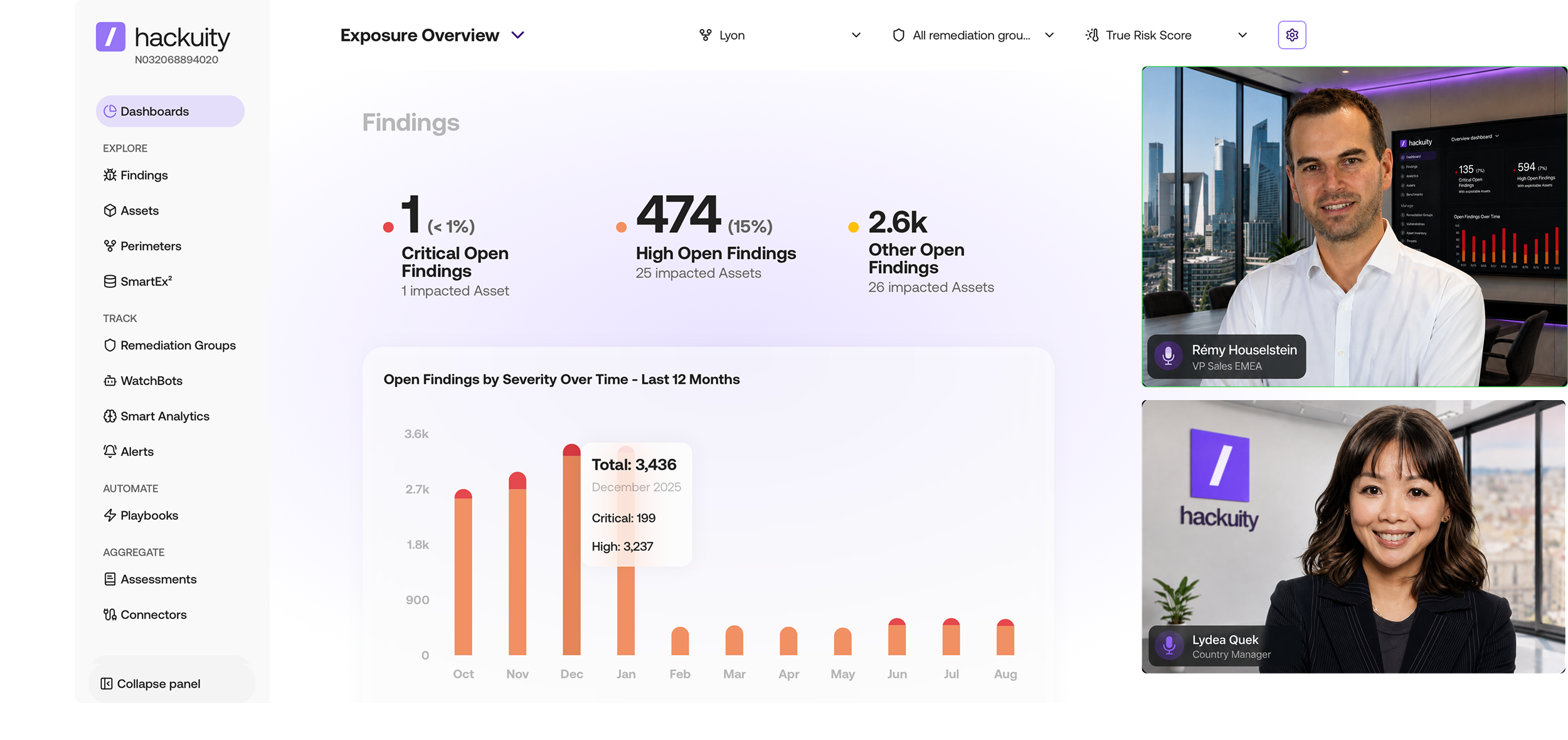











Hackuity’s primary selling point is the True Risk Score (TRS)
❌ WRONG
This is a fundamental misunderstanding.
Hackuity’s core is not a score, it’s operations. More precisely, end-to-end vulnerability operations. The TRS is a powerful component for risk evaluation, yes, but it’s just one piece in a broader system designed to industrialize how vulnerabilities are processed.
Reducing Hackuity to a score is like describing an aircraft by its altimeter.
“For a CISO looking for a risk number to present to the board, Hackuity is a powerful analytics tool.”
✅ TRUE
And that’s precisely why CISOs stop exporting CSVs into Excel or rebuilding dashboards in BI tools.
Reporting becomes native, continuous and contextual. No glue, no manual stitching, no “data reconciliation Fridays.”
“The True Risk Score is a black box creating dependency on a vendor’s secret sauce”
❌ WRONG
Everything is documented. Transparent. Accessible.
The confusion likely comes from effectiveness. When something consistently produces accurate prioritization, people sometimes assume opacity; or worse, “magic.”
There’s no magic here. Just nearly a decade of engineering, modeling, and iteration.
More importantly: customers are not locked in. They can:
- Use TRSIgnore TRS
- Build their own prioritization logic
- Inject their own scoring models
Try doing that in most platforms without rewriting half the product.
“Hackuity boasts around 80+ connectors”
❌ WRONG (and outdated)
It’s over 120, deployable in minutes without code or tuning.
We understand it’s hard to keep up. Hackuity moves quickly.
Also worth noting: we don’t offload integration work onto customers. If a connector is needed, we build it and at no extra cost. Because integration friction is wasted time, and wasted time is the enemy of operations.
And terminology matters: We call them connectors, not parsers, because the people using them are running security programs, not writing compilers.
For everything else, Hackuity universal connectors handle custom ingestion cleanly and efficiently.
Hackuity is a top-down dashboard with a cockpit view
✅ TRUE… but incomplete
Yes, visualization is strong.
But stopping there misses the entire point.
Hackuity is built to operate, not just observe. The objective of a VOC and a VulnOps approach is full-chain automation from discovery to remediation.
Dashboards don’t fix vulnerabilities. Operations do. Good news, it’s exactly what we do.
Hackuity will tell you exactly how bad a vulnerability is
✅ TRUE
And that’s only half the story.
Because prioritization without execution is just well-organized backlog.
Hackuity doesn’t stop at “this is critical.” It ensures remediation actually happens through deep native integrations with ITSM and DevOps ecosystems, including:
- ServiceNow
- Jira ITSM
- EasyVista
- Azure DevOps
- Helix ALM
- Ivanti Neurons
- Etc.
Configured in minutes: not days, not weeks, and not “after a proof of concept.”There’s a reason why process orchestration is where most tools fail. It’s also where Hackuity excels.
Final Thought
Comparisons are useful when they aim to inform.
Less so when they simplify, approximate, or lag behind reality.
The gap between “a tool that aggregates findings” and “a platform that operationalizes remediation at scale” is not semantic, it’s structural. And increasingly, it’s visible in how organizations evolve their security programs.
If your vulnerability management still depends on manual stitching, scattered workflows, and reporting gymnastics, the question is not which dashboard looks better.
It’s whether you are actually operating or just observing.
See for yourself.



VR-1 | Property |
|---|---|
Model type | Post-trained cyber reasoning model |
Primary specialization | Multi-domain enterprise attack-chain discovery |
Starting condition | A scoped foothold and a concrete objective |
Operating surfaces | Cloud, identity, runtime, code, CI/CD, SaaS, and organizational context |
Success signal | Execution-verified completion of the objective |
Primary evaluation | IntrusionBench |
Preliminary result (preview) | More than 2× black-box pass@3 over the strongest evaluated frontier baseline |
Trajectory budget | Two-hour wall-clock limit per trajectory, or 250 agent turns (whichever comes first) |