





Prove the risk is going down.

Track risk evolution, remediation performance and verified closure from one operational view. Turn vulnerability operations into measurable outcomes for security teams, management and auditors.

Ticket counts are not risk metrics

Closing more tickets does not necessarily mean reducing exposure. Hackuity measures what vulnerability operations are actually supposed to improve: exposure, remediation performance and verified closure.
01

CRITICAL ASSUMPTION

Severity ≠ Risk
A critical CVE is not always your highest priority. CVSS 9.8 Critical → TRS 420 Medium Risk
02

MEASUREMENT BIAS

Activity ≠ Progress
More closed tickets doesn't necessarily mean less exposure. 1,200 tickets closed → Risk unchanged
03

VALIDATION GAP

Closure ≠ Proof
A resolved ticket doesn't prove the vulnerability is gone. Ticket closed → Remediation verified

Know whether your vulnerability program is actually improving.

Hackuity tracks the metrics that matter for vulnerability operations, not just finding counts. Measure risk evolution, remediation speed, SLA performance, and verified closure across your organization.
01
EXPOSURE

Is our risk going down?

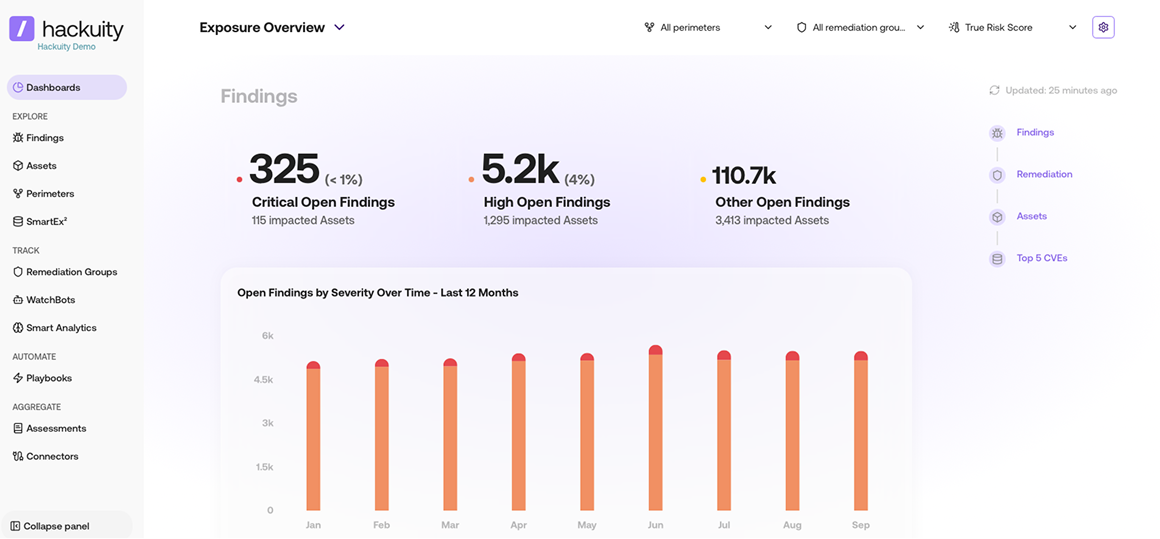
Track the evolution of your vulnerability exposure over time using contextualized risk, not raw finding volumes.
True Risk Score evolution
Critical exposure aging
Risk reduction over time
02
REMEDIATION PERFORMANCE

Are we fixing faster?

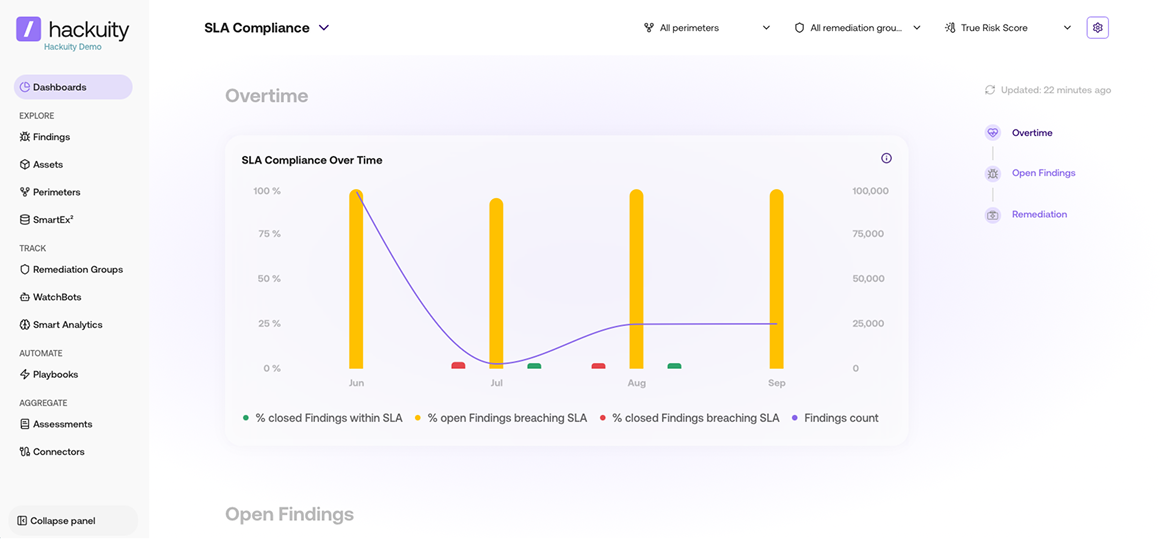
Measure how quickly vulnerabilities move from identification to effective remediation.
Mean Time to Remediate
SLA compliance
Overdue critical findings
03
VERIFIED OUTCOMES

Are vulnerabilities actually fixed?

Go beyond ticket status to track effective remediation and verified closure.
Verified remediation rate
Reopened / recurring findings
Closure validation

A closed ticket isn't proof. Verified remediation is.

Hackuity tracks remediation beyond ticket status. Once remediation is marked complete, updated security data can confirm whether the vulnerability has actually been resolved.
01

FINDING PRIORITIZED

Asset: Prod DB
TRS: 942 (Critical)
02

OWNER ASSIGNED

Infra Sec Team
Via auto-routing policy
03

REMEDIATION COMPLETED

ServiceNow #8410
Status: Resolved
04

SECURITY DATA REFRESHED

Qualys Scan Received
Automated delta trigger
05

REMEDIATION VERIFIED

Confirmed Removed ✓
Risk score dropped to 0

One source of truth. The view each stakeholder needs

Security operations, vulnerability managers, executives and audit teams need different answers. Hackuity turns the same underlying risk and remediation data into the view each audience needs.
01

Is our exposure actually going down?

Show how risk evolves, where exposure is concentrated and whether remediation is delivering measurable progress.
Risk evolution
Remediation progress
SLA performance
Critical exposure
02

Where is remediation working, and where is it stuck?
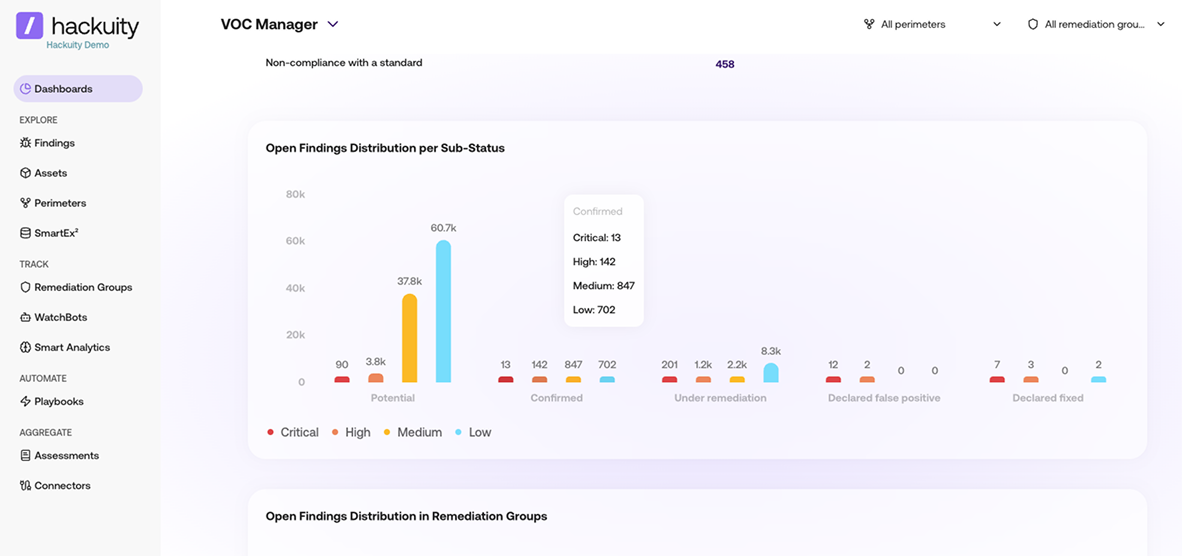
Track ownership, backlog, aging, remediation speed and operational performance.
Remediation progress
Aging and overdue findings
Team performance
Ownership and SLA status
03

Can we prove what was done?

Provide traceable evidence of remediation activity, SLA performance and verified closure.
Remediation history
Verification status
Audit trail

Build the right view

Create dashboards tailored to different stakeholders and operational needs.

Filter & compare

Analyze performance by team, business unit, application, technology or perimeter.

Export and connect

Share reporting with external tools and workflows through supported export and integration options.

Keep the proof behind every remediation outcome

Hackuity keeps risk, ownership, SLA status, remediation history and verification connected in one operational record, helping teams demonstrate not only what was done, but whether it reduced exposure.

Measure what changed. Let AI help you act on it.

Hackuity turns reporting into a continuous feedback loop. Once you can see how exposure evolves, where remediation slows down and what has actually been fixed, AI can help teams move faster across the full VOC lifecycle.
AI-POWERED VOC
Hackuity’s AI capabilities build on the same vulnerability data, workflows and controls to help teams ingest more signals, sharpen prioritization, validate exposure and accelerate remediation.

Reporting in practice.

What is the difference between MTTR and risk reduction in Hackuity?

MTTR measures remediation speed. Risk reduction measures whether that remediation is actually reducing exposure. Hackuity uses both to provide a more complete view of vulnerability program performance.

Report & Measure

Can I create custom dashboards for specific stakeholders?

Yes. Reporting views can be adapted to different operational and governance needs.

Report & Measure

Can I compare remediation performance across teams or business units?

Hackuity can be used to analyze remediation performance across defined scopes and organizational perimeters.

Report & Measure

How does Hackuity verify that a vulnerability is actually fixed?

Once a remediation is marked complete, Hackuity waits for updated scanner data and checks whether the vulnerability is still detected. If the finding is no longer present, the remediation is marked as verified. If it is still detected, the finding remains open or can be reopened according to the configured workflow.

Report & Measure

Can reports be exported or connected to external BI tools?

Hackuity supports reporting exports and integrations according to the available connectors and API capabilities. Contact us to confirm the options available for your environment.

Report & Measure
REPORT & MEASURE

Turn vulnerability operations into measurable risk reduction.

See how Hackuity can help you track exposure, measure remediation performance and prove whether vulnerabilities are actually being fixed.
Request a demo