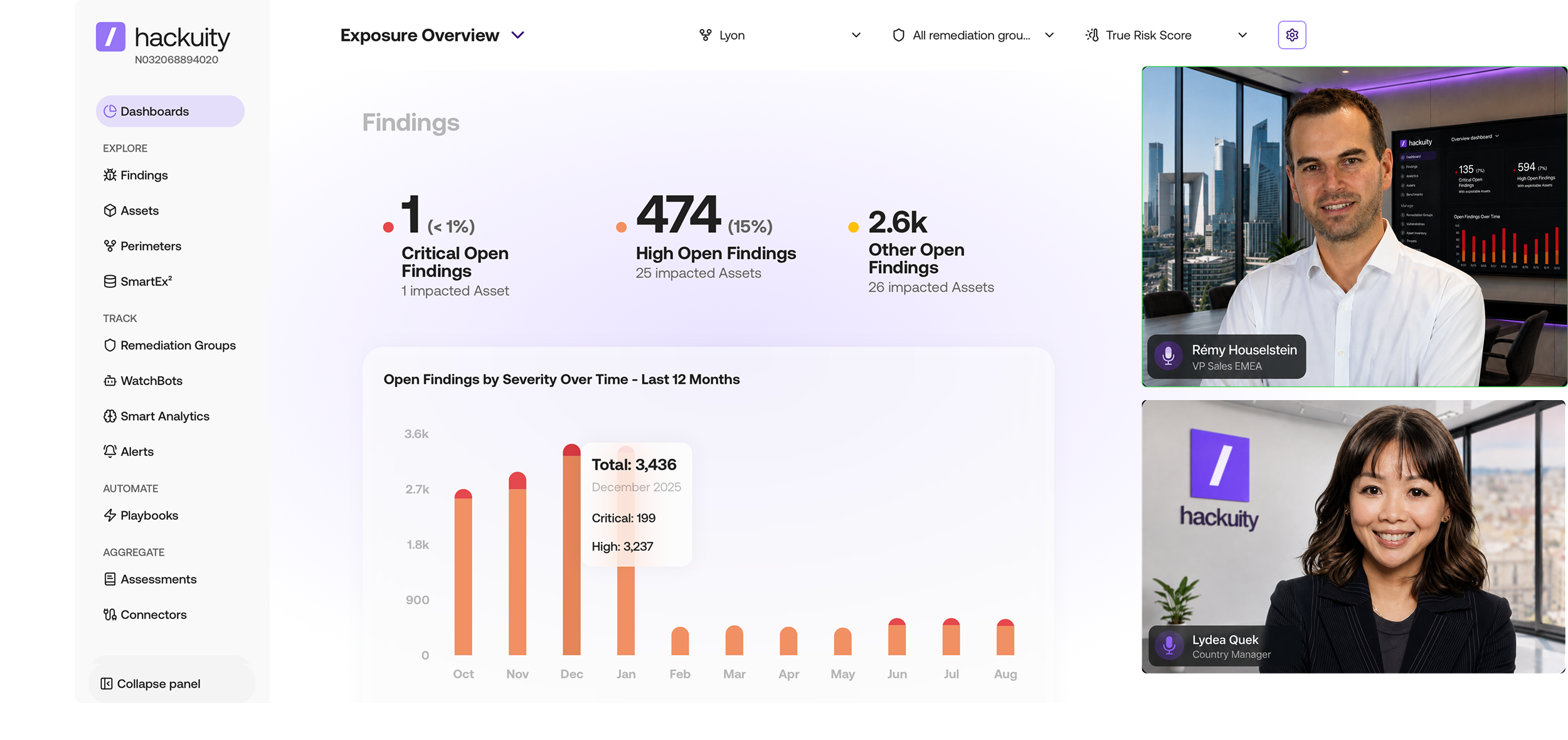









Hackuity Gets Access to Claude Mythos 5.1, Anthropic's Most Capable Cyber Model.
"Is this vulnerability actually exploitable on our system, right now?"
Every vulnerability operations team asks this question about its most critical findings. Most of the time, the answer still comes from a theoretical score, or from a pentester who already has ten other urgent requests. Neither scales.
Back in June, we shared that Hackuity had joined Anthropic's Cyber Verification Program (CVP) to explore what frontier AI can bring to this exact question. Anthropic has just expanded the program. Here's what changed, what it means for Probe, and how it fits into our broader AI roadmap.
The news: a bigger, tiered program
Anthropic’s CVP gives verified security organizations access to cyber capabilities that Claude blocks by default. Those capabilities are dual use: the same skills that help a defender validate a vulnerability could help an attacker exploit it. The program exists to put them in the right hands, under the right controls.
The expanded version is now organized into three access tiers. Each one includes Anthropic's most capable models for security work: Claude Mythos 5.1, Claude Opus 5.5 and Claude Sonnet 5.5.
- Defense Access is for teams defending systems they own or maintain. It covers vulnerability triage and verification, malware analysis, detection engineering and incident response.
- Red Team Access adds authorized penetration testing and red teaming, for in-house red teams and security testing firms.
- Specialized Access has the fewest restrictions. It's reserved for a small group of organizations protecting the most critical infrastructure and software.
Hackuity is in the Defense Access tier today. We have just applied for Red Team Access.
What it means for Hackuity, and for Probe
The short answer: Red Team Access is built for exactly the kind of work Probe requires.
Probe is our first AI agent for exploit validation. Its job is narrow on purpose. It takes one critical finding on an internet-exposed asset and checks whether it's actually exploitable, right now. The analyst gets a clear verdict, Exploitable or Not confirmed, with a confidence level and a plain-language debrief: what was done, what was observed, and where the result has limits.
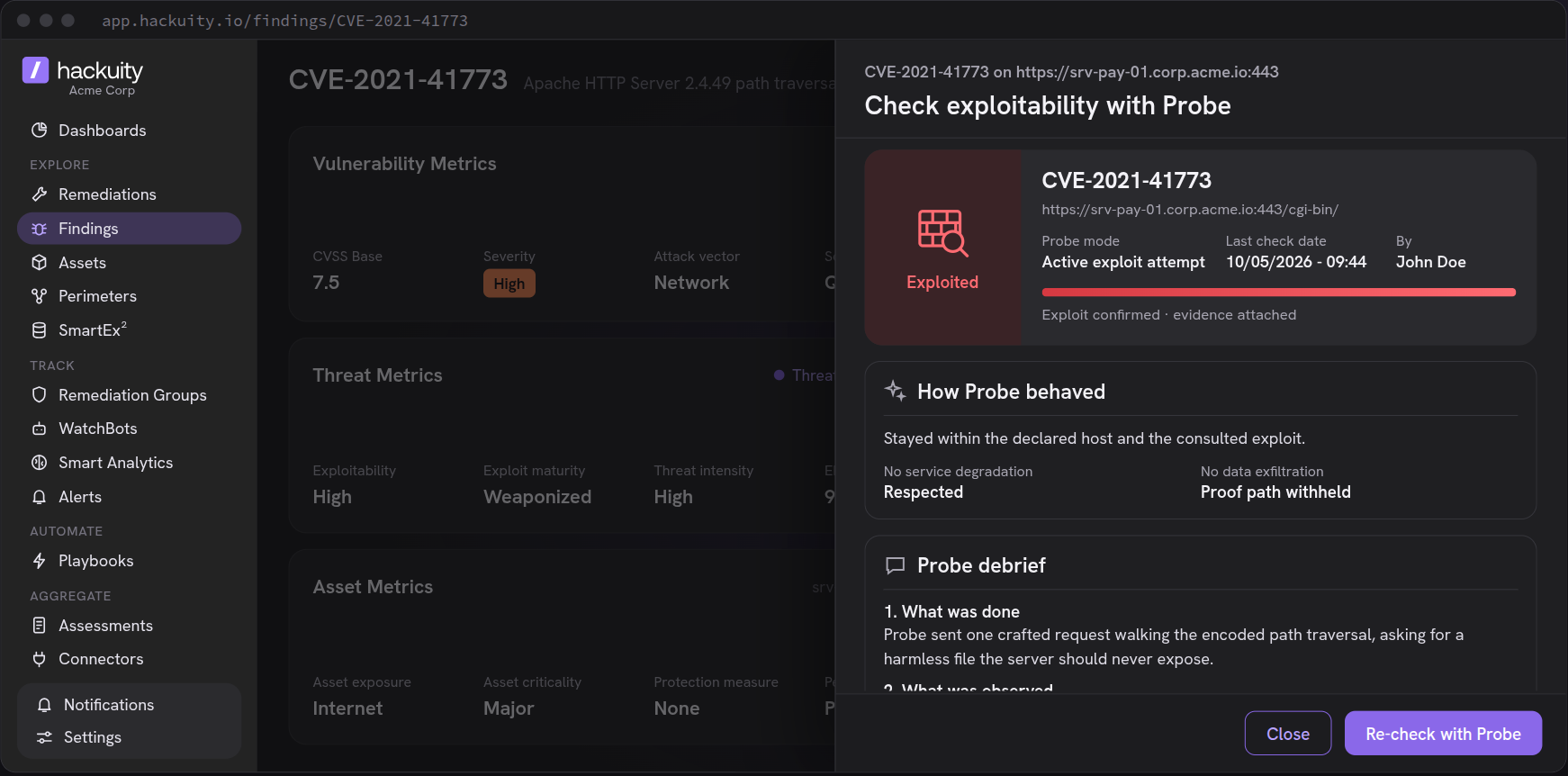
Probe works in two modes. In Passive mode, it reasons over existing signals and nothing is sent to the target. In Active mode, it attempts a safe, non-destructive exploit against the live endpoint.
Here's the catch. You can't prove a vulnerability is exploitable without understanding exactly how it gets exploited. Verifying exploitability is, by nature, controlled offensive work. Anthropic's own testing shows how much the tier matters: on multi-stage offensive scenarios, 46 out of 50 attempts were blocked at some point under Defense Access. Under Red Team Access, none were. We've hit that same wall in our R&D.
Red Team Access would help us in three concrete areas:
- Qualifying which vulnerabilities Probe can safely test. Probe never improvises its targets. It only acts on CVEs reviewed in advance for a safe, documented exploitation path. Frontier models help us analyze public vulnerability data to decide which CVEs make the cut, and which ones stay out.
- Building and testing validation logic in our own lab. Before anything reaches a customer environment, we develop and replay scenarios against vulnerable hosts we own and control.
- Stress-testing our safety boundaries. Probe works under strict prohibitions: no denial of service, no persistence, no data exfiltration, no lateral movement. Making those boundaries hold means understanding what an attacker would try.
Anthropic's guardrails stay on at every tier, and so do ours. Probe only acts on a reviewed list of supported vulnerabilities. Admins control who can trigger it. Every run is fully logged. And its result sits next to the True Risk Score (TRS) as a separate signal: it never overwrites it.
The release plan
- October 26, 2026: Feature Preview. Probe opens to a small group of pilot customers, on their own internet-exposed assets, under a dedicated validation agreement.
- January 2027: General Availability. Probe becomes available more broadly, with the hardening and controls we're building during the preview.
What doesn't change: your data stays yours
Just like in June, this is the point that matters most.
Hackuity doesn't use Anthropic's models on customer data or sensitive data. No findings, no assets, nothing from your environment reaches these models through the program.
We use them to design our features, and to support the features that handle customer data, never to process that data directly. In practice, that means analyzing public vulnerability information, building and qualifying exploit validation logic, and testing it in our own lab. We keep a strict wall between our R&D environment and the platform you use.
The bigger picture: where our AI roadmap is heading
Probe doesn't stand alone. It's one piece of a broader shift: moving from a platform that consolidates vulnerabilities to one where AI agents do the heavy lifting, and your experts make the calls.
Here's how that's taking shape:
- The foundation: MCP. Since early 2026, we've opened Hackuity to AI assistants through the Model Context Protocol (MCP), a standard way for AI tools to query and act on platform data. CVE intelligence, assets, findings, perimeters and remediation groups are all available today, with the AI model of your choice.
- Agents with one mission each. Probe validates exploitability. Remediation Advisor, also in Feature Preview, turns thousands of findings into a short list of patches ranked by real risk. Scout turns pentest and red team reports into tracked findings in seconds instead of days. It works through MCP today, and a native version is on the way.
- Next: orchestration. Our longer-term vision is a VOC Copilot that helps define SLA policies, generate compliance reporting and answer operational questions in natural language.
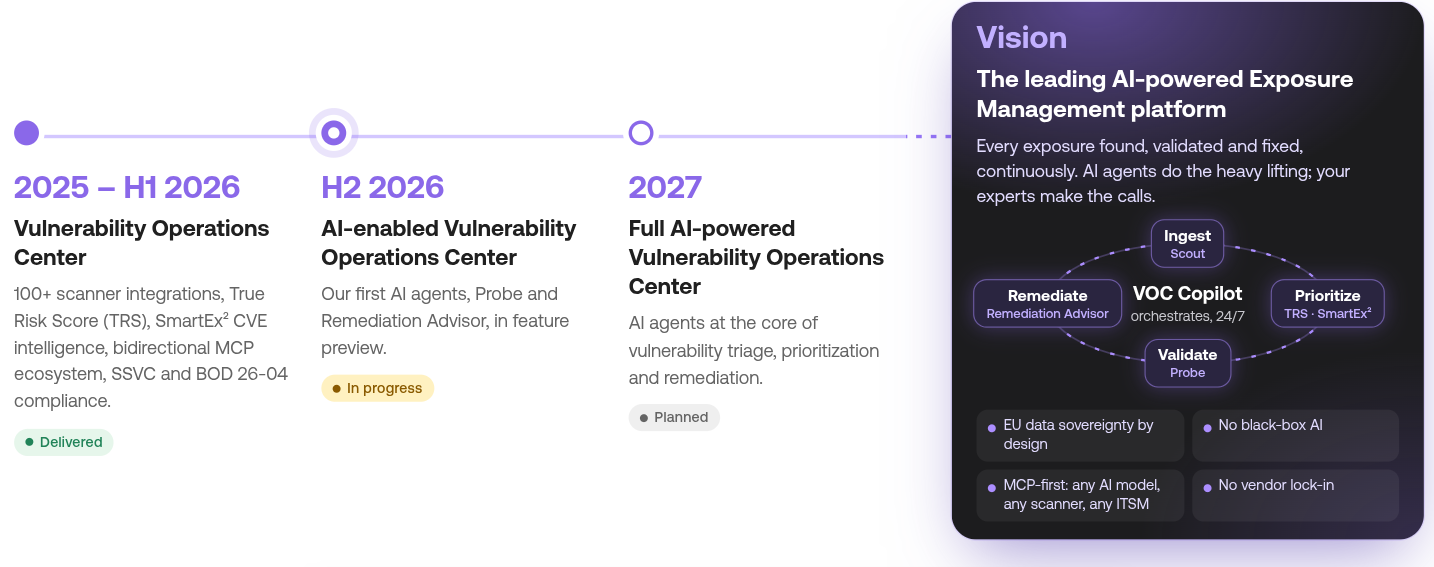
Over time, these signals will connect. For example, we're exploring a new generation of TRS that combines exploit validation results with attack path intelligence.
A few principles guide all of this. Our AI is explainable, not a black box. We design for European data sovereignty. And we stay open: any AI model, any scanner, any ITSM, no lock-in.
Looking ahead
Exploitation windows keep shrinking, and the volume of vulnerabilities keeps growing. Theoretical scores alone can't keep up. Security teams need evidence they can act on, and that their leadership can trust.
Probe is our first step toward turning "probably exploitable" into a verdict you can actually show. The expanded CVP gives us a structured, responsible way to build it properly.
If you'd like to follow the Feature Preview or join a future cohort, reach out to your Customer Success Manager. We'd love to build this with you.



VR-1 | Property |
|---|---|
Model type | Post-trained cyber reasoning model |
Primary specialization | Multi-domain enterprise attack-chain discovery |
Starting condition | A scoped foothold and a concrete objective |
Operating surfaces | Cloud, identity, runtime, code, CI/CD, SaaS, and organizational context |
Success signal | Execution-verified completion of the objective |
Primary evaluation | IntrusionBench |
Preliminary result (preview) | More than 2× black-box pass@3 over the strongest evaluated frontier baseline |
Trajectory budget | Two-hour wall-clock limit per trajectory, or 250 agent turns (whichever comes first) |