












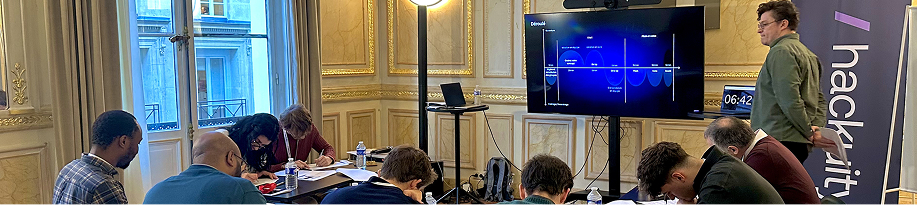

1. Introduction: An Inevitable Paradigm Shift
For over two decades, vulnerability management has rested on a remarkably stable model:
- Identify (scan)
- Prioritize (typically via CVSS)
- Remediate (patching or mitigation)
This model, championed by established players like Tenable and Qualys, has now reached its structural limits:
- An explosion in vulnerability volumes (millions of findings per organization)
- Prioritization disconnected from actual risk
- An inability to keep pace with modern attack velocity
At the same time, a major transformation is underway: the emergence of autonomous AI applied to offensive security, analyzed by Bruce Schneier in his seminal work on the future of hacking. The core insight is stark: AI is industrializing attacks, enabling systems that can autonomously explore, exploit, and chain vulnerabilities at scale.
Faced with this reality, incrementally improving scan tools is no longer sufficient.
This is where VulnOps emerges as a structural response. And for those already familiar with the Vulnerability Operations Center (VOC) framework, the convergence will be immediately obvious: VulnOps and VOC are two names for the same paradigm shift. More on that in a moment.
2. The Old World vs. The New World: A Necessary Rupture
2.1 The Legacy Model: A Static Approach
The old world: Scanners, detection, CVSS.
Traditional Vulnerability Assessment rests on several implicit assumptions:
- Vulnerabilities can be treated individually
- Their criticality is relatively stable over time
- Attackers have limited exploitation capabilities
All three of these assumptions are now false.
Here are, summed up, the structural flaws of this legacy model:
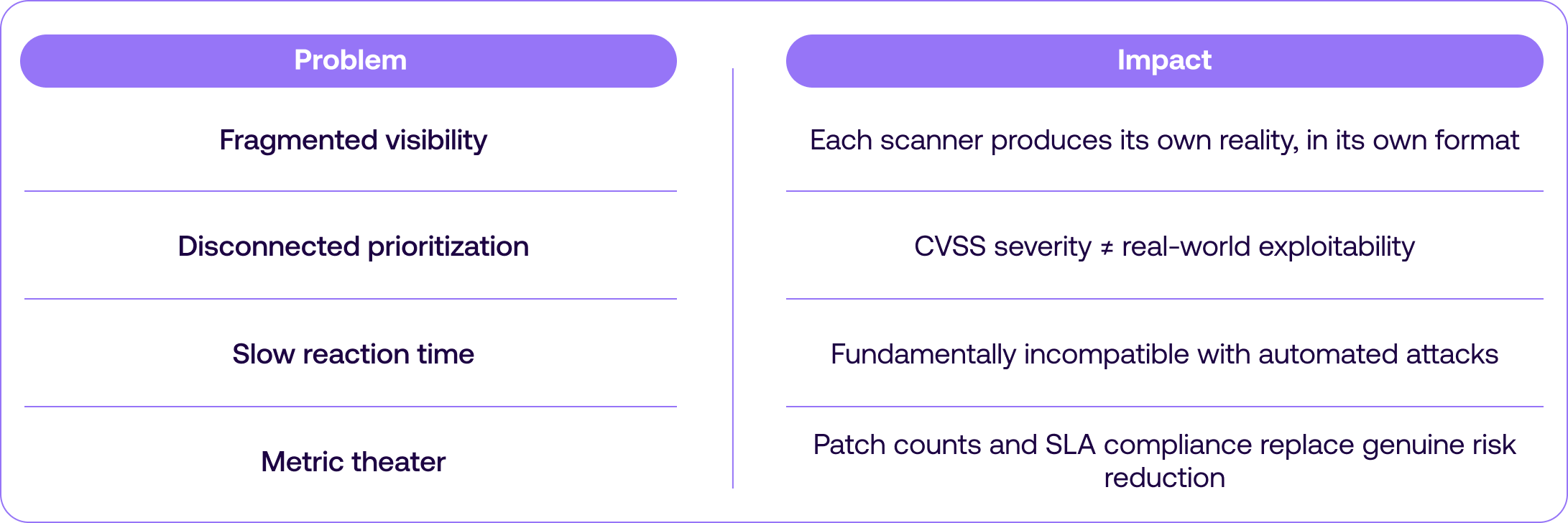
The old question this model is based on can be summed up as “What are my vulnerabilities?” But this question is fundamentally flawed as it can only be answered by lists instead of decisions and action.
2.2 The New World: VOC and VulnOps
The new world: VOC and VulnOps. These two concepts go hand in hand, and together they define the break from the legacy scanner model.
The Vulnerability Operations Center (VOC) was the first structural answer to the inadequacy of scanner-centric vulnerability management. As Hackuity has long articulated, the VOC is to vulnerability management what the SOC is to threat detection: a dedicated operational framework built around a completely different mission.
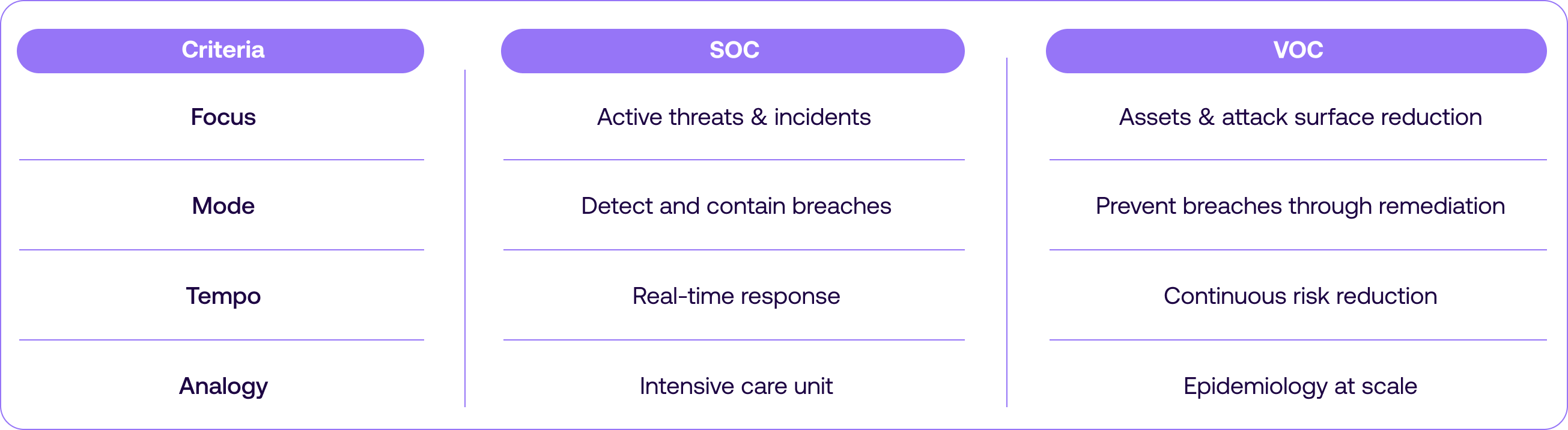
The VOC was the conceptual breakthrough. It reframed the central question:
- Before: "What are my vulnerabilities?"
- After: "Where is my systemic exposure, and how fast am I reducing it?"
VulnOps is the operational discipline that brings the VOC to life in an era of autonomous AI. The two concepts are deeply aligned, sharing the same three foundational pillars:
1. Aggregation
Unification of all vulnerability sources: infrastructure, cloud, application, threat intelligence, bug bounty, EDR. A single source of truth replaces fragmented scanner dashboards.
2. Contextual Prioritization
Real risk calculation based on:
- Exposure (network position, internet-facing assets)
- Exploitability (active exploit availability, EPSS, threat intelligence)
- Business criticality (CIA triad, asset importance)
- Possible attack chains
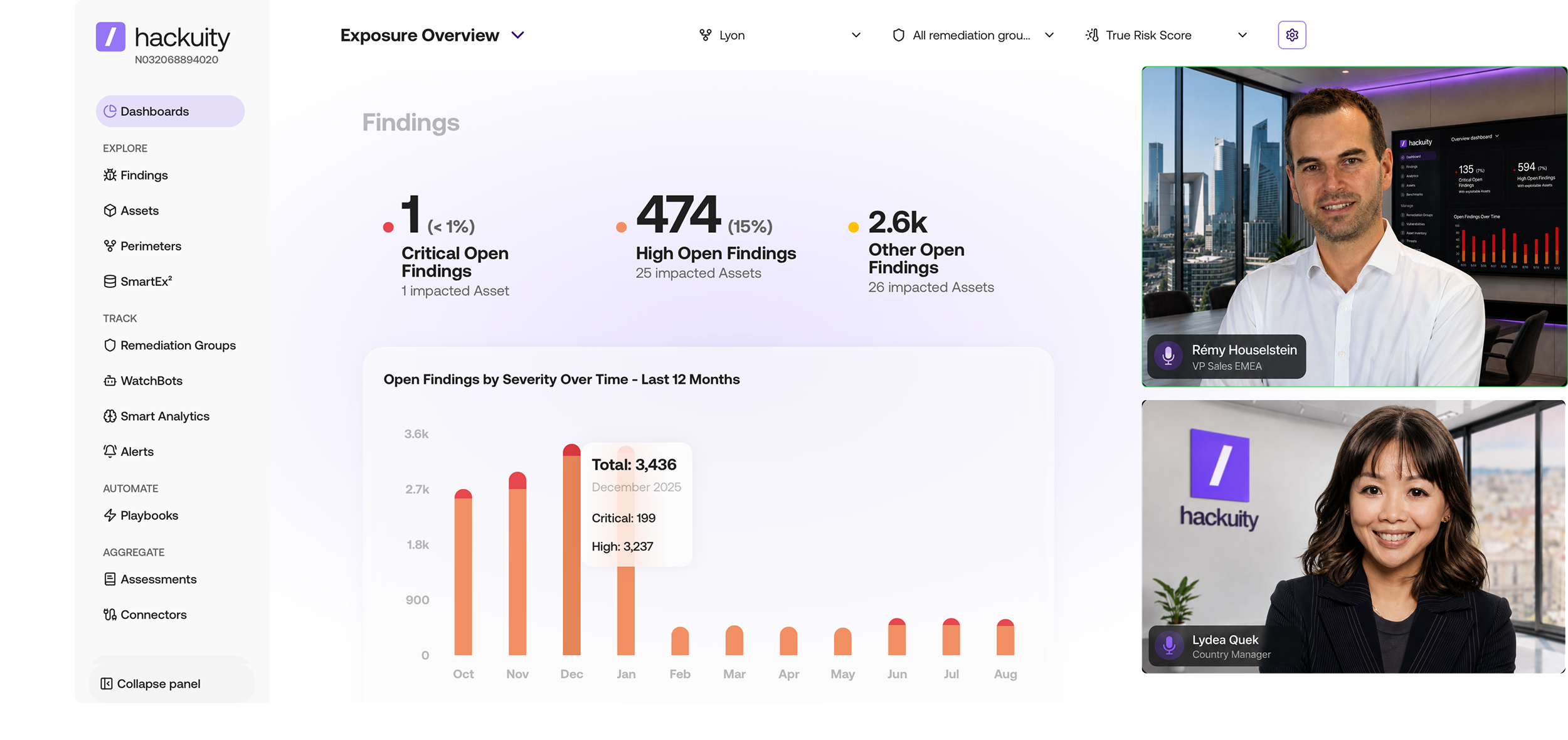
This is precisely what Hackuity's True Risk Score (TRS) operationalizes: moving from 10,000 noisy findings to the 50 that genuinely matter.
3. Orchestration
Transforming decisions into actions: patching workflows, isolation, compensatory mitigations, bidirectional ITSM integration, team delegation, SLA tracking.
VOC and VulnOps should not be positioned against each other, as both describe operational models. The relevant contrast is between these practical approaches and CTEM, which is primarily a conceptual framework.
3. The Impact of Autonomous AI on Cybersecurity
3.1 The Industrialization of Attack
Bruce Schneier's analysis points to a qualitative shift, not a mere acceleration. Offensive AI systems can now conduct automated reconnaissance at scale, chain vulnerability exploits in sequence, help with real-time adaptation to defensive responses, and discover complex attack paths no human attacker could map at the same speed.
The economic consequence is stark: what once required a skilled attacker investing hours of effort can now be delegated to an autonomous system operating continuously. The marginal cost of an attack is approaching zero.
3.2 The End of "Scan + Patch"
In a world where attacks are automated, vulnerabilities are chained rather than exploited in isolation, and attack paths are dynamic rather than static, fixing a single vulnerability in isolation is no longer meaningful.
Speed beats exhaustiveness. And prioritization, when it is real, contextual, and intelligence-driven, becomes the central operational problem rather than detection.
3.3 Toward Extreme Asymmetry
Autonomous AI gives the attacker infinite exploration capacity, no fatigue, no budget constraints and continuous learning and adaptation. Security teams on legacy models are not only slower, but structurally outpaced.
This is the asymmetry that VOC and VulnOps were built to address: not by matching the attacker tool for tool, but by shifting from reactive detection to continuous and intelligence-driven exposure reduction.
4. Mythos and the Rise of Autonomous Offensive Systems
The emergence of concepts like "Mythos", and more broadly, autonomous offensive agents, illustrates a clear trajectory: systems capable of simulating attackers at scale, continuously, without human intervention. What was once a research curiosity has now become a practical reality that security programs must account for.
4.1 What These Systems Change
Autonomous offensive systems come with many advantages compared to traditional pentests:
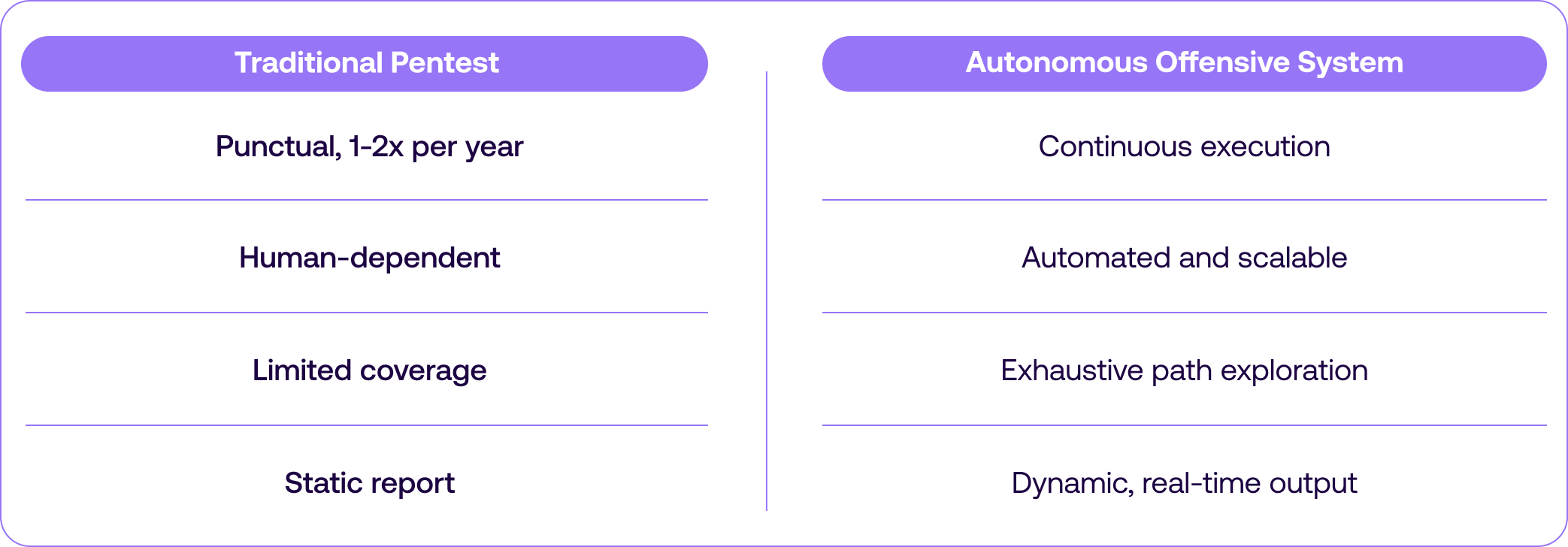
4.2 The Limits of Current Practices
Vulnerability Assessment remains fundamentally static. It identifies findings without understanding their context, their chaining potential, or their real-world exploitability. The result is noise, not decision: thousands of findings with no clear operational signal.
Penetration Testing is periodic, human-dependent, and limited in scope. It produces valuable insights but cannot scale to match the speed or breadth of automated adversaries, as well as being directly linked to the skill of the person performing it.
4.3 Their Progressive Obsolescence
These practices will not disappear overnight. But their role will fundamentally change:
- The VA becomes a raw data source, feeding the aggregation layer
- The pentest becomes a targeted validation exercise, confirming what the system already suspects
The center of gravity shifts toward autonomous systems capable of continuously simulating the adversary.
5. VulnOps as the Structural Response
Based on those findings, it soon becomes clear that VulnOps (fully aligned with the VOC framework for maximum efficiency) is the only coherent operational model in the face of this evolution.
Where legacy approaches produce data, VulnOps produces decisions, which in turn helps security teams drive action.
5.1 Why?
VulnOps addresses the four failures of the legacy model simultaneously.
- It aggregates all signals into a single operational view, eliminating the fragmentation that lets critical risks hide in scanner noise.
- It understands context like asset criticality, network exposure, active threat intelligence, turning raw findings into meaningful risk signals.
- It prioritizes dynamically rather than statically like was done in legacy models.
- It orchestrates remediation at scale, across teams, with clear ownership and measurable outcomes.
This is exactly the transformation Hackuity enables: from scattered vulnerability data to unified exposure operations, in the same way Splunk transformed the SOC from siloed logs to unified threat operations.
5.2 AI as a Force Multiplier in VulnOps
AI is not a feature added on top of VulnOps, it acts as a force multiplier.
- Analysis layer: it enables multi-source correlation and pattern detection across vulnerability datasets too large for human review.
- Prioritization layer: it powers dynamic risk scoring that updates in real time as threats evolve, moving far beyond the static limitations of CVSS, as well as exploitation prediction such as EPSS and active threat intelligence
- Orchestration layer: it drives automated remediation recommendations and progressively reduces the manual effort required to act on risk, on top of offering auditable automated response workflows
The result is a system that scales human judgment rather than replacing it, allowing small security teams to operate with the effectiveness of much larger ones.
5.3 Toward Autonomous VulnOps
Based on those observations, the trajectory is clear:
- Detection → automated
- Analysis → AI-assisted
- Decision → semi-autonomous
- Remediation → orchestrated and progressively automated
This is not science fiction, it is the logical endpoint of a transformation already underway. Each phase of maturity brings security operations closer to matching the speed and continuity of the threats they face.
6. A Technical and Organizational Transformation
The move to VulnOps is not merely a tool replacement. Organizations that approach it as such will underestimate the depth of change required and stall.
Instead, the transformation is simultaneously technical, organizational, and cultural.
6.1 Technical Impacts
- Data-oriented architecture: quality of asset inventory becomes the foundation of everything
- API-first integration: every tool must feed the central aggregation layer
- Dependency graphs: understanding asset relationships and attack chains
- Deduplication and normalization at scale: one finding per vulnerability, not one per scanner
6.2 Organizational Impacts
- Security and Ops convergence: remediation cannot be owned by security alone
- Distributed accountability: asset owners, DevOps, IT teams become active participants
- Risk governance: clear escalation paths and SLA frameworks
- New roles emerging: VulnOps Lead, Risk Engineer, Exposure Analyst
6.3 A New Metric Regime
Perhaps the most visible (and politically fraught) aspect of the transformation is the shift in how success is measured.
Legacy vulnerability management optimized for metrics that are easy to count: number of vulnerabilities detected, patch compliance rates, mean time to remediate. These metrics are legible, but they measure activity rather than outcome.
This shift requires abandoning metrics such as:
- Number of vulnerabilities detected
- Patch compliance rates
In favor of:
- Reduction of exploitable attack surface over time
- Time-to-remediate critical risks (real, not theoretical)
- Residual exposure on business-critical assets
- Risk posture trend for executive and board reporting
This shift is not just technical: it requires re-educating stakeholders, renegotiating what "good" looks like, and building the reporting infrastructure to make these metrics visible.
Done well, it turns the security function from a cost center into a measurable risk reduction engine.
7. A Strategic Roadmap for CISOs
Now that we’ve seen what should be done, how should you go about bringing this change in your organisation?
The transition to VulnOps does not happen overnight, and it should not be attempted as a single transformation project. The organizations that succeed are those that treat it as a phased journey, building capability incrementally, validating at each stage, and resisting the temptation to skip ahead before the foundations are solid.
Phase 1: Clean the Foundations (0–6 months)
No prioritization model can compensate for poor data. The first priority is building a reliable and comprehensive asset inventory, one that covers infrastructure, cloud, on-premise, application layer, and shadow IT.
- Consolidate asset inventory
- Centralize vulnerability sources into a single platform
- Improve data quality (deduplication, normalization)
- Align Security and IT teams on shared ownership
The organizational dimension is equally important at this stage. Security and IT teams need to align on shared definitions (what counts as a critical asset, what constitutes an acceptable remediation SLA, who owns what). These conversations are often harder than the technical work.
Goal: Build an exploitable data foundation. Everything that follows depends on it.
Phase 2: Introduce VulnOps (6–18 months)
With clean data in place, the organization can begin to operationalize risk-based prioritization.
- Deploy an aggregation and prioritization platform (Hackuity, Nucleus Security, Brinqa)
- Define a contextual risk scoring model (TRS-type approach)
- Integrate ITSM workflows for remediation delegation
- Establish realistic, enforceable SLAs
The prioritization model needs to incorporate business context: not all assets are equal, not all vulnerabilities carry the same exploitability in the current threat landscape.
Building this scoring logic is an iterative process: it will evolve as the organization's understanding of its own risk profile deepens.
Goal: Move from data to decision, and from decision to accountable action.
Phase 3: Augment with AI (12–24 months)
Once the operational foundation is stable, AI can be introduced as a force multiplier (and not as a shortcut to skip the earlier phases!)
At this stage, the focus is on enriching vulnerability data automatically: pulling in real-time threat intelligence, EPSS scores, active exploit feeds, and vendor advisories to keep risk scores current without manual intervention.
- Automated vulnerability enrichment (threat intelligence, EPSS, exploit feeds)
- Dynamic prioritization that updates in real time
- AI-assisted remediation guidance
- Systematic noise reduction
The net effect is a meaningful reduction in noise: teams see fewer false priorities and get a clearer signal. And a security team that spends its time acting on real risk rather than managing data is a security team that actually reduces risk for a business.
Goal: Scale human capacity without scaling headcount.
Phase 4: Simulate the Adversary (18–36 months)
Prioritization built on static data and threat intelligence is valuable, but it can be made significantly more precise by introducing attack simulation.
- Integrate attack simulation capabilities
- Continuously test exploitation paths
- Validate and challenge prioritization decisions with offensive evidence
The value is twofold.
- First, it surfaces exploitation paths that are invisible to passive scanning, such as chained vulnerabilities, lateral movement opportunities, misconfigurations that become critical only in combination.
- Second, it provides an independent check on the scoring model: if simulated attacks consistently exploit vulnerabilities ranked as medium risk, the model needs recalibration.
This is also the phase where security and offensive teams begin to operate in genuine collaboration; not as separate functions running parallel programs, but as a unified capability focused on the same question: where can an attacker realistically go, right now?
Goal: Align defense with offensive reality.
Phase 5: Toward Autonomy (24–48 months)
The final phase closes the loop entirely. Human oversight remains, but shifts from execution to governance: reviewing decisions, handling exceptions, and managing edge cases that fall outside automated playbooks.
- Controlled and auditable automation of remediation workflows
- Closed-loop: detection → analysis → decision → remediation
- Real-time adaptation to evolving threat landscape
The result is a system that can respond to the velocity of automated attacks without requiring proportional growth in human resources.
This level of maturity is of course not achievable in months. But like the old adage says, “better late than never”, and certainly better now than later. Those that wait are not standing still: they are falling further behind an adversary that is not waiting.
Goal: Match the speed and scale of automated attacks.
8. Conclusion
VulnOps is not an incremental evolution.
It is a rupture, both technical, operational, and conceptual.
And crucially: this rupture is not new. The Vulnerability Operations Center (VOC) already defined it. VulnOps is the operational maturation of the same paradigm, accelerated by the arrival of autonomous AI on the offensive side.
The real divide is not between VulnOps and VOC. They are the same revolution, named twice. The real divide is between:
The old world: scanners, CVSS, static lists, reactive patching.
The new world: VOC and VulnOps: aggregation, context, dynamic prioritization, orchestrated remediation, and progressive automation.
In a world where attacks become autonomous, continuous, and infinitely scalable, traditional approaches such as Vulnerability Assessments and Pentests are no longer sufficient as central pillars. They don't disappear, but they become inputs into a larger operational system.
The future belongs to systems capable of:
- Understanding risk in context
- Deciding rapidly and with precision
- Acting at scale
In other words: AI-augmented VulnOps. Which is, in essence, what a mature VOC was always meant to become.
For CISOs, the question is no longer whether this transformation will happen, but how quickly your organization can get there, before the adversary's automation outpaces your manual processes entirely.
Hackuity is the platform that makes this transformation operational: the category-defining solution for the Vulnerability Operations Center, turning scattered vulnerability data into unified, intelligence-driven exposure reduction.



VR-1 | Property |
|---|---|
Model type | Post-trained cyber reasoning model |
Primary specialization | Multi-domain enterprise attack-chain discovery |
Starting condition | A scoped foothold and a concrete objective |
Operating surfaces | Cloud, identity, runtime, code, CI/CD, SaaS, and organizational context |
Success signal | Execution-verified completion of the objective |
Primary evaluation | IntrusionBench |
Preliminary result (preview) | More than 2× black-box pass@3 over the strongest evaluated frontier baseline |
Trajectory budget | Two-hour wall-clock limit per trajectory, or 250 agent turns (whichever comes first) |