















Disclosure: this guide is published by Hackuity, which develops one of the platforms discussed. All vendors are assessed against the same lifecycle criteria and public sources, no vendor is ranked overall, and vendor claims are labeled as such. Methodology is described at the end of the guide.
Short answer: There is no single top-rated CTEM tool. Continuous Threat Exposure Management (CTEM) is a five-stage operating model, and tools specialize in different stages: EASM and CAASM for discovery, risk-based vulnerability management for prioritization, attack path management and breach and attack simulation for validation, and orchestration platforms for mobilization. Large security teams usually combine several of them around one shared view of exposure.
The right choice depends on which stage of your program is weakest. A team with an incomplete asset inventory needs better discovery. A team drowning in findings needs prioritization. A team that cannot tell which exposures are exploitable needs validation. And a team whose priorities never turn into fixes needs mobilization. Most vendors now call their product a "CTEM platform"; few cover all five stages with equal depth.
The stakes are concrete. Verizon's 2026 Data Breach Investigations Report found that 31% of breaches began with the exploitation of a software vulnerability, ahead of stolen credentials (Verizon DBIR 2026). CISA's Known Exploited Vulnerabilities catalog listed 1,767 entries on November 3, 2026 (CISA KEV). The problem is no longer finding exposures; it is deciding which ones matter and getting them fixed across many teams.
The top-rated CTEM tool is therefore not necessarily the one with the longest feature list. For large security teams, the right choice depends on which stages of the CTEM lifecycle need the most support, how well a platform integrates with the existing security stack, how reliably it validates exposure, and whether it helps the organization mobilize remediation and measure risk reduction.
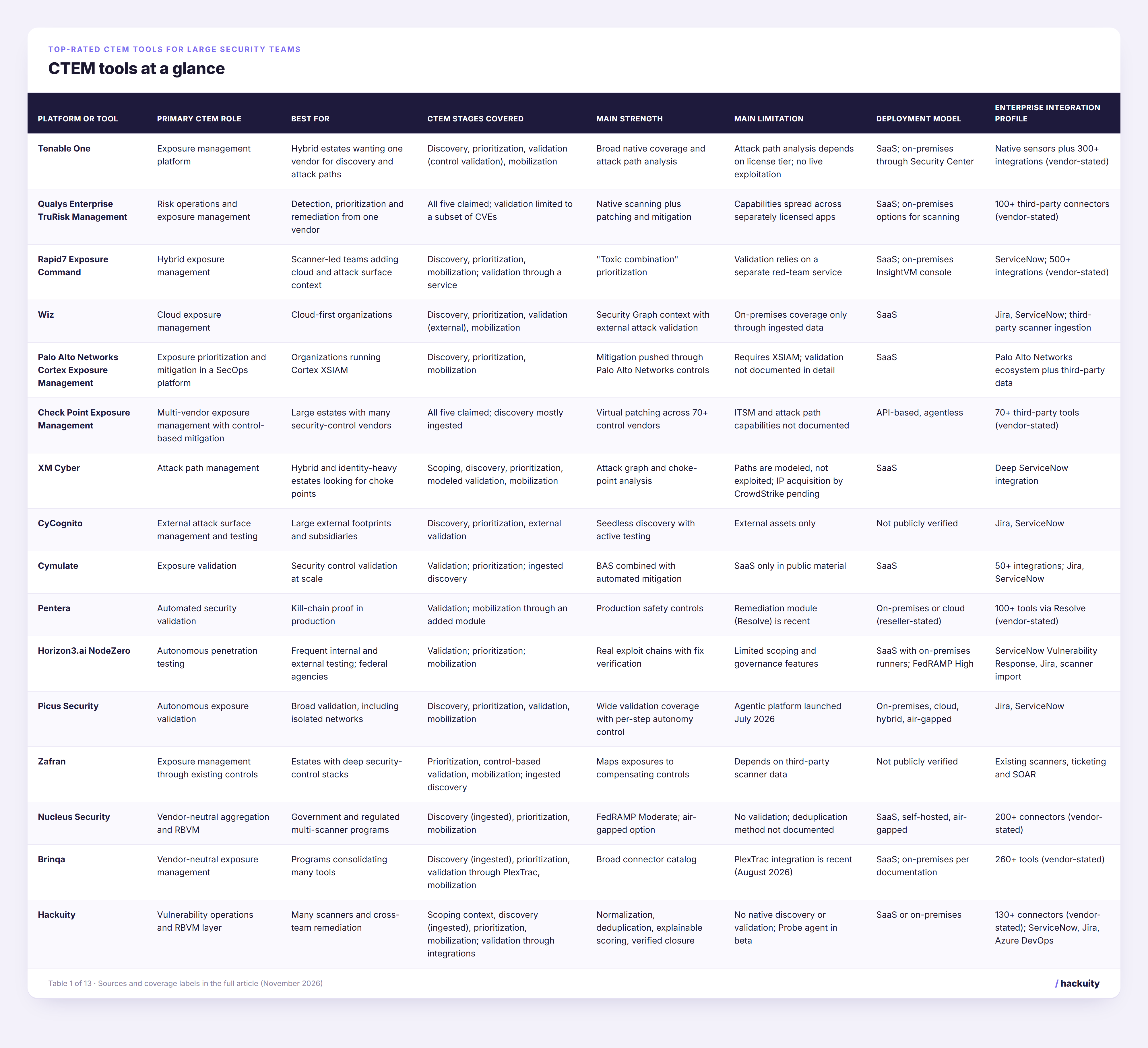
CTEM tools at a glance
The table summarizes sixteen platforms by primary CTEM role. It is not a ranking. Capabilities come from vendor documentation reviewed between October 27 and November 4, 2026; the detailed matrix and sources follow later in the guide.
Other vendors were reviewed but not profiled: IONIX (external attack surface and validation), AttackIQ and SafeBreach (breach and attack simulation), Terra Security (agentic penetration testing) and Armis Centrix for VIPR (now part of ServiceNow). IBM's Randori was divested to Palo Alto Networks in 2024 and is no longer sold as an IBM product (IBM), and Vulcan Cyber's technology now powers Tenable One connectors.
What is CTEM?
Continuous Threat Exposure Management (CTEM) is a program that continuously identifies, prioritizes, validates and reduces the exposures most likely to harm an organization's critical business services. Gartner introduced the framework and describes it as a set of processes and capabilities that let enterprises "continually and consistently evaluate" the accessibility, exposure and exploitability of their assets (Gartner, Implement a Continuous Threat Exposure Management (CTEM) Program, October 2023, as reproduced by SafeBreach). CTEM extends vulnerability management beyond CVEs to misconfigurations, identities, attack paths and external assets, and ties every cycle to remediation.
CTEM runs in five stages, repeated continuously:
- Scoping: decide which business services, assets and threat scenarios the program covers.
- Discovery: find the assets in scope and their vulnerabilities, misconfigurations and control gaps.
- Prioritization: rank exposures by exploitability, threat activity and business impact.
- Validation: confirm whether an exposure is reachable and exploitable, and whether controls already stop it.
- Mobilization: get the right teams to fix it, track the work and verify the result.
A CTEM program is business-aligned, threat-informed, risk-based and continuous. It focuses on reducing exposure rather than counting findings, depends on many data sources and teams, and treats remediation as part of the cycle rather than a hand-off. Its central idea is focus: the exposures most likely to affect critical services come first, instead of every vulnerability receiving equal attention.
Gartner predicted that by 2026, organizations prioritizing security investments through a CTEM program would be "three times less likely to suffer from a breach" (same report). It is a forecast, not a measured result; no published study has yet tested it.
CTEM is a program, not just a product
CTEM is an operating model; no product delivers it alone. Be cautious when a vendor calls its product a "complete CTEM platform": several vendors cited in this guide make that claim, while their documentation shows uneven depth across stages. Six terms are often confused:
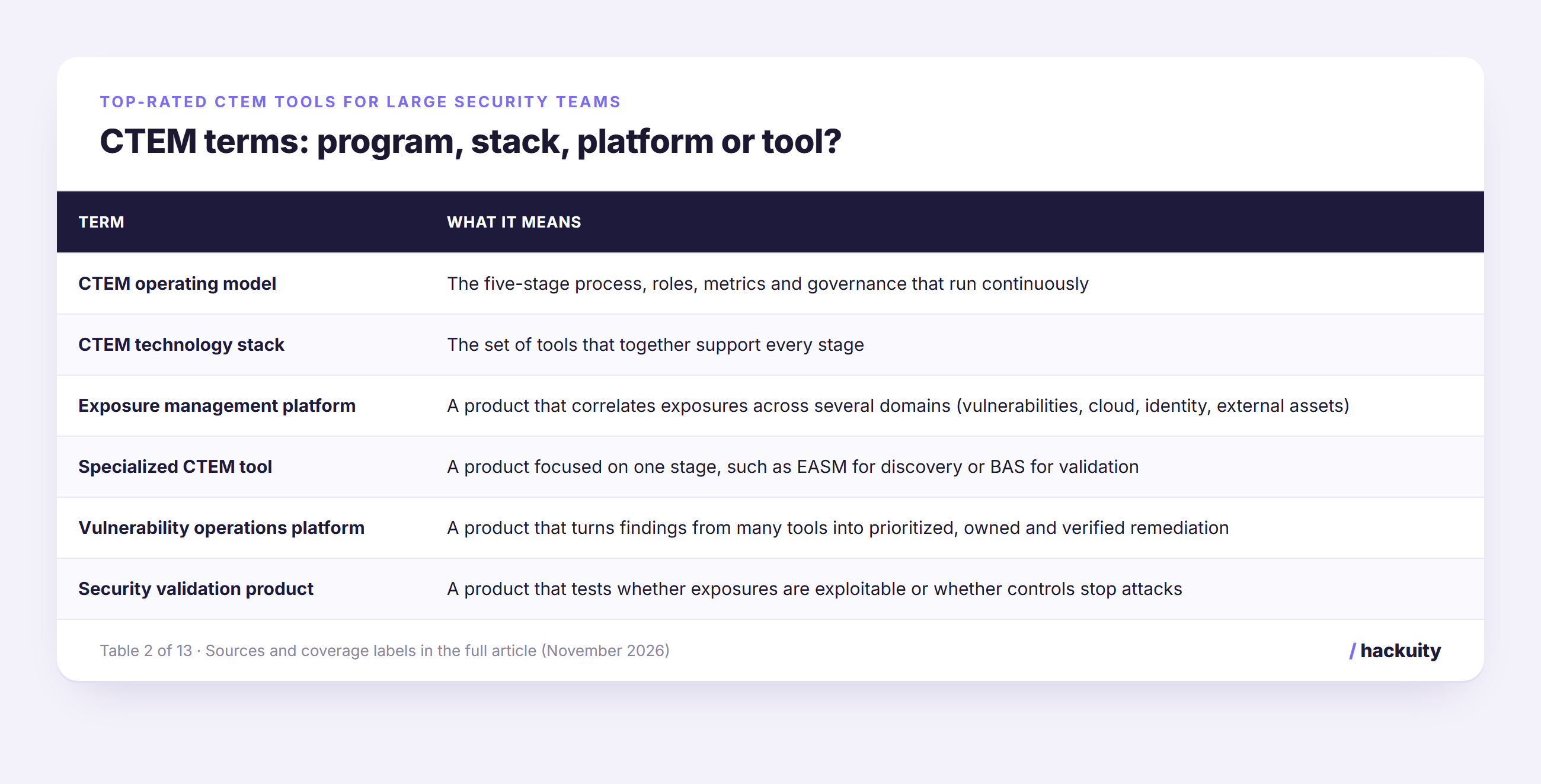
Some vendors cover several stages; others specialize in one. Specialization is not a weakness: a focused product may be the best choice if it fixes your most important gap. What matters is that, together, your tools cover all five stages and share data, so that discovery feeds prioritization, validation refines priorities and mobilization closes the loop.
How do CTEM tools support each stage of the lifecycle?
Each CTEM stage needs different data and different tools. The five sections below explain what each stage requires; the matrix after them shows which tool categories contribute where.
Stage 1: Scoping
Scoping defines what the program protects and why. It identifies business-critical applications, crown-jewel assets, high-value data, critical identities, external-facing services, important business processes, relevant threat scenarios, risk appetite and compliance priorities. Without scoping, every later stage treats all assets as equal.
Scoping relies more on context than on detection. The contributing tools are asset inventories and CMDBs, CAASM platforms that reconcile inventories, EASM tools that reveal unknown internet-facing assets, GRC systems that hold risk appetite and compliance obligations, identity platforms that show privileged accounts, and business service mapping. The output is a scope with named owners, not a tool configuration.
Stage 2: Discovery
Discovery finds the assets in scope and their exposures: internet-facing assets, cloud resources, applications and APIs, identities, endpoints, network infrastructure, containers, SaaS assets, shadow IT, vulnerabilities, misconfigurations and security control gaps.
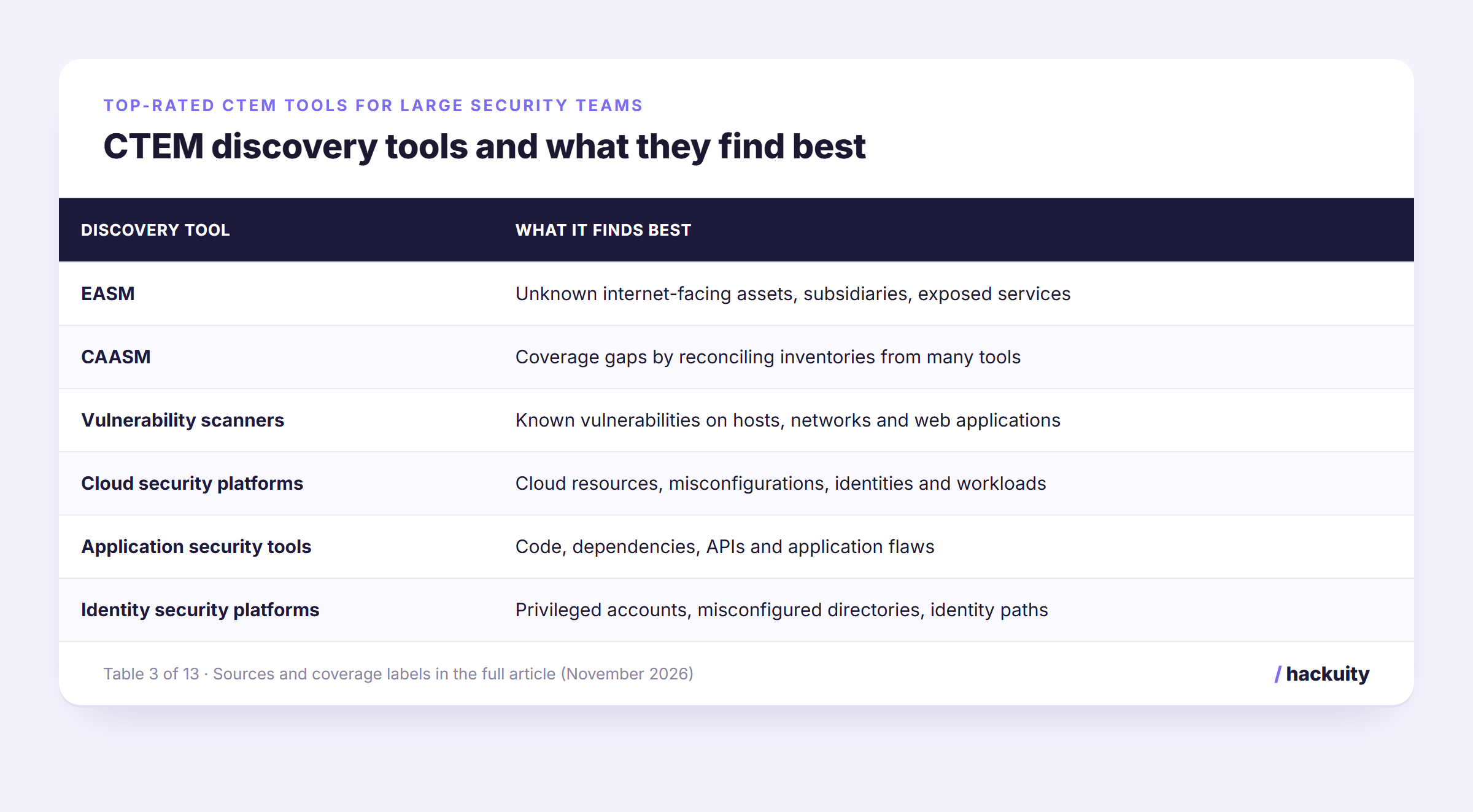
Large enterprises usually run several of these at once. Discovery then produces overlapping, conflicting data, which is why normalization and deduplication matter before prioritization.
Stage 3: Prioritization
Prioritization ranks exposures by the likelihood and impact of exploitation in your environment. CVSS alone cannot do this: it measures technical severity, not whether a flaw is being exploited or whether the affected asset matters.
Effective prioritization combines exploitability and active exploitation (for example CISA KEV), exploitation probability (FIRST's EPSS), threat intelligence, asset criticality and business impact, internet exposure, attack paths, identity privilege, compensating controls and their effectiveness, vulnerability age, remediation effort and regulatory requirements. CISA's BOD 26-04, issued June 10, 2026, uses a similar logic for US federal agencies, setting remediation urgency from asset exposure, KEV status, exploit automation and technical impact.
For large teams, prioritization must be contextual, explainable, transparent, adjustable, auditable and actionable. A score that IT teams cannot understand or challenge will not move remediation.
Stage 4: Validation
Validation confirms whether an exposure is real and meaningful before teams spend effort on it. It distinguishes six situations that discovery alone cannot separate:
- A vulnerability exists.
- It is reachable by an attacker.
- It is exploitable in this environment.
- It is connected to a critical asset.
- A security control already mitigates it.
- A remediation action actually reduced exposure.
Validation techniques range from modeling to live testing: attack path analysis, breach and attack simulation (BAS), adversarial exposure validation, automated penetration testing, exploitability testing, security control validation, external exposure validation, cloud attack path analysis, purple team exercises and manual penetration testing. Gartner groups automated testing products under adversarial exposure validation; in a 2026 market guide it projected that by 2029, 60% of organizations will adopt a structured exposure validation practice as part of CTEM (as reproduced by AttackIQ).
Live testing raises governance questions every large enterprise should ask:
- Is testing non-disruptive, and how is production testing controlled?
- Is human approval required before risky steps?
- Are all tests logged and the scope restricted?
- Can the platform avoid damaging systems, with throttling or an emergency stop?
- Can findings be independently verified?
Stage 5: Mobilization
Mobilization turns analysis into fixes. It covers ownership assignment, remediation campaigns, ITSM ticketing, SLA tracking, exception management and risk acceptance, compensating controls, patch and configuration workflows, cross-team coordination, remediation validation, closure verification and executive reporting.
Mobilization is often the gap between an impressive exposure dashboard and actual risk reduction. Verizon's 2026 DBIR reports, as summarized by watchTowr, that the median time to fully remediate known exploited vulnerabilities rose to 43 days and that only 26% were fully remediated. [To be validated before publication against the DBIR PDF.] Better scores do not shorten those numbers; ownership, workflows and verification do.
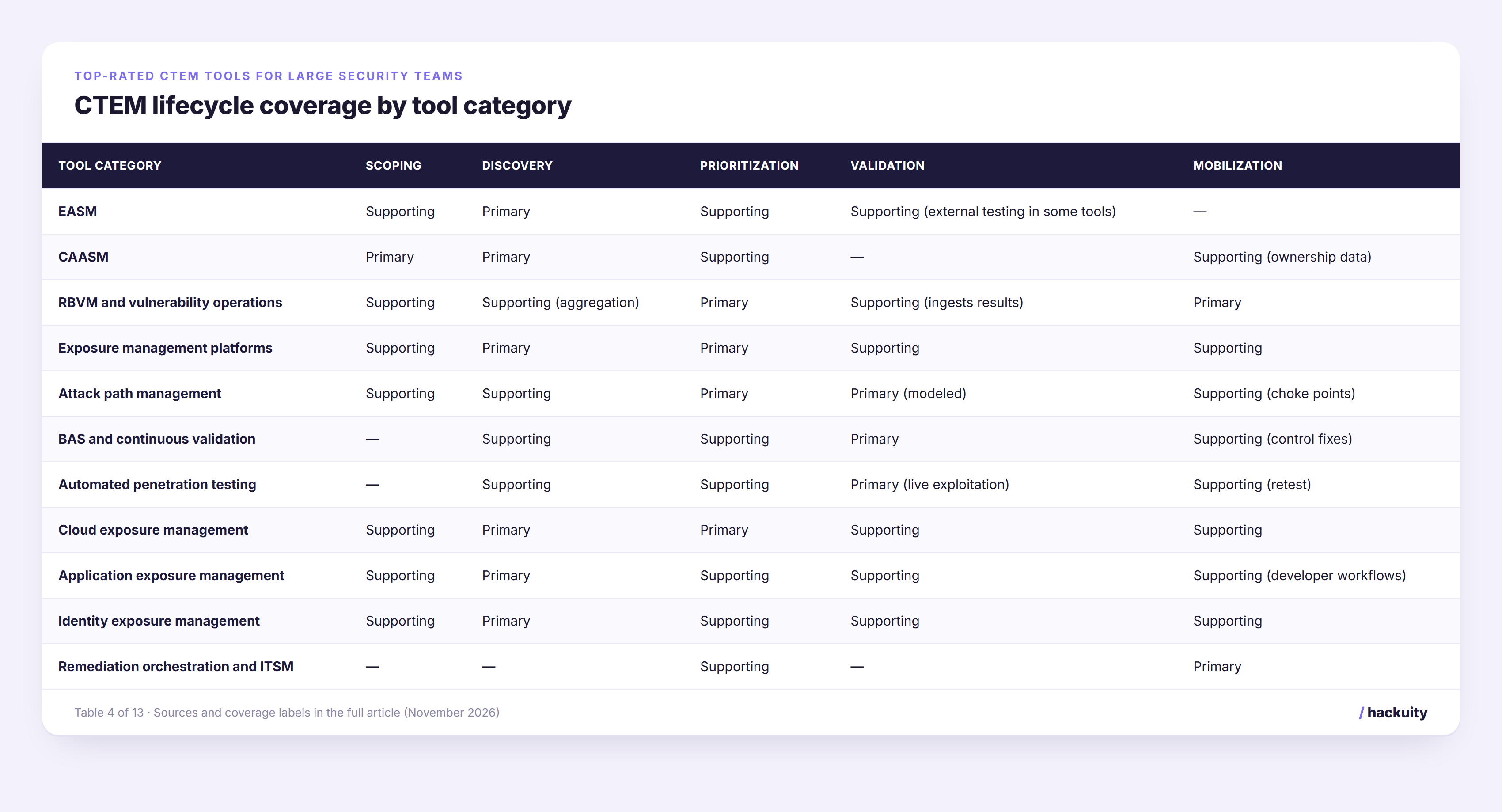
CTEM lifecycle coverage by tool category
The matrix shows typical coverage by category, not by vendor. "Primary" means the stage is the category's main purpose; "Supporting" means it contributes data or actions; a dash means little or no typical contribution.
What categories of CTEM tools exist?
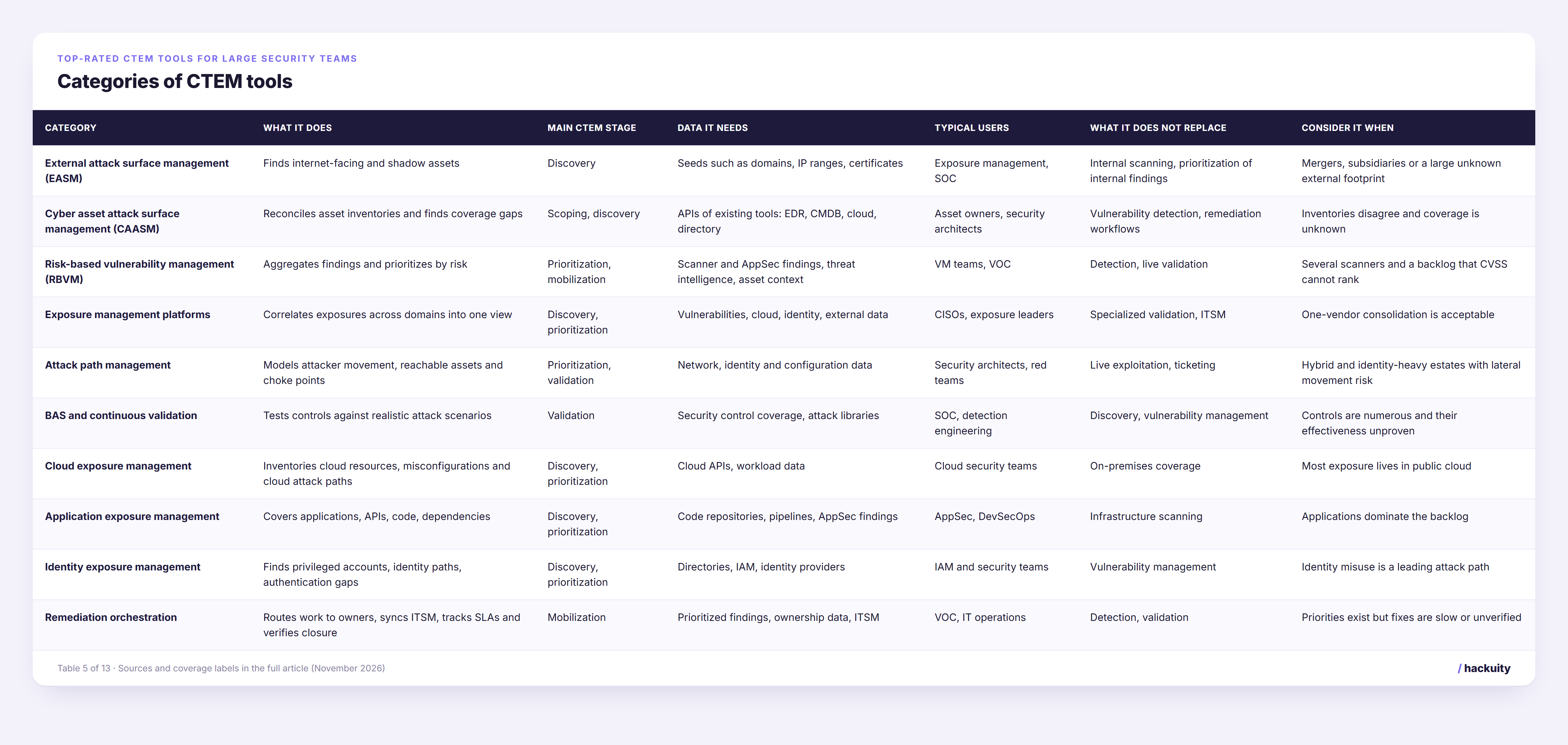
Ten categories of tools contribute to CTEM. Each solves a specific problem and none replaces the others.
How should large security teams evaluate CTEM tools?
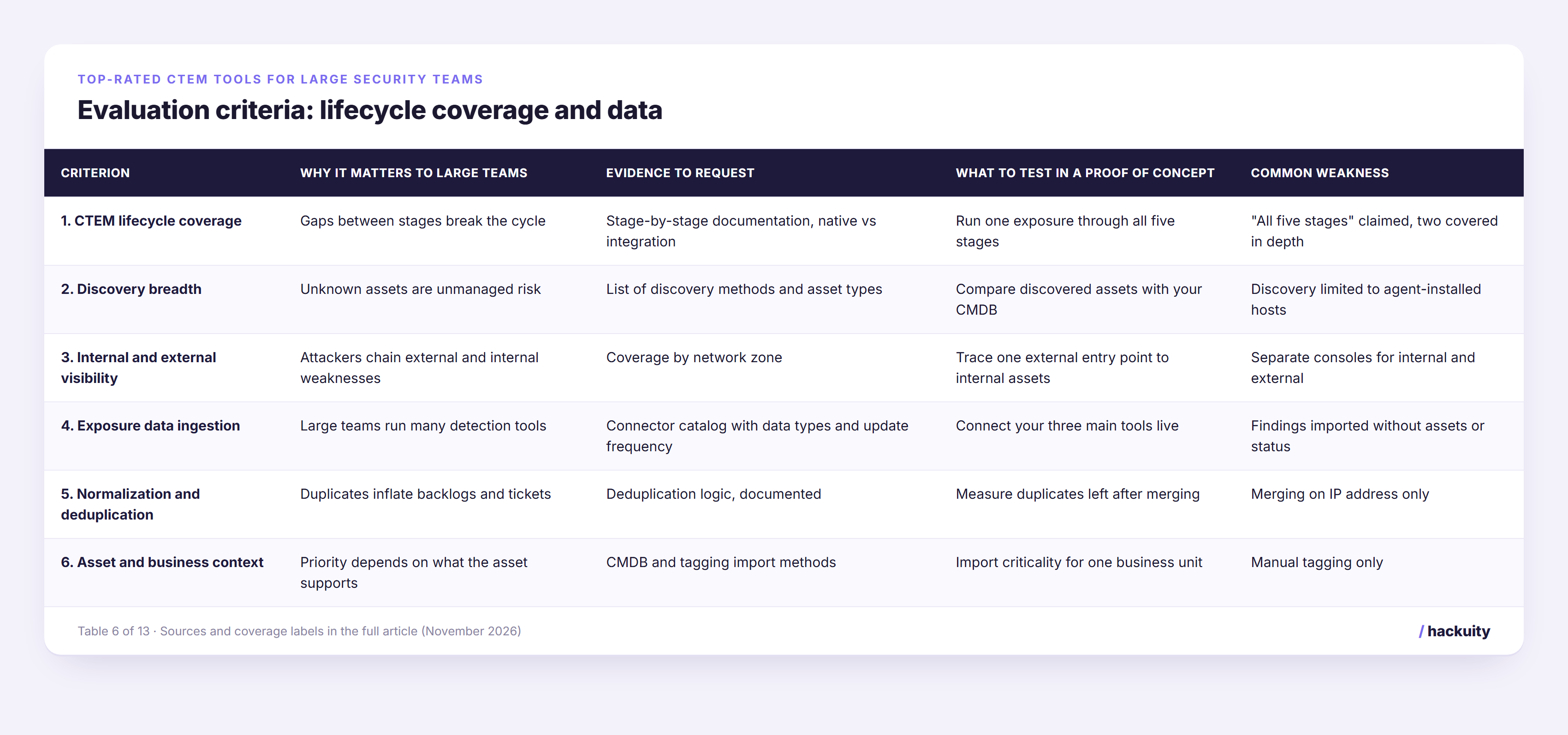
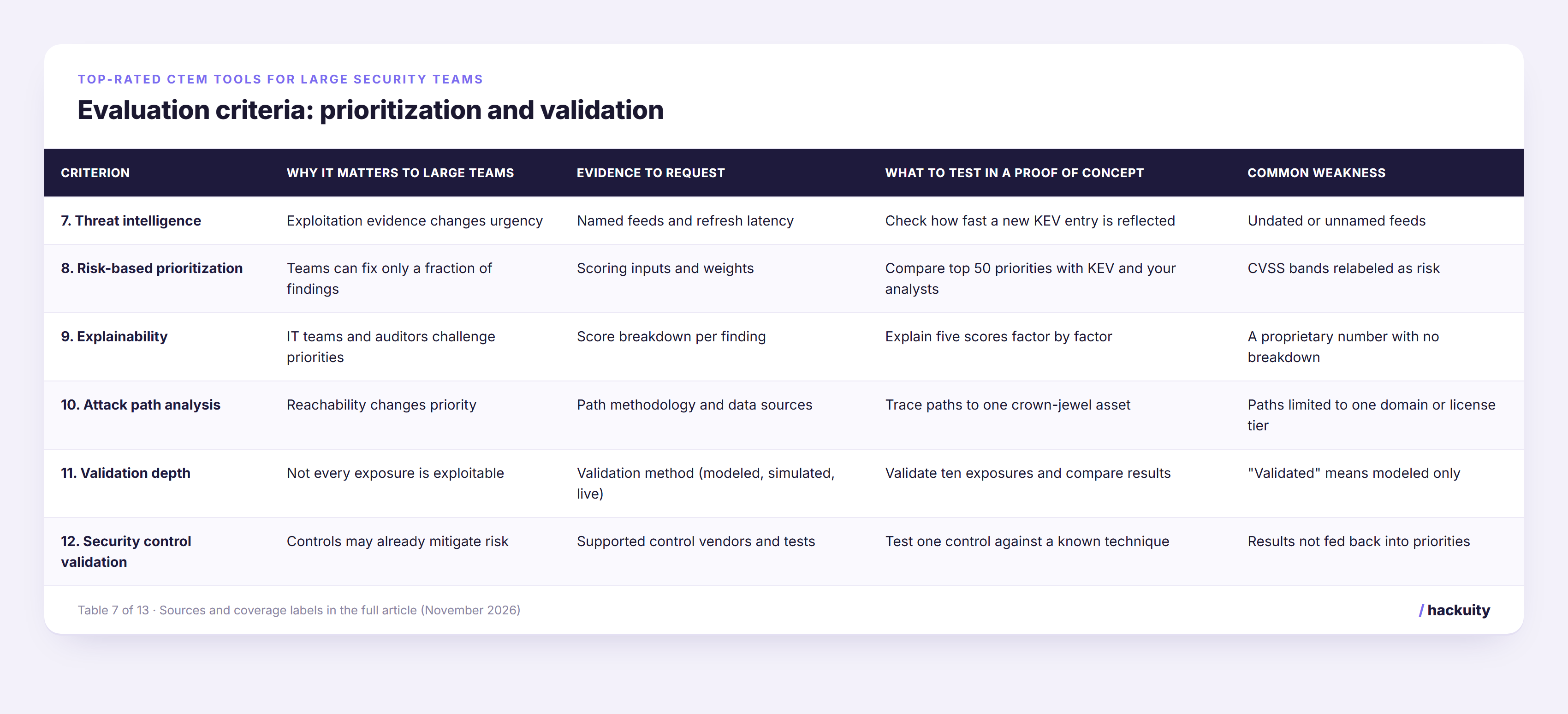
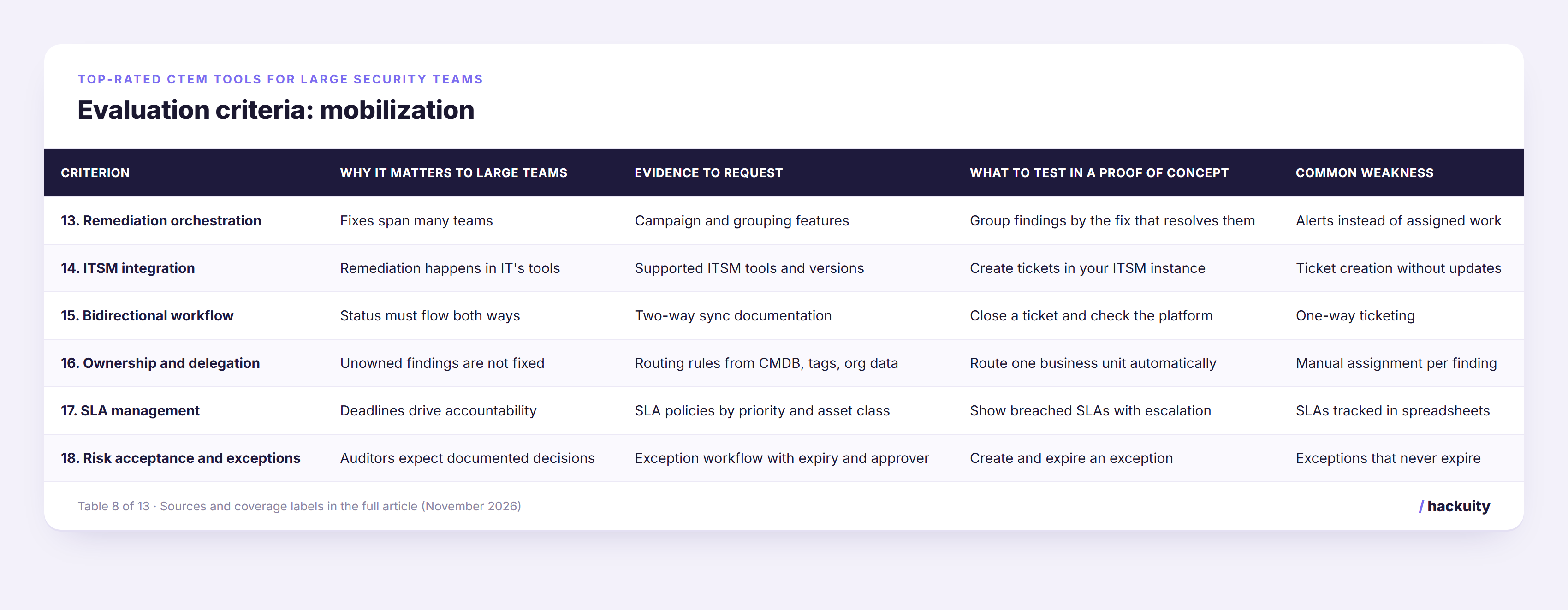
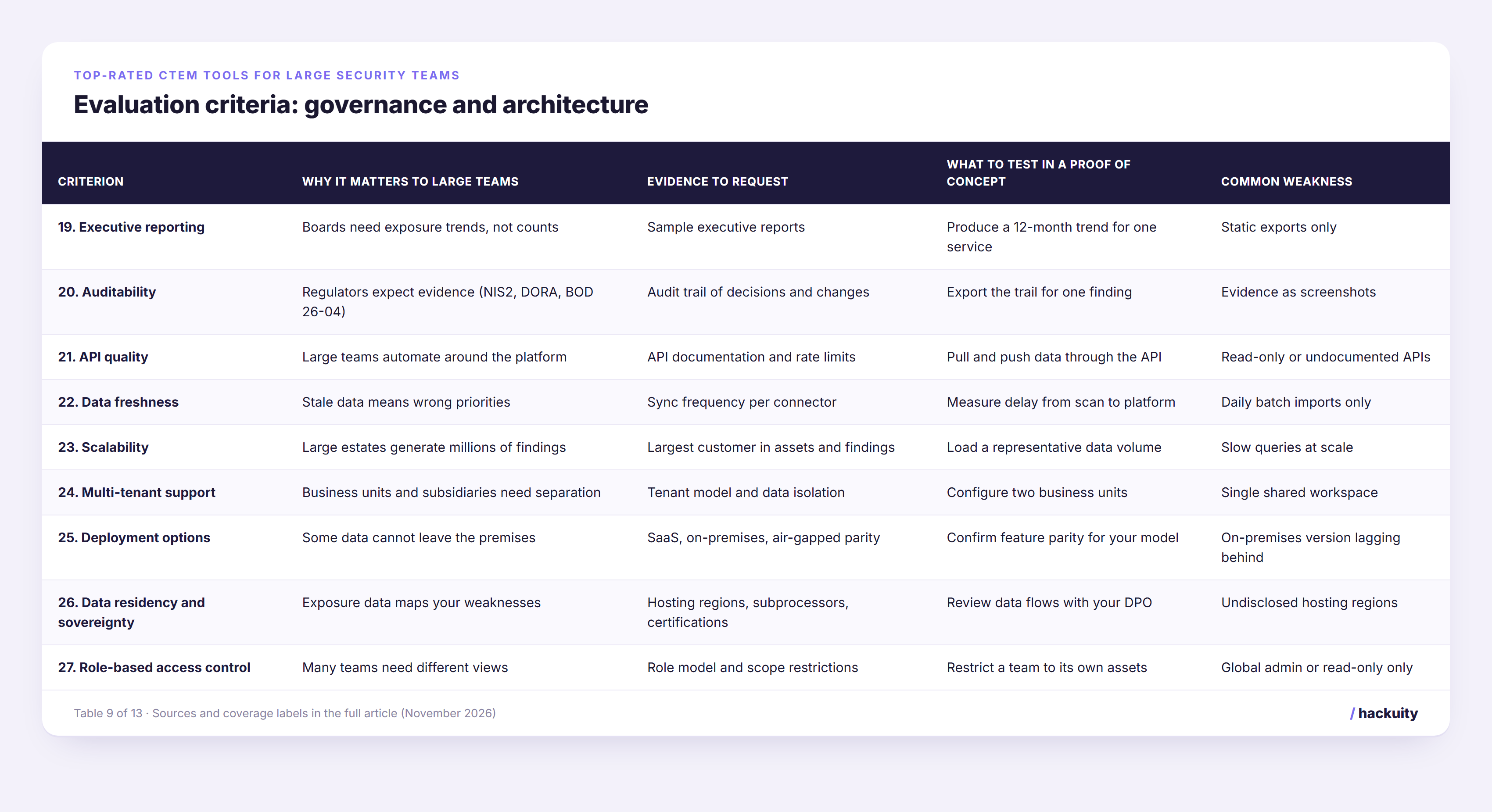
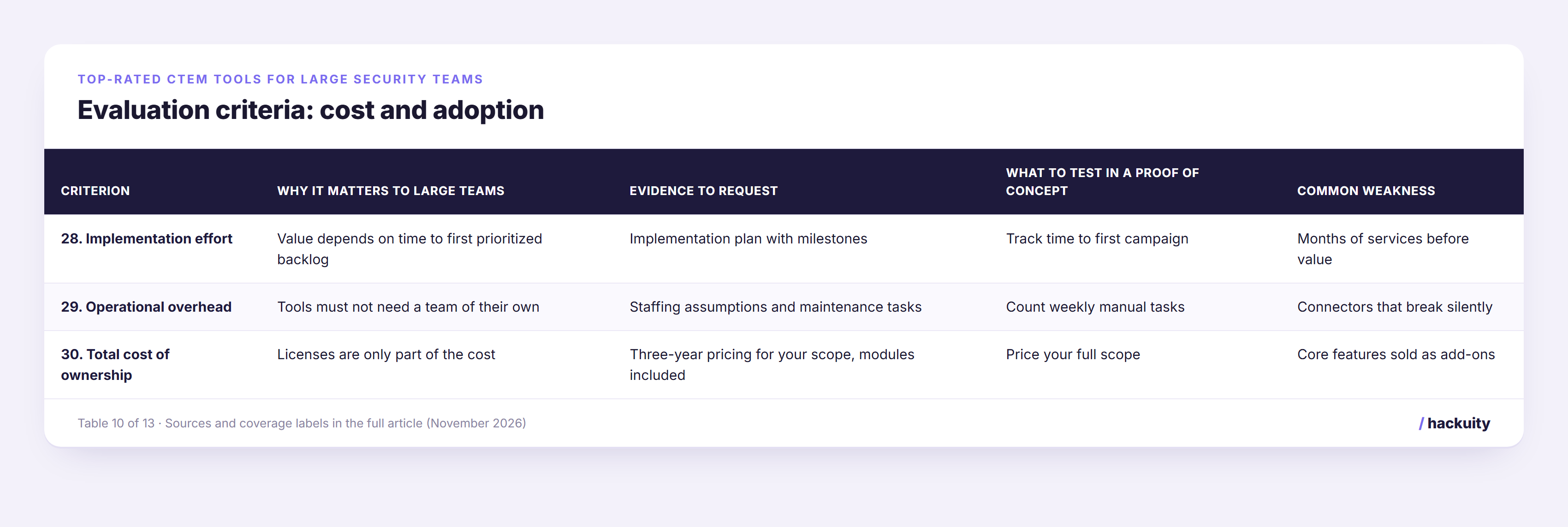
Evaluate CTEM tools on evidence from your own environment, across 30 criteria grouped in five families. For each criterion, the table says why it matters at scale, what evidence to request, what to test in a proof of concept and what a common weakness looks like.
Lifecycle coverage and data
Prioritization and validation
Mobilization
Governance and architecture
Cost and adoption
Scoring methodology
This guide uses an editorial, lifecycle-based model, not an analyst ranking. Each family carries a default weight that a buyer should adjust to their own priorities:
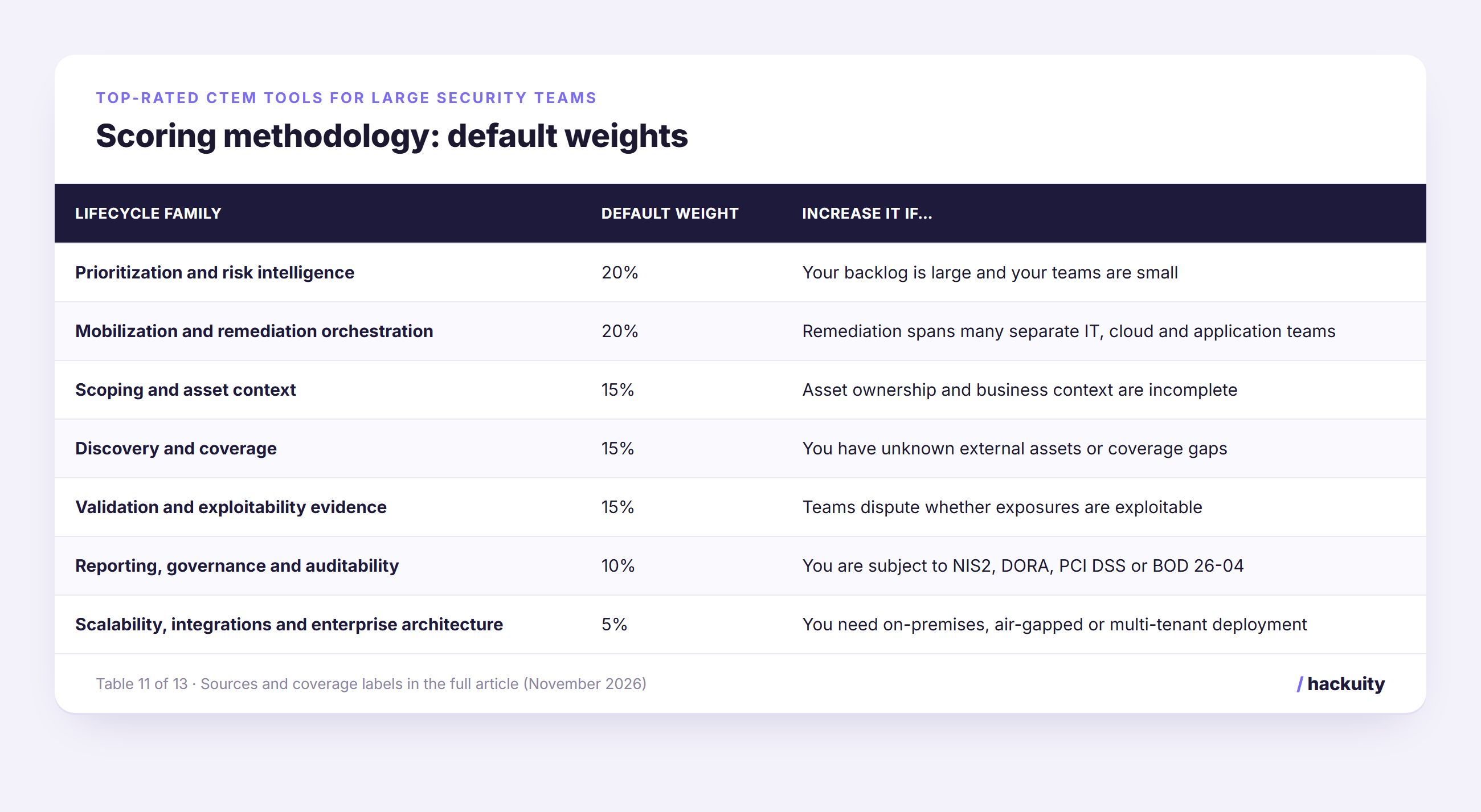
Coverage in the matrices uses qualitative labels: Strong (documented, central capability), Moderate (documented with narrower scope), Limited, Specialized (deep but focused on one use case), Via integration (depends on a third-party tool), Requires additional module and Not publicly verified (not confirmed in public documentation, which does not mean absent). No numeric scores are published: public documentation shows what a product offers, not how well it performs on your estate. Labels are editorial assessments based on vendor documentation unless a source is marked independent.
Detailed CTEM capability matrix
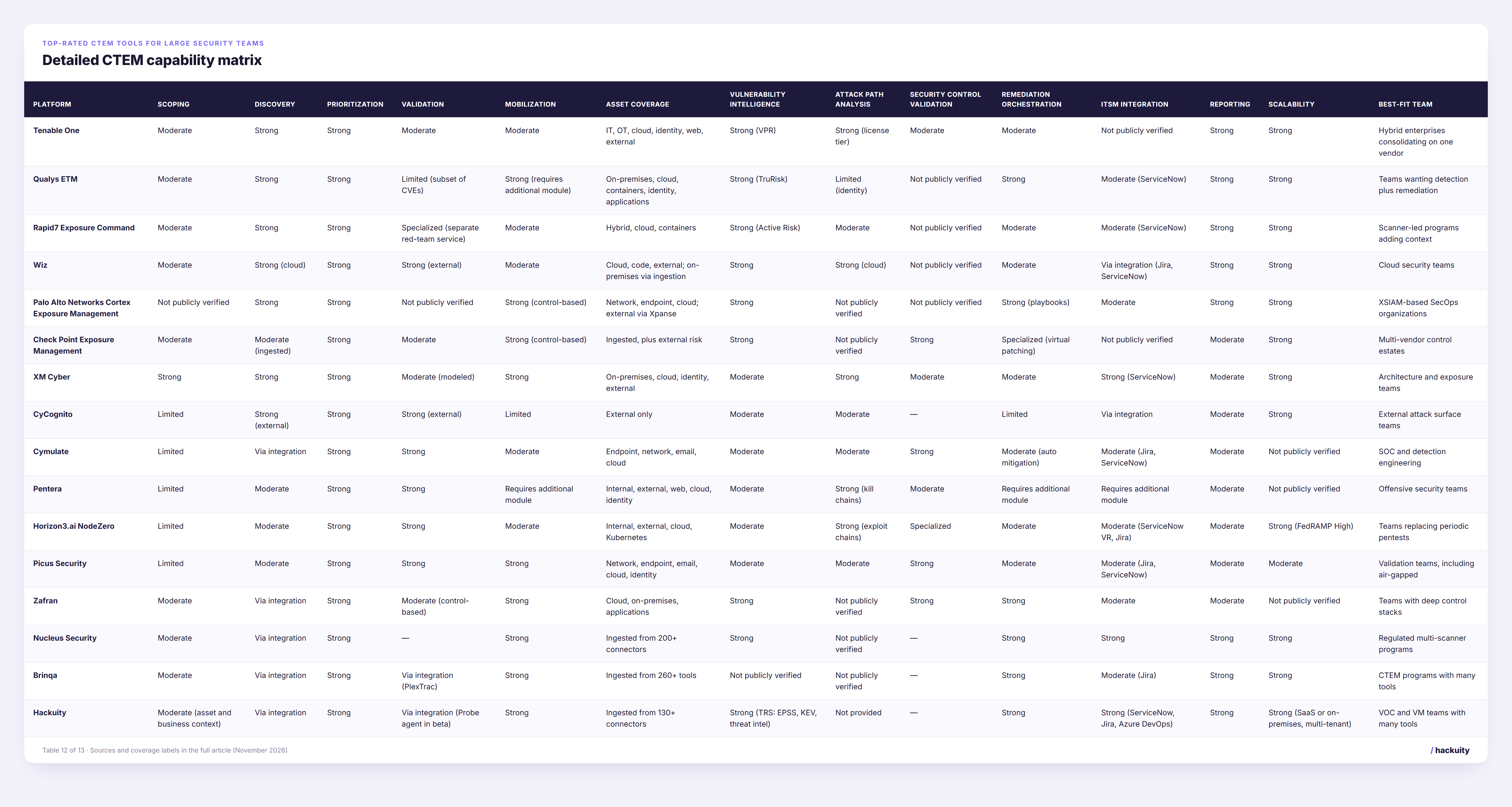
Native and integrated capabilities are distinguished: "Via integration" means the stage depends on another product, even when results appear in the platform.
CTEM platform profiles
Every profile uses the same structure. Capability statements come from vendor documentation unless marked otherwise; verdicts are editorial. Hackuity is profiled in its own section, with the same structure.
Tenable One
Primary CTEM role: a cross-domain exposure management platform built on Tenable's native sensors.
Best for: hybrid enterprises that want discovery, prioritization and attack path analysis from one vendor.
CTEM stages covered: discovery (strong, native sensors plus third-party data), prioritization (strong), validation (moderate: continuous control validation, made available to all Tenable One customers in June 2026 according to SecurityBrief, independent), mobilization (moderate).
What it does well
- Broad native coverage across IT, OT, cloud, identity, web applications and external assets.
- Attack path analysis mapped to MITRE ATT&CK, with choke points.
- Third-party connectors that ingest competitors' asset and weakness data.
Limitations and trade-offs: attack path analysis requires specific license tiers; exploit validation is limited and there is no native adversarial testing; third-party asset merge rules are not customizable.
Enterprise considerations: mainly cloud-based, with on-premises scanning through Security Center; scale and connector depth should be tested on your own data; implementation effort grows with the number of modules.
Questions to validate in a proof of concept
- Which license tier is required for attack path analysis on our scope?
- How are third-party findings deduplicated against Tenable findings?
- Which ITSM tools support two-way synchronization?
- How does control validation change priorities in practice?
- What is the data latency from a scan to an updated exposure score?
Editorial verdict: a strong option for organizations ready to consolidate discovery and exposure analysis on one vendor. Pair it with a validation tool if live exploitability evidence matters.
Qualys Enterprise TruRisk Management (ETM)
Primary CTEM role: a risk operations platform combining native detection, third-party data and remediation.
Best for: enterprises that want detection, prioritization and remediation, including patching and mitigation, from one vendor.
CTEM stages covered: all five claimed; discovery and prioritization are strong; validation (TruConfirm) covers a defined set of CVEs; remediation through TruRisk Eliminate, a separate product.
What it does well
- Native agents, scanners and sensors plus 100+ third-party connectors (vendor-stated).
- Remediation options beyond patching: mitigate, uninstall or isolate.
- TruRisk scoring that includes asset criticality and financial impact.
Limitations and trade-offs: validation is limited to supported CVEs; attack path analysis is identity-focused; capabilities are spread across separately licensed apps.
Enterprise considerations: SaaS on regional platforms, with on-premises options for scanning; documented rule-based deduplication of third-party findings; licensing should be modeled over three years.
Questions to validate in a proof of concept
- Which apps and licenses does our full CTEM scope require?
- How are third-party findings scored compared with Qualys detections?
- Which of our critical CVEs does TruConfirm cover?
- How is ServiceNow change management synchronized?
- How are mitigations tracked when no patch is applied?
Editorial verdict: a coherent choice when one vendor should detect, prioritize and remediate. Organizations with many non-Qualys tools should test how third-party data is treated.
Rapid7 Exposure Command
Primary CTEM role: hybrid exposure management combining vulnerability, cloud and attack surface data.
Best for: scanner-led programs that want cloud and external context without a separate aggregation layer.
CTEM stages covered: discovery (strong), prioritization (strong, with "toxic combination" analysis), mobilization (moderate), validation through Vector Command, a human-led red-team service.
What it does well
- Ingests third-party findings, including Qualys, Tenable, Wiz and CrowdStrike, in Remediation Hub.
- Active Risk scoring based on named threat sources.
- Choice between SaaS and an on-premises InsightVM console.
Limitations and trade-offs: validation is a separate service, not platform automation; cross-tool deduplication is not documented; cloud and application coverage depend on the tier.
Enterprise considerations: tiered packaging; ServiceNow integration where status flows from tickets back to remediation projects; attack path features in the Essentials and Ultimate tiers.
Questions to validate in a proof of concept
- How are duplicate findings from two scanners merged?
- Which tier covers our cloud and application scope?
- How do Vector Command findings feed back into priorities?
- How is a fix verified before a remediation is closed?
- Can business units be separated with their own views?
Editorial verdict: a good fit for Rapid7 scanning customers moving toward exposure management. Validation at scale requires the separate service or another tool.
Wiz
Primary CTEM role: cloud exposure management with external attack surface validation.
Best for: cloud-first organizations, especially multi-cloud ones.
CTEM stages covered: discovery (strong for cloud and external), prioritization (strong, graph-based), validation (strong for external assets: attack surface management simulates attacks and provides proof, generally available since December 2025), mobilization (moderate).
What it does well
- Agentless onboarding through cloud APIs with Security Graph context.
- Third-party scanner ingestion with deduplication (vendor-stated).
- Owner mapping and developer workflows through Wiz Code.
Limitations and trade-offs: on-premises coverage relies on ingested data or a sensor; detailed documentation is behind a login; managed service provider program in preview.
Enterprise considerations: SaaS only; FedRAMP High for the government offering; Google completed its acquisition of Wiz in March 2026, and Wiz keeps its brand.
Questions to validate in a proof of concept
- How are on-premises findings prioritized next to cloud findings?
- How are duplicates merged between Wiz and third-party tools?
- Which capabilities require Wiz Code or the sensor?
- Is Jira and ServiceNow synchronization two-way?
- How is external validation scoped and logged?
Editorial verdict: a strong fit when most exposure lives in public cloud. Hybrid enterprises should test on-premises depth explicitly.
Palo Alto Networks Cortex Exposure Management
Primary CTEM role: exposure prioritization and mitigation inside the Cortex XSIAM security operations platform; Cortex Xpanse remains a separate attack surface management product.
Best for: organizations running Cortex XSIAM and Palo Alto Networks controls.
CTEM stages covered: discovery (strong: native network, endpoint and cloud scanners plus third-party data), prioritization (strong), mobilization (strong: mitigation through security controls or ticketing); validation not documented in detail.
What it does well
- Pushes protections into Palo Alto Networks network, endpoint and cloud controls.
- Converges exposure management with SOC workflows and playbooks.
- Xpanse covers internet-facing assets.
Limitations and trade-offs: requires XSIAM; the relationship between Xpanse and Cortex Exposure Management is not documented publicly; on-premises deployment not documented.
Enterprise considerations: SaaS on Palo Alto Networks' data lake; strongest value where the control estate is largely Palo Alto Networks.
Questions to validate in a proof of concept
- Which third-party scanners and controls are supported?
- How are Xpanse findings combined with internal exposures?
- How is mitigation through controls tracked and reversed?
- Is ITSM synchronization two-way?
- What validation evidence is available for prioritized exposures?
Editorial verdict: compelling for XSIAM customers seeking one SecOps and exposure platform. Multi-vendor estates should test third-party depth.
Check Point Exposure Management
Primary CTEM role: multi-vendor exposure management with preemptive mitigation through existing security controls; built on Veriti, acquired by Check Point in June 2025, with external risk management from Cyberint.
Best for: large organizations running security controls from many vendors that want to reduce exposure without waiting for patches.
CTEM stages covered: all five claimed; discovery mostly ingested from more than 70 third-party tools; prioritization strong; validation moderate ("agentic exposure validation" of policy changes before enforcement); mobilization strong through control-based remediation.
What it does well
- Virtual patching, IPS activation and indicator sharing across more than 70 control vendors (vendor-stated).
- External threat intelligence, brand monitoring and takedowns from Cyberint.
- API-based, agentless deployment.
Limitations and trade-offs: relies on third-party scanners for detection; ITSM integration and attack path analysis are not documented publicly.
Enterprise considerations: strongest where the control estate is large and heterogeneous; change management for automated control updates needs clear governance.
Questions to validate in a proof of concept
- Which of our control vendors support automated mitigation?
- How are control changes approved, logged and rolled back?
- How are remediation tickets created and synchronized?
- How is a mitigated exposure tracked until a permanent fix?
- How are findings from our scanners deduplicated?
Editorial verdict: valuable for buying time on exposures that cannot be patched quickly. It complements, rather than replaces, scanner and ITSM-based remediation.
XM Cyber
Primary CTEM role: attack path management, modeling how attackers move toward critical assets.
Best for: hybrid and identity-heavy estates that need to find choke points where one fix breaks many attack paths.
CTEM stages covered: scoping (strong, around critical assets), discovery, prioritization (strong, choke points), validation (moderate: paths are modeled on a digital twin, not exploited), mobilization (strong ServiceNow integration across ITSM, Vulnerability Response and CMDB).
What it does well
- Attack graphs across on-premises, cloud and identity.
- Choke-point remediation that disrupts multiple paths at once.
- No live attacks, which simplifies production safety.
Limitations and trade-offs: modeled paths do not prove exploitability, so most teams pair it with BAS or automated penetration testing. In July 2026, CrowdStrike agreed to acquire XM Cyber's intellectual property; XM Cyber states it will continue as a standalone business under license.
Enterprise considerations: SaaS; on-premises, air-gapped and multi-tenant options not publicly verified; the product roadmap after the transaction should be discussed contractually.
Questions to validate in a proof of concept
- Which data sources does path modeling need on our estate?
- How accurate are modeled paths compared with a penetration test?
- How do choke points translate into ServiceNow tasks?
- What does the CrowdStrike transaction mean for our support and roadmap?
- Can scanner findings from other vendors enrich the graph?
Editorial verdict: a mature example of attack path management for complex hybrid estates. Validate the roadmap and pair it with live validation.
CyCognito
Primary CTEM role: external attack surface discovery with active security testing.
Best for: organizations with large, distributed internet footprints, subsidiaries and acquisitions.
CTEM stages covered: discovery (strong, seedless), prioritization (strong, using discoverability and attractiveness to attackers), validation (strong for external assets: active testing and continuous DAST), mobilization (limited, through integrations).
What it does well
- Discovery without seed lists, including subsidiaries.
- Active testing of exposed assets; AI penetration testing is labeled new by the vendor.
- Cross-asset attack chains for external exposures.
Limitations and trade-offs: external assets only; deployment model and ITSM depth not documented publicly.
Enterprise considerations: typically one input to a broader CTEM stack; results must flow into the team that owns prioritization and remediation.
Questions to validate in a proof of concept
- How many unknown assets does it find on our footprint?
- How are external findings attributed to business units and owners?
- How are active tests scoped and approved?
- Is Jira or ServiceNow synchronization two-way?
- How do its findings feed our central prioritization layer?
Editorial verdict: a strong discovery and external validation tool. It is a component of a CTEM stack, not its center.
Cymulate
Primary CTEM role: exposure validation and security control testing, extended into an exposure management platform launched in August 2025.
Best for: teams that need continuous proof that security controls stop real attack techniques.
CTEM stages covered: validation (strong: BAS, continuous automated red teaming, exposure validation), prioritization (strong, with exploitability proof), discovery (ingested from scanners and EASM), mobilization (moderate: automated mitigation rules pushed to controls).
What it does well
- Security control validation across endpoint, network, email, web gateway and cloud.
- Automated mitigation for controls that fail tests.
- 50+ integrations, including scanners and EDR (vendor-stated).
Limitations and trade-offs: public material describes SaaS only; release status of newer agentic features is not stated.
Enterprise considerations: the vendor states tests are designed to run safely in production; governance of test scope and approvals should be verified.
Questions to validate in a proof of concept
- Which controls and attack techniques are tested on our estate?
- How are production tests approved, throttled and logged?
- How do failed tests change exposure priorities?
- Is ITSM synchronization two-way?
- Which features are generally available today?
Editorial verdict: a strong validation layer for control-heavy environments. It works best feeding a central prioritization and mobilization process.
Pentera
Primary CTEM role: automated security validation through agentless kill-chain testing.
Best for: teams that need proof of exploitability across internal, external, cloud and identity attack surfaces.
CTEM stages covered: validation (strong), prioritization (strong, by proven impact), discovery (moderate), mobilization through Pentera Resolve, a separate module. Pentera's own FAQ describes the product as supporting CTEM rather than being a CTEM platform.
What it does well
- Complete kill chains executed safely, with attack throttling, emergency stop and audit logs.
- Coverage of internal networks, external assets, web applications, cloud and identity.
- Retesting after fixes.
Limitations and trade-offs: Resolve is recent and its two-way ITSM synchronization is not confirmed; deployment documentation is not public.
Enterprise considerations: live testing needs clear scoping, approvals and coordination with operations teams.
Questions to validate in a proof of concept
- Which exploit types can we allow or block?
- How are tests scheduled to avoid business disruption?
- How do Resolve tickets synchronize with our ITSM?
- How are findings deduplicated with our scanners?
- What is the deployment model for our isolated networks?
Editorial verdict: one of the most mature options for live validation. It answers "is this exploitable?" better than "who fixes it?".
Horizon3.ai NodeZero
Primary CTEM role: autonomous penetration testing that executes real exploit chains.
Best for: organizations that want frequent, repeatable penetration tests instead of annual engagements, including US federal agencies.
CTEM stages covered: validation (strong: real exploit chains and fix verification), prioritization (strong, by proven impact), discovery (moderate, during tests), mobilization (moderate: ServiceNow Vulnerability Response tickets and Jira).
What it does well
- Production safety controls: buyers choose which exploit types are allowed.
- Imports Tenable, Rapid7 and Qualys scan data to show which findings are exploitable.
- FedRAMP High authorization for NodeZero Federal.
Limitations and trade-offs: limited scoping, governance and business-context features compared with exposure management platforms; two-way ITSM synchronization not confirmed.
Enterprise considerations: SaaS control plane with on-premises runners for internal tests; managed service provider program available.
Questions to validate in a proof of concept
- Which exploit types can we restrict in production?
- How long does a full internal test take on our estate?
- How are proven exploits linked to our scanner findings?
- How are tickets updated after a retest?
- Which data leaves our network during a test?
Editorial verdict: strong live validation at a frequency manual testing cannot match. It needs a central program to turn results into owned remediation.
Picus Security
Primary CTEM role: exposure validation, extended in July 2026 into an "autonomous exposure validation platform".
Best for: teams that need broad validation, including air-gapped networks.
CTEM stages covered: discovery (moderate, attack surface validation that ingests Tenable, Qualys, Wiz and directory data), prioritization (strong), validation (strong: security control validation, attack path validation, automated penetration testing), mobilization (strong: Jira and ServiceNow tickets closed or reopened by revalidation).
What it does well
- Wide validation coverage across network, endpoint, email, cloud and identity.
- Deployment on-premises, in the cloud, hybrid and air-gapped (vendor-stated).
- Autonomy set per step, from manual to fully autonomous, with guardrails and kill switches.
Limitations and trade-offs: the agentic platform is new; most claims are vendor-sourced and release status of AI agents is not stated.
Enterprise considerations: channel and MSSP-led distribution; per-step autonomy helps align with change management.
Questions to validate in a proof of concept
- Which features are generally available today?
- How are autonomy levels approved and audited?
- How does revalidation close or reopen tickets?
- How are scanner findings deduplicated?
- Is the air-gapped version functionally equal to SaaS?
Editorial verdict: one of the broadest validation options, with deployment flexibility large regulated teams need. Test the newest agentic features carefully.
Zafran
Primary CTEM role: threat exposure management that maps exposures to existing compensating controls.
Best for: large estates with deep security-control stacks and long patch backlogs.
CTEM stages covered: discovery (ingested from existing tools, with optional detection), prioritization (strong: runtime presence, reachability, exploitation, control mitigations), validation (moderate, focused on control effectiveness), mobilization (strong: remediation operations and agentic remediation with approvals).
What it does well
- Shows which exposures are already mitigated by EDR, firewall, WAF or cloud controls.
- Reduces patch backlogs by using controls already deployed.
- Normalizes and deduplicates findings across tools.
Limitations and trade-offs: depends on third-party scanner data; deployment model and connector count not documented publicly.
Enterprise considerations: value depends on how many controls can be read through APIs.
Questions to validate in a proof of concept
- Which of our controls can be assessed?
- How is "mitigated by a control" verified?
- How are findings deduplicated across scanners?
- Which remediation actions run automatically, under which approvals?
- What is the deployment model for our data residency needs?
Editorial verdict: a distinctive approach for teams that cannot patch everything quickly. It complements validation and ITSM rather than replacing them.
Nucleus Security
Primary CTEM role: vendor-neutral aggregation and risk-based vulnerability management.
Best for: government and regulated organizations with many scanners and strict deployment requirements.
CTEM stages covered: discovery (ingested from 200+ connectors, vendor-stated), prioritization (strong), mobilization (strong: automation rules and ticketing); no native validation.
What it does well
- FedRAMP Moderate authorization for Nucleus for Government.
- AWS GovCloud, self-hosted and air-gapped options.
- Documented separation for managed service providers.
Limitations and trade-offs: deduplication method not documented publicly; validation must come from other tools.
Enterprise considerations: project-based licensing counts an asset in each project where it appears (vendor documentation).
Questions to validate in a proof of concept
- How are duplicates merged across our tools?
- How do validation results from other tools change priorities?
- How does licensing apply to our business units?
- Is ITSM synchronization two-way?
- Which AI features are generally available?
Editorial verdict: a credible central layer for regulated multi-scanner programs. Pair it with validation tools.
Brinqa
Primary CTEM role: vendor-neutral exposure management for programs consolidating many tools.
Best for: large enterprises building a CTEM program with a configurable exposure data model.
CTEM stages covered: discovery (ingested from more than 260 tools, vendor-stated), prioritization (strong), validation through PlexTrac, acquired in August 2026, mobilization (strong: owner mapping and ticketing).
What it does well
- One of the broadest connector catalogs among aggregation platforms (vendor-stated).
- Findings deduplicated, attributed and prioritized.
- Penetration test management and validation through PlexTrac.
Limitations and trade-offs: the PlexTrac integration is recent; threat intelligence sources and multi-tenancy are not documented publicly.
Enterprise considerations: a flexible data model rewards investment in implementation.
Questions to validate in a proof of concept
- Which threat intelligence feeds drive prioritization?
- How does PlexTrac validation connect to remediation closure?
- Which ITSM tools support two-way synchronization?
- How long does implementation take for our scope?
- How are business units separated?
Editorial verdict: a strong fit for mature teams that want a configurable, vendor-neutral exposure layer.
How Hackuity fits into a CTEM program
Hackuity can serve as an operational layer within a CTEM program, connecting fragmented exposure data to contextual prioritization, remediation workflows and measurable progress. Its foundation is vulnerability operations and risk-based vulnerability management: it does not scan, simulate attacks or map attack paths itself, and it is not intended to replace the tools that do. Instead, it connects and orchestrates them, as Hackuity describes in its own CTEM overview (Hackuity).
Primary CTEM role: the vulnerability operations layer that turns findings from many tools into one prioritized, owned and verified remediation backlog.
Best for: large security teams running many vulnerability and security tools, with duplicate and conflicting findings, cross-functional remediation problems and a need for explainable prioritization. It also fits programs moving from RBVM toward broader exposure management while preserving existing scanner investments.
Hackuity's contribution to each CTEM stage
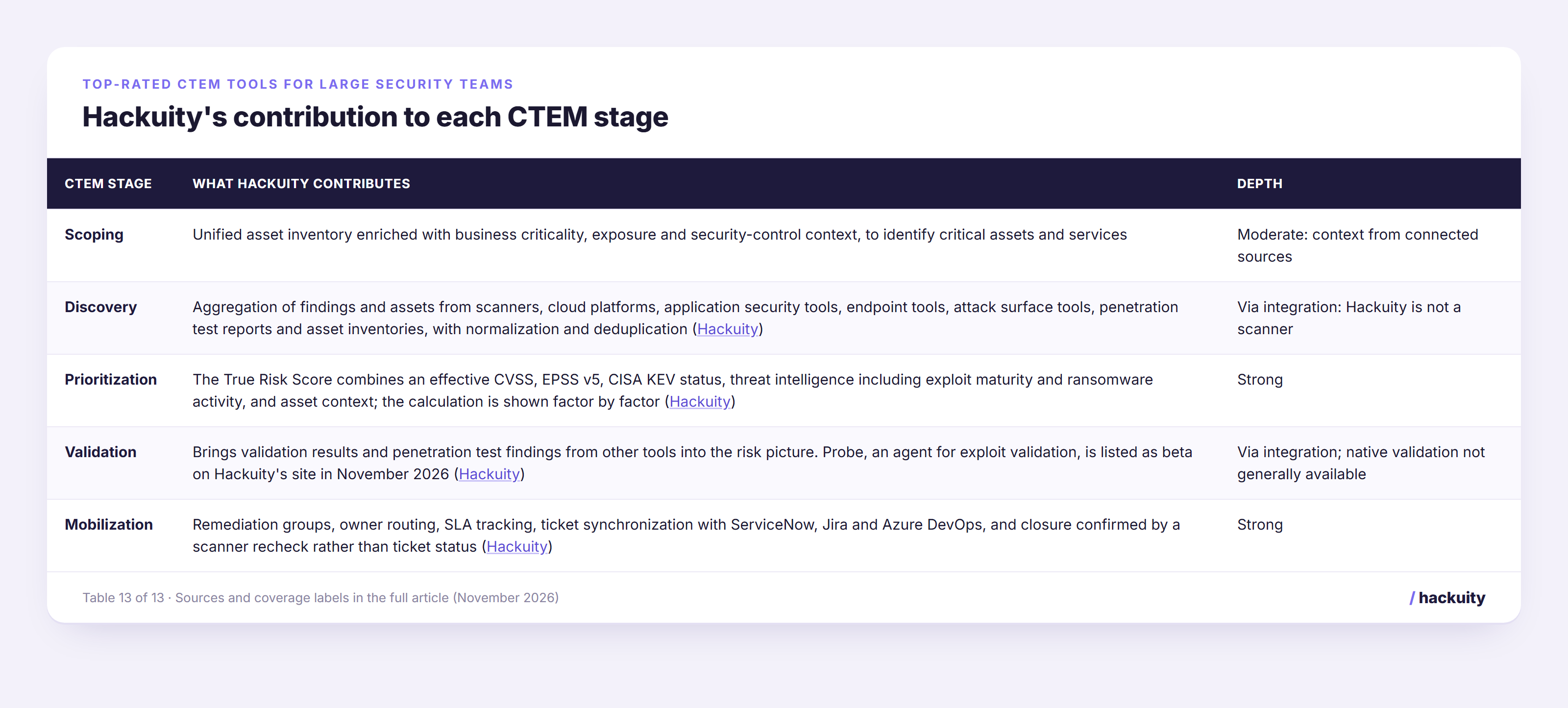
Aggregation of findings and assets from scanners, cloud platforms, application security tools, endpoint tools, attack surface tools, penetration test reports and asset inventories, with normalization and deduplication (Hackuity)
The True Risk Score combines an effective CVSS, EPSS v5, CISA KEV status, threat intelligence including exploit maturity and ransomware activity, and asset context; the calculation is shown factor by factor (Hackuity)
Brings validation results and penetration test findings from other tools into the risk picture. Probe, an agent for exploit validation, is listed as beta on Hackuity's site in November 2026 (Hackuity)
Remediation groups, owner routing, SLA tracking, ticket synchronization with ServiceNow, Jira and Azure DevOps, and closure confirmed by a scanner recheck rather than ticket status (Hackuity)
What it does well
- Vendor-neutral aggregation across 130+ connectors (vendor-stated; Hackuity Integrations), so findings from competing scanners are treated with one model.
- Normalization and deduplication of findings and assets, which reduces backlog noise and repeated tickets.
- Explainable prioritization that IT teams, auditors and executives can follow and challenge.
- Mobilization with verified closure, connecting priorities to campaigns, owners, SLAs and ITSM workflows.
Limitations and trade-offs
Hackuity is not a replacement for EASM, attack path management, breach and attack simulation, penetration testing or vulnerability scanners. It may not be the right primary tool when an organization needs only:
- external asset discovery;
- automated penetration testing;
- BAS or security control validation;
- cloud posture management;
- a native patch deployment tool rather than an orchestration layer.
A very small, homogeneous environment with one scanner may also get enough from that scanner's own prioritization.
Enterprise considerations
- Deployment: SaaS or on-premises (Hackuity); SOC 2 Type II certified.
- Scale and tenancy: multi-tenant architecture with scope-based access control, used by managed service providers (Hackuity for MSSPs).
- AI governance: the MCP server is available now; other agents (Probe, Remediation Advisor, VOC Copilot) are listed as beta, and Scout as planned for 2026. Hackuity states that agents operate with configurable approval thresholds.
- Implementation: value depends on connecting the main detection tools, the CMDB and the ITSM platform.
Questions to validate in a proof of concept
- Import our main scanners: how many findings remain after deduplication, and how is each merge explained?
- Show the True Risk Score breakdown for five findings, then change one asset's criticality.
- Import results from our validation tool or penetration tests: how do they change priorities?
- Close a ticket without fixing the vulnerability: what happens at the next scan?
- Configure two business units with separate scopes and SLA policies.
- Which AI features are generally available for our deployment model?
Editorial verdict
Hackuity is most relevant for large teams whose bottleneck is turning many tools' findings into prioritized, owned and verified fixes. In a CTEM stack, it typically sits between detection and validation tools on one side and ITSM on the other.
How to build a CTEM stack and run a proof of concept
Build the stack around your weakest stage, not around a single vendor's claim of completeness. A practical sequence for large teams:
- Assess maturity per stage. Rate scoping, discovery, prioritization, validation and mobilization separately, using metrics you already have: asset coverage, backlog size, share of findings with owners, time to remediate.
- Choose the central layer. Decide where exposures are correlated, prioritized and assigned: an exposure management platform, a vulnerability operations platform or your ITSM.
- Add specialists for gaps. EASM or CAASM for discovery gaps, attack path management or validation tools when exploitability is disputed, remediation orchestration when fixes stall.
- Connect data both ways. Validation results should change priorities; remediation status should reach every tool.
- Run a two- to four-week proof of concept with your own data, at least two business units and your ITSM instance. Measure deduplication, top-priority quality against KEV, validation accuracy, ticket round-trips and closure verification.
- Ask about availability. Record which features you tested are generally available, in beta or planned.
Track CTEM with outcome metrics rather than activity metrics: exploitable exposures on critical services, time to remediate by priority tier, share of exposures with an owner, SLA compliance, validated versus theoretical exposures, and the trend of exposure over time.
Conclusion: choose for your weakest CTEM stage
The top-rated CTEM tool for a large security team is the one that strengthens the stage where its program breaks today. Teams with unknown assets should start with EASM or CAASM. Teams that cannot rank findings need risk-based prioritization. Teams that argue about exploitability need attack path management or validation. Teams whose priorities never become fixes need remediation orchestration. Most large enterprises will combine several of these tools; what makes them a CTEM program is a shared view of exposure, explicit ownership and evidence that risk goes down.
For security leaders: See how Hackuity helps large security teams turn fragmented vulnerability and exposure data into prioritized remediation and measurable risk reduction.
For technical teams: Explore how Hackuity can connect your existing scanners, security tools, asset context and ITSM workflows within a more operational CTEM model.
Frequently asked questions
What are the top-rated CTEM tools?
There is no single top-rated CTEM tool, because CTEM is a five-stage program and tools specialize by stage. Commonly evaluated options include exposure management platforms such as Tenable One, Qualys ETM and Rapid7 Exposure Command; attack path management such as XM Cyber; validation tools such as Pentera, Horizon3.ai, Cymulate and Picus; EASM such as CyCognito; and vendor-neutral prioritization and orchestration layers such as Hackuity, Nucleus Security and Brinqa. The right mix depends on your weakest stage.
What is the best CTEM platform for a large enterprise?
The best CTEM platform for a large enterprise is the combination that covers all five stages with shared data and clear ownership. Enterprises consolidating on one vendor often choose an exposure management platform. Enterprises with many scanners often add a vendor-neutral layer for prioritization and remediation. Most also add a specialized validation tool. Scale, multi-tenancy, deployment constraints and ITSM integration usually decide between shortlisted options.
What is CTEM?
Continuous Threat Exposure Management (CTEM) is a program, introduced by Gartner, that continuously identifies, prioritizes, validates and reduces the exposures most likely to harm critical business services. It extends vulnerability management to misconfigurations, identities, attack paths and external assets. CTEM is defined by its process and outcomes, not by a product category, and it depends on several tools and teams working from one view of exposure.
What are the five stages of CTEM?
The five stages are scoping, discovery, prioritization, validation and mobilization. Scoping defines what matters to the business. Discovery finds assets and exposures. Prioritization ranks exposures by exploitability and impact. Validation confirms whether exposures are reachable and exploitable, and whether controls stop them. Mobilization gets the right teams to fix them and verifies the result. The cycle then repeats continuously.
Is CTEM a product or an operating model?
CTEM is an operating model. It combines processes, roles, metrics and tools that together reduce exposure. Vendors sell products that support one or several CTEM stages, and some describe them as complete CTEM platforms, but no product delivers the program alone. Organizations still need defined scope, ownership, governance and cross-team workflows, whatever tools they choose.
What is the difference between CTEM and vulnerability management?
Vulnerability management finds and fixes known software vulnerabilities, usually identified by CVE. CTEM is broader: it covers misconfigurations, identities, attack paths and external assets, starts with business scoping, and adds validation of whether exposures are actually exploitable. Vulnerability management remains a core input to CTEM, and risk-based vulnerability management supplies much of its prioritization and remediation work.
What is the difference between CTEM and exposure management?
Exposure management is the broader practice of identifying and reducing all forms of cyber exposure. CTEM is a specific, structured way to run it: a continuous five-stage cycle defined by Gartner. Vendors often use "exposure management platform" for products that correlate exposures across domains, while CTEM describes the program those products support. In practice, the terms overlap and are often used together.
What types of tools are used in a CTEM program?
CTEM programs typically combine EASM and CAASM for discovery, vulnerability scanners and cloud, application and identity security tools, risk-based vulnerability management or exposure management platforms for prioritization, attack path management, breach and attack simulation and automated penetration testing for validation, and remediation orchestration with ITSM for mobilization. Large enterprises rarely use only one of these categories.
Which tools support CTEM discovery?
Discovery relies on EASM for internet-facing and shadow assets, CAASM for reconciling internal inventories, vulnerability scanners for known flaws, cloud security platforms for cloud resources and misconfigurations, application security tools for code and APIs, and identity security platforms for privileged accounts. Aggregation platforms such as Hackuity, Nucleus Security and Brinqa do not discover assets themselves; they collect and deduplicate what these tools find.
Which tools support CTEM prioritization?
Prioritization is supported by risk-based vulnerability management platforms, exposure management platforms and attack path management tools. Effective prioritization combines exploitation evidence such as CISA KEV, exploitation probability such as EPSS, threat intelligence, asset criticality, internet exposure and attack paths. For large teams, the score should be explainable and adjustable, so that IT teams and auditors can understand why an exposure ranks first.
Which tools validate exploitability?
Exploitability is validated by automated penetration testing tools such as Horizon3.ai NodeZero and Pentera, by breach and attack simulation and exposure validation tools such as Cymulate, Picus, AttackIQ and SafeBreach, by external testing tools such as CyCognito, and by manual penetration testing. Attack path management tools such as XM Cyber model exploitability rather than executing exploits. Production safety controls differ widely and should be tested.
What is attack path management?
Attack path management models how an attacker could move from an entry point to critical assets by chaining vulnerabilities, misconfigurations and identity privileges. It identifies choke points where one fix breaks many paths, which helps prioritize remediation. Most attack path tools model paths rather than exploiting them, so they are often paired with live validation tools.
What is the role of BAS in CTEM?
Breach and attack simulation (BAS) supports the validation stage by testing whether security controls detect and block realistic attack techniques. It shows which exposures are already mitigated and which controls need tuning. BAS does not discover assets or orchestrate remediation, so its results are most useful when they feed back into prioritization and mobilization.
What is the role of vulnerability management in CTEM?
Vulnerability management supplies much of CTEM's raw material and remediation workload. Scanners discover known flaws; risk-based vulnerability management prioritizes them; vulnerability operations turns priorities into owned, tracked and verified fixes. CTEM adds business scoping, broader exposure types and validation around this core rather than replacing it.
How should large security teams evaluate CTEM tools?
Start by rating your program's maturity at each of the five stages, then evaluate tools against the weakest ones. Use weighted criteria covering lifecycle coverage, discovery, prioritization, validation, mobilization, governance and architecture. Run a two- to four-week proof of concept with your own data, several business units and your ITSM instance, and ask vendors which tested features are generally available.
Can one platform cover all five CTEM stages?
Several vendors claim to cover all five stages, but public documentation usually shows uneven depth. Scoping and validation are the stages most often covered lightly or through integrations. Large enterprises typically combine a central platform for discovery, prioritization and mobilization with specialized validation or attack surface tools. Treat "complete CTEM platform" claims as a starting point for proof-of-concept testing.
What integrations should a CTEM platform support?
A CTEM platform should integrate with the vulnerability scanners and security tools you already run, asset inventories and CMDBs, cloud providers, identity platforms, threat intelligence feeds, validation tools and ITSM platforms such as ServiceNow and Jira. Integrations should be bidirectional where possible, so that validation results update priorities and ticket status updates the platform.
How does CTEM reduce cyber exposure?
CTEM reduces exposure by focusing remediation on the exposures most likely to be exploited against critical services, confirming them through validation, and making sure fixes are assigned, tracked and verified. Instead of patching by severity alone, teams fix fewer but more important issues faster, and use compensating controls when immediate remediation is not possible.
How is CTEM measured?
CTEM is measured by outcomes rather than activity. Useful metrics include exploitable exposures on critical services, time to remediate by priority tier, share of exposures with an accountable owner, SLA compliance, the ratio of validated to theoretical exposures, coverage of in-scope assets and the trend of exposure over time. Each metric should have a documented definition so results can be compared across periods.
Does Hackuity provide a CTEM platform?
Hackuity provides a vulnerability operations platform that supports a CTEM program rather than replacing every CTEM tool. It aggregates and deduplicates findings from many tools, prioritizes them with its True Risk Score and mobilizes remediation through campaigns, SLAs and ITSM integrations. Discovery relies on connected tools, and validation relies on integrations; its Probe validation agent is in beta.
How does Hackuity support CTEM?
Hackuity supports CTEM mainly in discovery through aggregation, prioritization and mobilization. It unifies asset and finding data from scanners, cloud, application and attack surface tools, adds business and threat context, explains each priority factor by factor, and routes remediation to owners through ServiceNow, Jira or Azure DevOps, with closure confirmed by scanner data. It works alongside EASM, attack path and validation tools.
Is Hackuity a replacement for vulnerability scanners?
No. Hackuity is not a vulnerability scanner and does not replace scanners. It ingests findings from the scanners and security tools an organization already runs, normalizes and deduplicates them, and turns them into prioritized, owned remediation. Organizations keep their detection tools and use Hackuity to make their combined output actionable.
Sources, methodology and editorial notes
Research date: October 27 to November 4, 2026. Author: [Author name, job title]. Technical reviewer: [Reviewer name, job title].
Definition of "top-rated". In this guide, "top-rated" means best suited to a given CTEM stage and enterprise context according to documented capabilities, not a ranking from reviews or analysts. No vendor is ranked overall.
Framework and scoring. The lifecycle uses Gartner's five CTEM stages. Coverage labels (Strong, Moderate, Limited, Specialized, Via integration, Requires additional module, Not publicly verified) are editorial assessments based on official vendor documentation; weights are defaults for buyers to adjust. No numeric scores are published.
Basis of statements. Capability statements come from official vendor documentation unless marked independent. Independent evidence includes the FedRAMP Marketplace, government and standards sources, and press coverage of acquisitions. Analyst research is cited only for definitions and public projections, through vendor-hosted reprints where gartner.com was not accessible. Customer reviews were not used as evidence.
Limits. Documentation changes quickly, several vendors keep details behind logins, and many AI features are recent or in beta. "Not publicly verified" means a capability could not be confirmed, not that it is absent. Hackuity, the publisher, is one of the platforms discussed.
Industry and standards sources
- Gartner, Implement a Continuous Threat Exposure Management (CTEM) Program, October 2023, via SafeBreach
- Gartner, Market Guide for Adversarial Exposure Validation, 2026, via AttackIQ
- Verizon, 2026 Data Breach Investigations Report
- CISA, Known Exploited Vulnerabilities catalog (1,767 entries on November 3, 2026)
- CISA, BOD 26-04: Prioritizing Security Updates Based on Risk, June 10, 2026
- FIRST, Exploit Prediction Scoring System
- FedRAMP, Nucleus for Government listing


VR-1 | Property |
|---|---|
Model type | Post-trained cyber reasoning model |
Primary specialization | Multi-domain enterprise attack-chain discovery |
Starting condition | A scoped foothold and a concrete objective |
Operating surfaces | Cloud, identity, runtime, code, CI/CD, SaaS, and organizational context |
Success signal | Execution-verified completion of the objective |
Primary evaluation | IntrusionBench |
Preliminary result (preview) | More than 2× black-box pass@3 over the strongest evaluated frontier baseline |
Trajectory budget | Two-hour wall-clock limit per trajectory, or 250 agent turns (whichever comes first) |