
















As AI expands vulnerability detection, safe automation depends on reliable context, explicit controls and a deliberate operating model.
The central idea
Automation should act on a prioritized, contextualized finding. It should not be asked to create the context, make the decision and execute the action without control
Vulnerability management is entering a new operational phase. Security teams are seeing more findings from more sources, while the time available to respond is becoming shorter. Traditional scanners remain essential, but they are now complemented by cloud, endpoint and identity tools, as well as AI-based capabilities that surface vulnerabilities traditional tools did not detect.
This creates a practical problem. Better detection produces greater visibility, but also more findings to assess and process. The central challenge is no longer simply identifying vulnerabilities. It is understanding which findings matter most, deciding what should happen next and executing that decision quickly without losing control.
The Hackuity and Mindflow use case shows why contextual prioritization must come before automation.
Watch the Hackuity x Mindflow webinar replay →
AI is increasing the volume of vulnerability findings
Vulnerability teams have long dealt with noise. The difference now is the number and variety of sources contributing to it.
Many organizations collect vulnerability and asset information from several security tools. They also use large language models and AI-based tools to perform additional assessments and identify vulnerabilities that traditional tools did not surface.
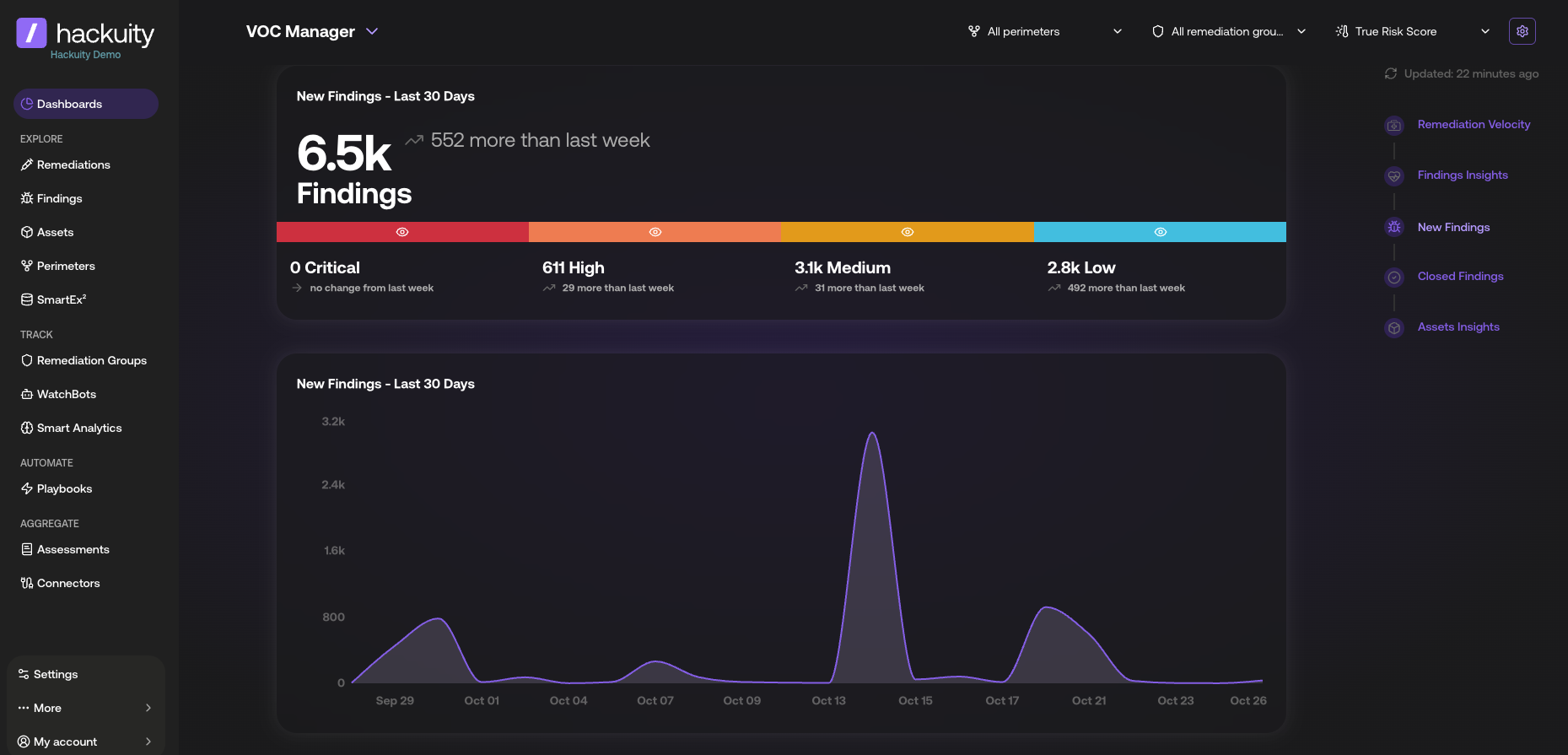
Hackuity reported that some customers saw the number of detected findings double during the summer as AI-based detection capabilities became part of their assessment Process.
At the same time, the exploitation window is becoming shorter. In some cases, the time available to act has shrunk from several days to only a few hours. This changes the operational priority for security teams. The goal is to identify the vulnerabilities that require action and respond before the relevant window closes.
More data does not automatically produce better decisions
A vulnerability cannot be assessed independently from the asset it affects. The same vulnerability carries a different level of risk depending on the affected asset, its exposure and whether exploitation is known.
Vulnerability management therefore requires more than a list of severity scores.
Hackuity addresses this challenge through a model built around three successive layers: aggregating information from different sources, adding context to prioritize the most relevant risks, and automating the actions that follow from that prioritization.
The order matters. Automation accelerates a decision but does not compensate for a lack of reliable context.
Hackuity’s role: consolidate and prioritize the risk
Hackuity aggregates information from the different security tools used by an organization. This includes vulnerability scanners, cloud security tools, endpoint platforms and identity-related sources.
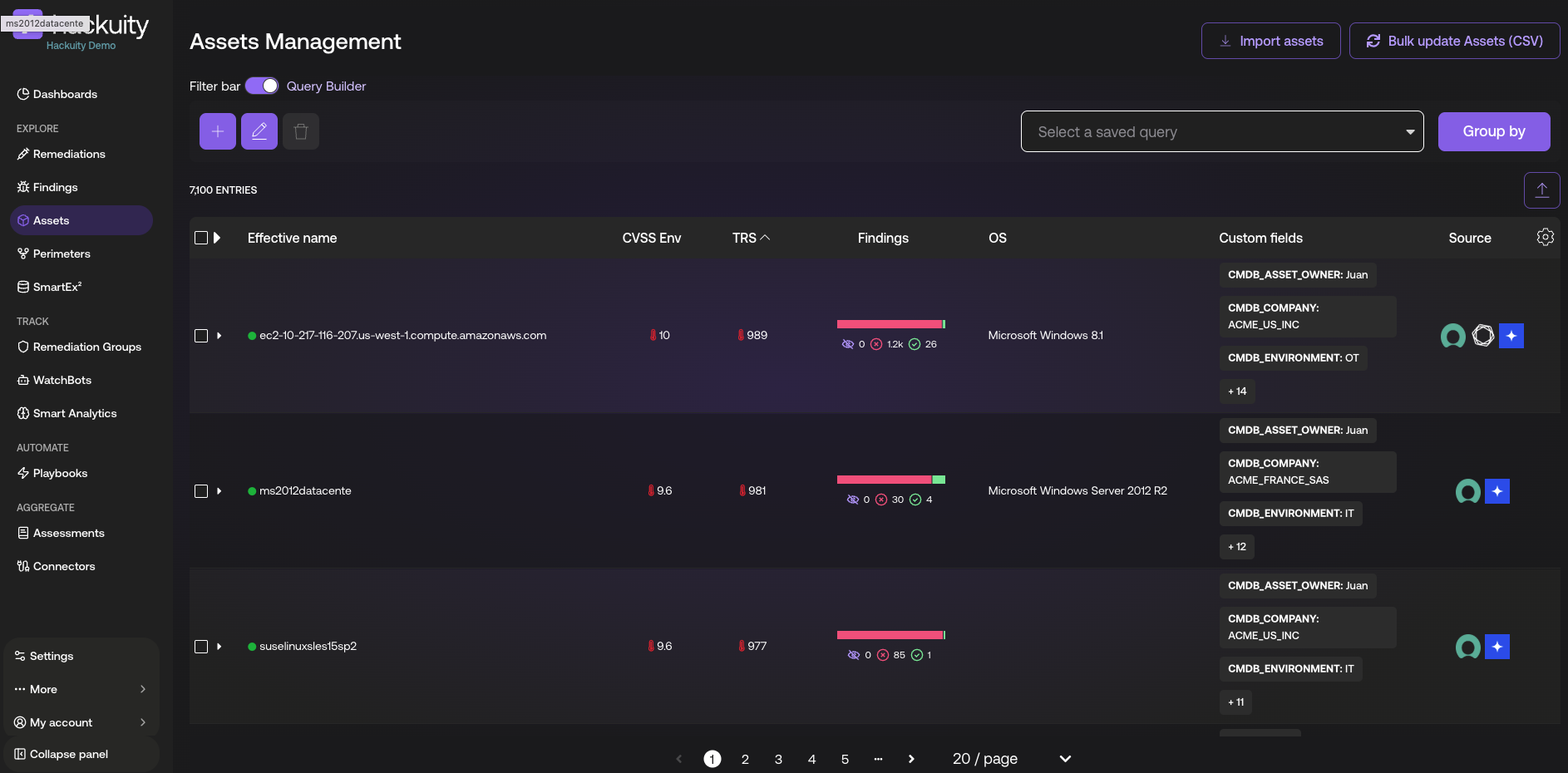
The platform also normalizes and deduplicates the data. If several tools identify the same asset, Hackuity brings the information together rather than treating it as several unrelated objects. This provides a unified view of assets, applications and findings.
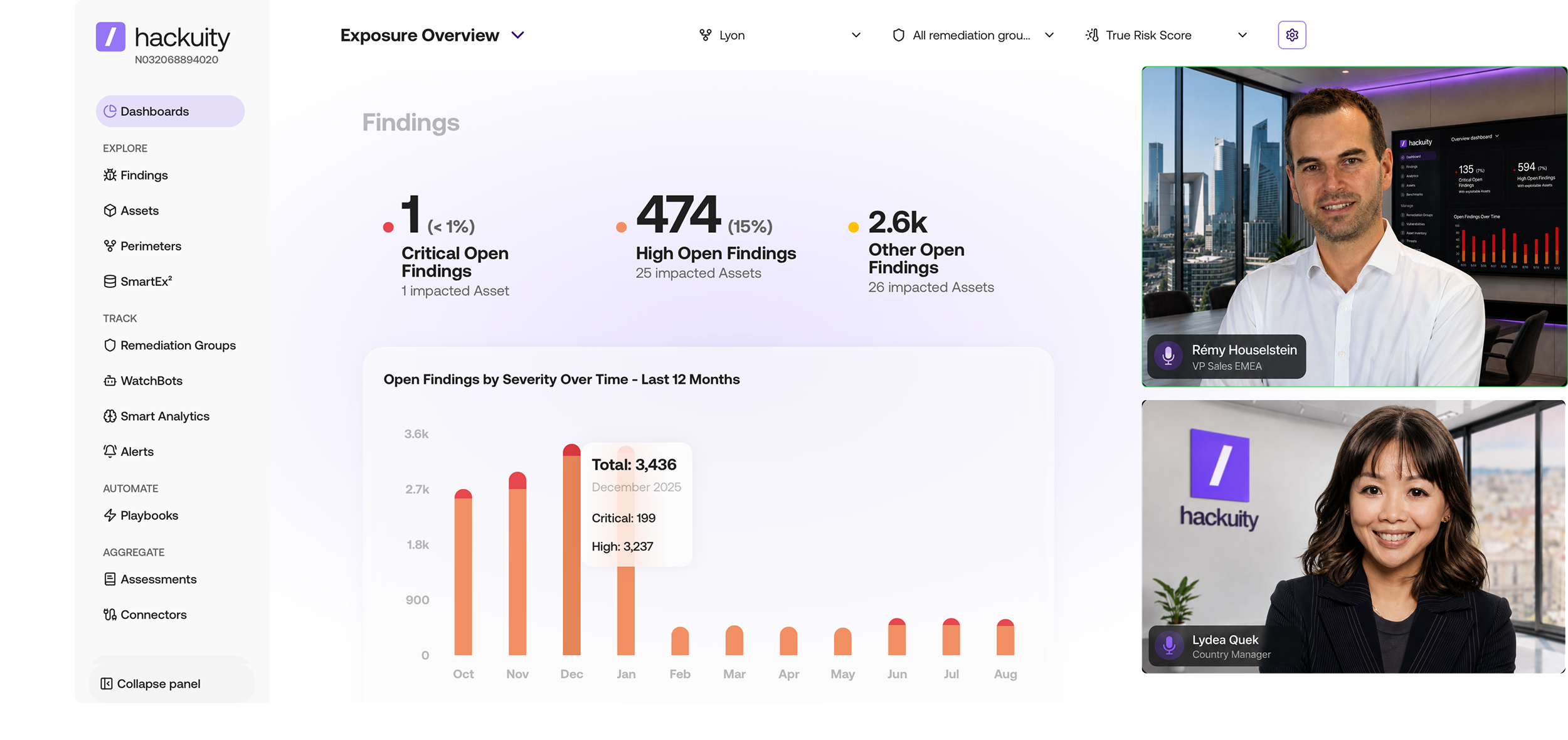
The next step is to add intelligence to this data. Hackuity takes into account threat intelligence, asset exposure, exploitability and other contextual information to produce a risk score and help teams identify what should be addressed first.
Hackuity estimates that fewer than one percent of findings require urgent action in a typical environment. Prioritizing these findings gives security teams a practical way to focus on the vulnerabilities that require action now.
Prioritization therefore acts as a control layer for everything that happens next.
Mindflow’s role: orchestrate the response
Once a finding has been consolidated and prioritized, the next challenge is operational. Mindflow provides a platform for automating workflows and implementing agentic AI in enterprise environments. It connects to applications through APIs and combines AI agents with deterministic workflow steps.
In a vulnerability management process, Mindflow orchestrates activities such as enriching a finding, analyzing a justification, requesting or validating an owner’s review, updating a status, adding a comment, sending a notification and verifying whether a vulnerability has been fixed.
Hackuity provides the vulnerability and asset context needed to make a better decision. Mindflow provides the workflow layer that turns this context into a controlled and traceable action.
A practical use case: validating a potential false positive
An application owner received an alert concerning a vulnerability associated with an application under their responsibility. In Hackuity, the owner reviewed the finding, the information provided by the original scanner and additional information about the vulnerability.
The owner reviewed what the vulnerability affected, whether exploitation was known and whether the relevant component was actually present in the application. In the demonstrated scenario, the application owner concluded that the vulnerable component was not installed.
They added a comment explaining the analysis and declared the finding to be a false positive. The finding was not immediately considered closed. The declaration triggered a workflow in Mindflow.
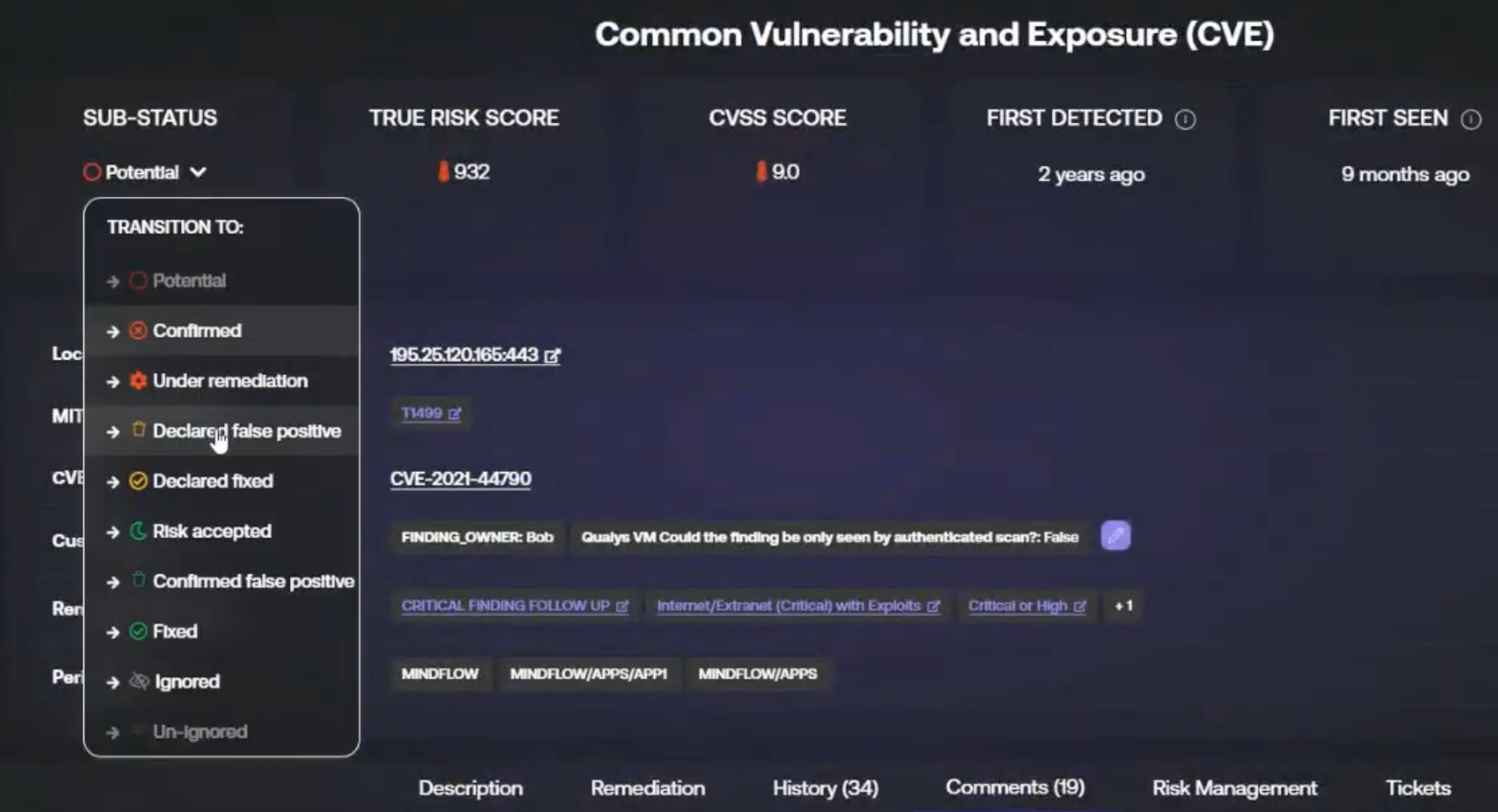
A finding moves through defined statuses in Hackuity, including the false-positive review used in the demonstration.
A vulnerability triage agent reviewed the owner’s explanation and compared it with the information available in Hackuity. The agent analyzed whether the justification was consistent with the finding and the affected asset.
A separate confidence gate then controlled the next step. The triage agent analyzed the situation, while the workflow controlled the final action.
If the decision was approved, another step updated the finding, changed the status to confirm the false positive and added a comment documenting the result.A notification was then sent to the application owner.
In the demo, a review that usually takes days was completed in minutes, while preserving a record of what was analyzed and what action was taken.
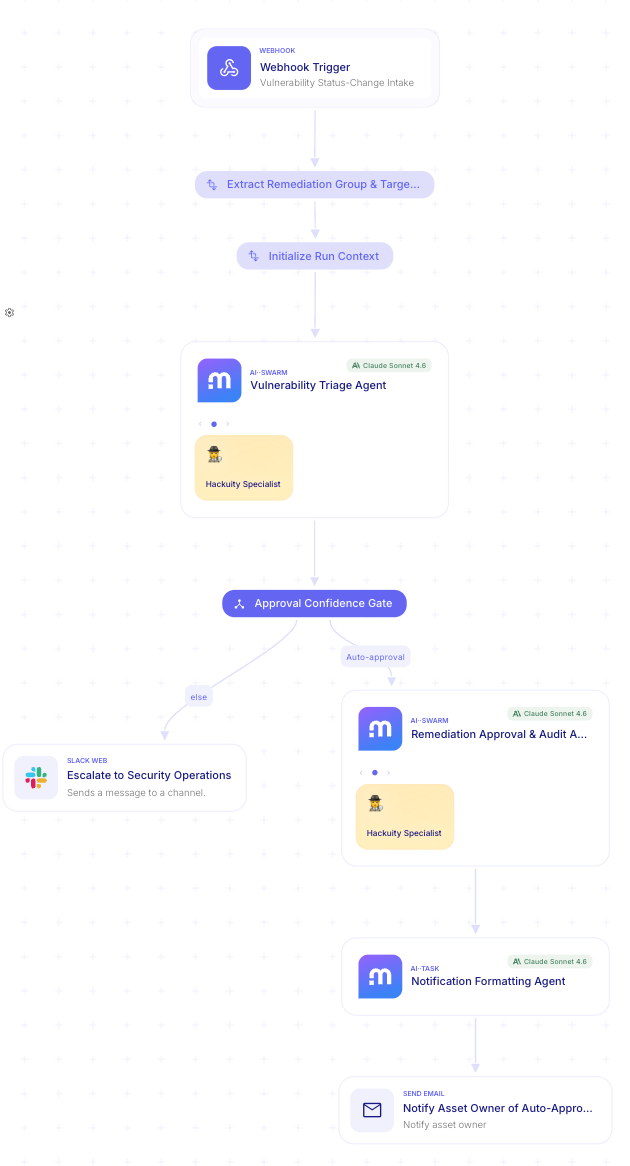
The workflow connects the Hackuity status change to analysis, approval, execution and notification in Mindflow.
Safe automation separates judgment, policy and execution
The false-positive use case illustrates a broader principle. A controlled automation workflow should distinguish between analysis, policy and execution.
An agent analyzes the available information and assesses whether an explanation is coherent with the finding and the asset context. A deterministic control defines the confidence required before the workflow continues and determines when the case must be escalated for human review. A separate step then performs the approved action, such as updating the status, adding a comment or sending a notification.
This separation reduces the risk of allowing a single agent to interpret a finding and close it without control. It also makes the workflow easier to observe and improve. Teams review the actions performed by the agent, test the workflow with controlled data and refine the process before using it in production.
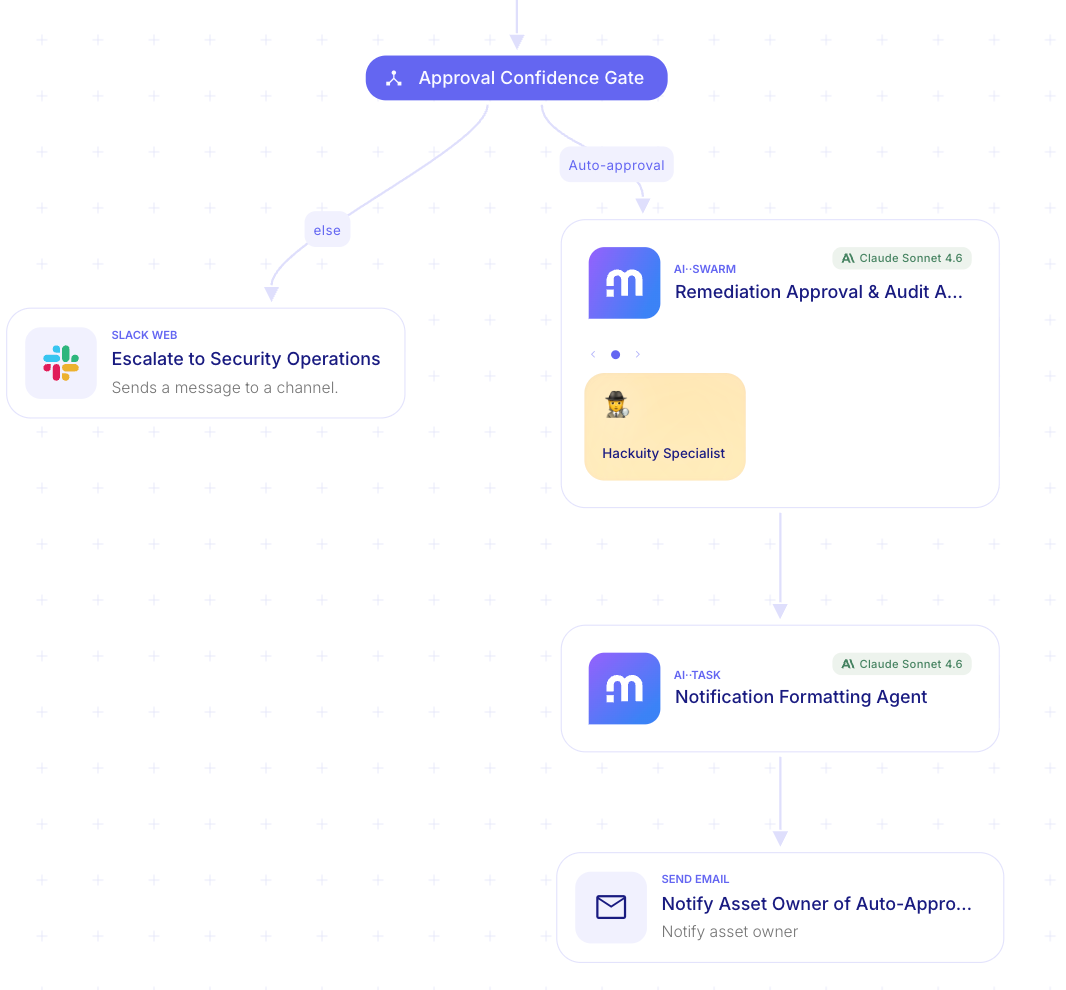
A separate approval gate controls whether the workflow proceeds automatically or escalates the case for review.
Automation should be progressive
The Hackuity and Mindflow approach follows a progressive model rather than automating every vulnerability management decision immediately.
Organizations start with enrichment, while keeping a person responsible for the final action. Once a process is sufficiently clear and repeatable, teams automate more steps. Typical workflows include verifying whether a vulnerability has been fixed after a ticket is closed, running a new scan to confirm remediation, managing permissions, applying escalation rules when an application owner does not respect an SLA and triggering a conditional security action.
The level of automation depends on the operation. For high-volume and predictable activities, deterministic workflow steps provide a reliable structure. AI is more useful when the process requires additional enrichment or advanced contextual reasoning.
This progressive approach helps organizations avoid automating the wrong action faster.
Automated remediation remains a controlled use case
Automatic remediation is technically possible, but it is not equally appropriate for every type of asset.
Routine updates on certain endpoints are easier to automate because the potential impact of an error is limited. Production servers are different. The consequences of an incorrect action are much greater, which explains why fully automated server remediation remains uncommon.
In these environments, the appropriate response is often to provide accurate risk and exploitability information to a human or to Mindflow, notify the relevant owner, escalate a missed SLA or apply a policy-defined compensating control. The remediation policy remains an organizational decision
A practical operating model
The use case supports a clear operating model for teams exploring AI-assisted vulnerability management.
Start by consolidating vulnerability and asset data. Add context before asking an automated system to make a decision. Keep human review in the process while the use case is being understood. Then automate the specific operations that are repeatable, testable and sufficiently controlled.
The result is a process in which Hackuity provides the risk context and Mindflow orchestrates the response. Policy remains part of the workflow and determines which actions are permitted.
Teams facing more findings and shorter exploitation windows should prioritize with context before automating action.
____
Hackuity is the leading AI-powered Vulnerability Operations Center (VOC) platform, helping organizations transform fragmented cyber exposure data into prioritized, actionable remediation. By unifying security findings from across the cybersecurity ecosystem into a single pane of glass, Hackuity enables Executives, security, IT, and engineering teams to cut through the growing volume of vulnerabilities and focus on the risks that matter most.
Combining AI-powered exposure prioritization, remediation orchestration, and cross-functional collaboration, Hackuity empowers enterprises to operationalize Cyber Exposure Management and accelerate risk reduction at scale.
Mindflow is the Enterprise Agentic Command Center. We help large organizations run AI agents securely, reliably, and at scale in the most complex enterprise environments. Our no-code, AI-driven flows connect tools, data, and teams, with your own LLM, guardrails, human oversight, and full auditability.



VR-1 | Property |
|---|---|
Model type | Post-trained cyber reasoning model |
Primary specialization | Multi-domain enterprise attack-chain discovery |
Starting condition | A scoped foothold and a concrete objective |
Operating surfaces | Cloud, identity, runtime, code, CI/CD, SaaS, and organizational context |
Success signal | Execution-verified completion of the objective |
Primary evaluation | IntrusionBench |
Preliminary result (preview) | More than 2× black-box pass@3 over the strongest evaluated frontier baseline |
Trajectory budget | Two-hour wall-clock limit per trajectory, or 250 agent turns (whichever comes first) |