
















Our connector story: a philosophy, not just a feature
From the very beginning, Hackuity made the deliberate choice of a technology-agnostic architecture. Why? Because our customers, large enterprises, critical infrastructure operators, MSSPs, do not live in a single-tool world. They operate with dozens of heterogeneous security solutions: vulnerability scanners, cloud security platforms, EDRs, ITSM tools, pentest platforms, identity managers...
Since our very first connector, we’ve been asking ourselves one essential question: how do you aggregate all these data sources to extract a shared truth about risk?
We expand our coverage by following real field usage, including:
- The needs of MSSPs managing heterogeneous stacks across their clients
- Feedback from enterprise customers dealing with tool sprawl
- Requests from technology partners eager to integrate their solution into our ecosystem
What connectors bring to our customers
Unified visibility across the entire environment
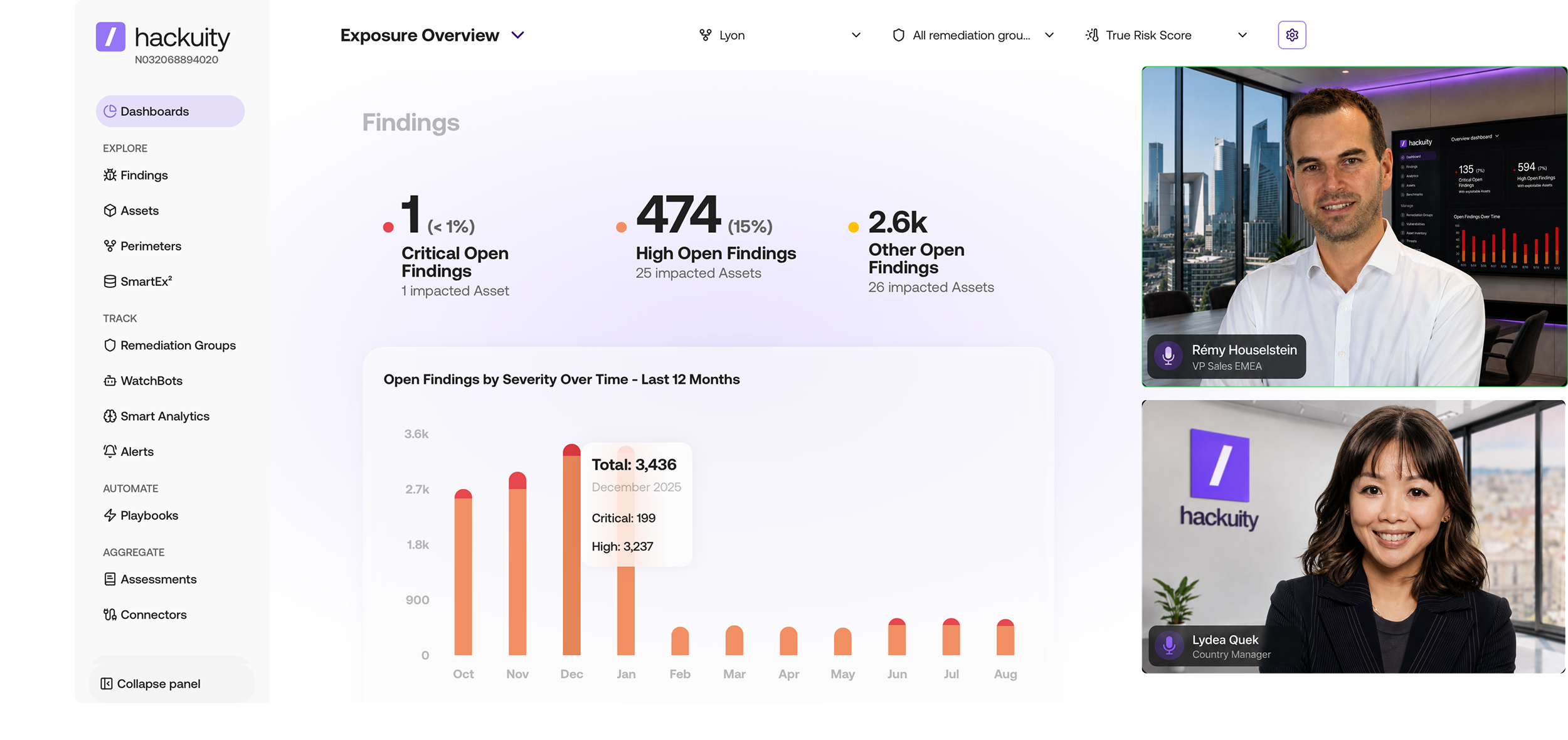
Every connector is a data source that feeds the Hackuity correlation engine. By aggregating, normalizing, and deduplicating vulnerabilities from dozens of tools, our customers move from a siloed tool-by-tool analysis to a single, coherent, and actionable picture of their risk exposure, regardless of the number or diversity of tools in their stack.
No disruption to existing tools
Your teams are already using Tenable, Qualys, Rapid7, CrowdStrike, or ServiceNow? Hackuity connects to their tools without replacing what already works. This principle, "no rip and replace", is at the heart of our value proposition.
A real impact on prioritization
Thanks to the True Risk Score (TRS), Hackuity transforms an overwhelming volume of vulnerabilities into an actionable set of truly critical priorities. The result: a reduction of up to 10,000x in the number of vulnerabilities requiring immediate action. This is only possible because TRS feeds on multi-source data flowing from all active connectors.
A catalog covering every use case
Today, our 130+ connectors span the entire security ecosystem :

A use case that hits close to home for enterprise: Mergers & Acquisitions
For large entreprises, tool sprawl isn’t only contained within their own organisation: they face it at scale every time they acquire a new company..
Most of our enterprise customers complete several acquisitions per year. Every new entity brings its own security tools, its own maturity level, and its own risk posture. Yet the board expects consolidated cyber risk reporting from day one, long before any technical consolidation happens.
That transition typically lasts at least 6 months. During that window, security teams must manage a wider tool disparity than ever while still delivering a unified view to leadership.
With 130+ connectors, Hackuity plugs into the acquired entity's existing stack immediately, providing full visibility and board-ready reporting without waiting for the tools to be harmonized.
The joint value: when 1 + 1 = 10
The power of our connectors goes far beyond simple data aggregation. It lies in the joint value generated for our shared customers.
When Hackuity integrates with a partner tool, the customer benefits from a combination that goes well beyond what each solution delivers on its own:
- Enriched detection: vulnerabilities discovered by scanners are contextualized by Hackuity with real-world threat data, business impact, and TRS
- Accelerated remediation: tickets are automatically created in the ITSM (ServiceNow, Jira...) with the right priority levels
- Extended visibility: assets discovered by partner tools (CMDB, EASM, CNAPP...) enrich the analyzed attack surface
- Unified reporting: security teams and MSSP clients benefit from a consolidated view regardless of stack complexity
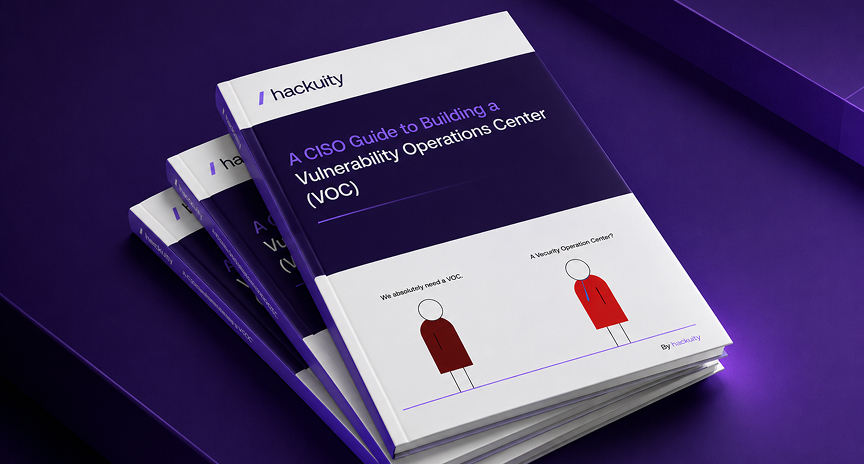
This connector ecosystem is precisely what enables Hackuity to power a Vulnerability Operations Center (VOC) at scale. For MSSPs operating across heterogeneous client environments, the ability to plug into any combination of security tools, without rip-and-replace, is what makes a managed VOC service both operationally viable and commercially differentiated. Instead of rebuilding an integration layer for each client, MSSPs can deploy a single, multi-tenant platform that adapts to any stack, from day one.
Introducing: the Preferred Technological Highlight of the Month ✨
Because every integration tells a story, we are launching a new monthly feature on our website.
🏅 The Preferred Technological Highlight of the Month
Each month, Hackuity puts our best technology partners and their connectors in the spotlight, covering:
- A partner presentation and overview of their solution
- A CTA linking to the connector page and the partner profile
This is not just a showcase: It is a way for us to demonstrate concretely how the Hackuity ecosystem multiplies value for security teams.
This is just the beginning
50 connectors. Then 130. Soon 200.
Every new connector is a bridge between Hackuity and a tool your teams are already using. Every integration reduces friction, enriches the TRS, and brings your teams closer to truly risk-based vulnerability management.
Explore the full catalog at connectors



VR-1 | Property |
|---|---|
Model type | Post-trained cyber reasoning model |
Primary specialization | Multi-domain enterprise attack-chain discovery |
Starting condition | A scoped foothold and a concrete objective |
Operating surfaces | Cloud, identity, runtime, code, CI/CD, SaaS, and organizational context |
Success signal | Execution-verified completion of the objective |
Primary evaluation | IntrusionBench |
Preliminary result (preview) | More than 2× black-box pass@3 over the strongest evaluated frontier baseline |
Trajectory budget | Two-hour wall-clock limit per trajectory, or 250 agent turns (whichever comes first) |