


















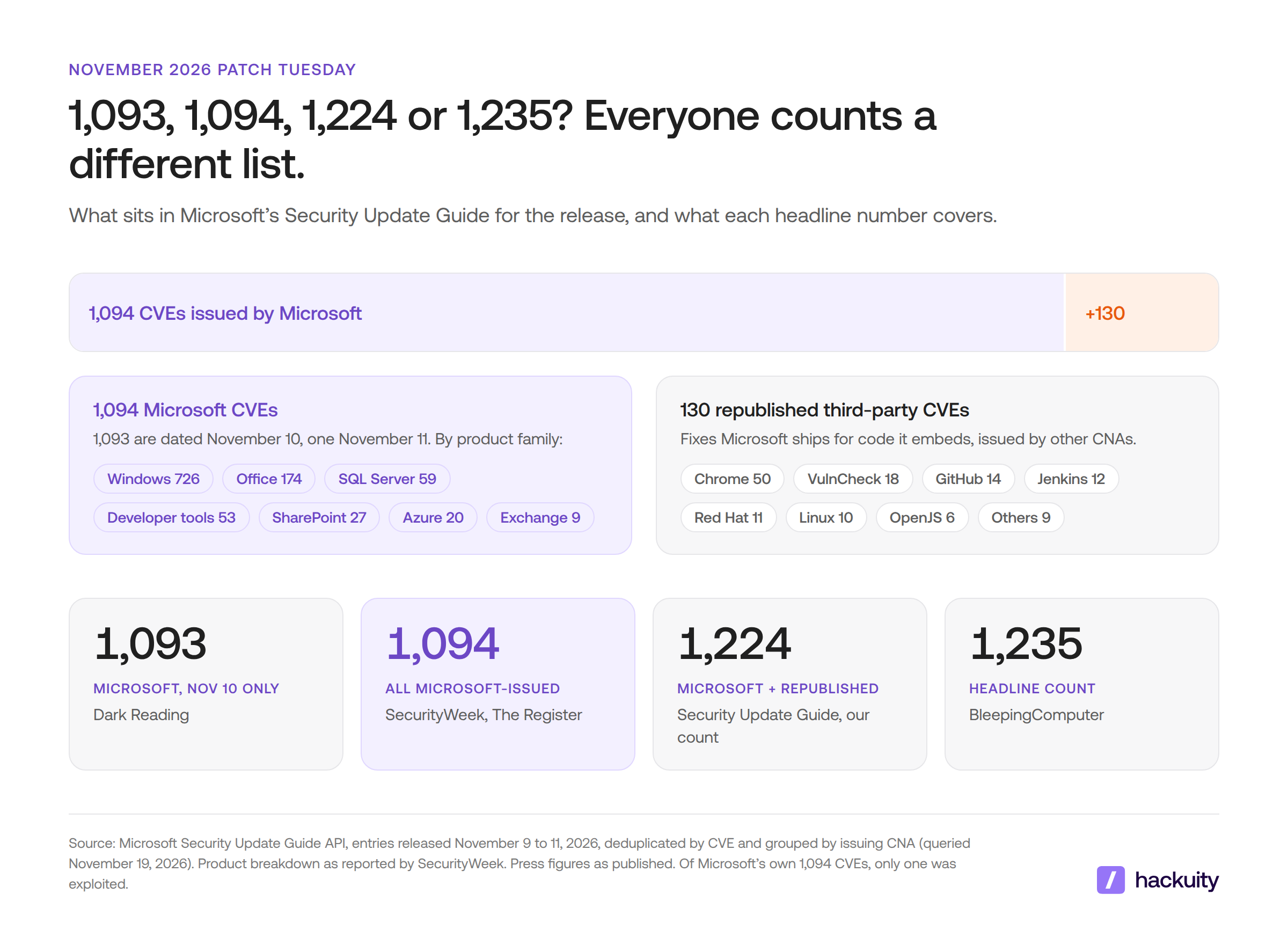
On November 10, 2026, Microsoft shipped its second Patch Tuesday in a row with more than 1,000 CVEs. Depending on who counts, the release holds 1,093, 1,094 or 1,235 vulnerabilities. The gap is mostly bookkeeping: Microsoft issued 1,094 CVEs itself and republished 130 from other vendors, Chromium included.
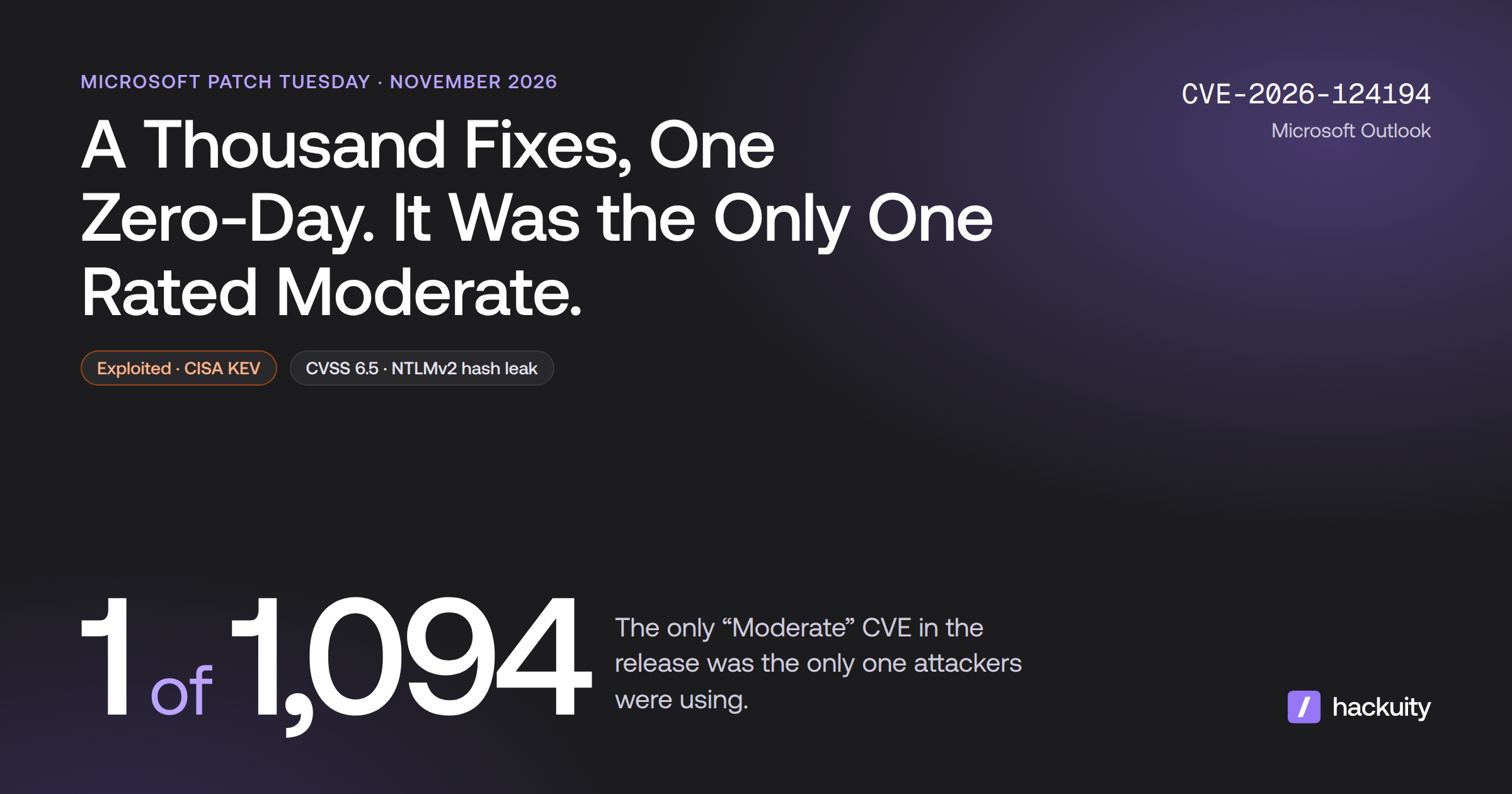
Of Microsoft's own 1,094 CVEs, only one had been exploited before the fix. CISA added it to the Known Exploited Vulnerabilities catalog the same day.
Sort the release by severity and you find that one at the very bottom. That is the November story worth telling.
What CVE-2026-124194 actually does
Microsoft classifies it as spoofing: Outlook fails to warn the user before an unsafe action. The real impact is credential exposure.
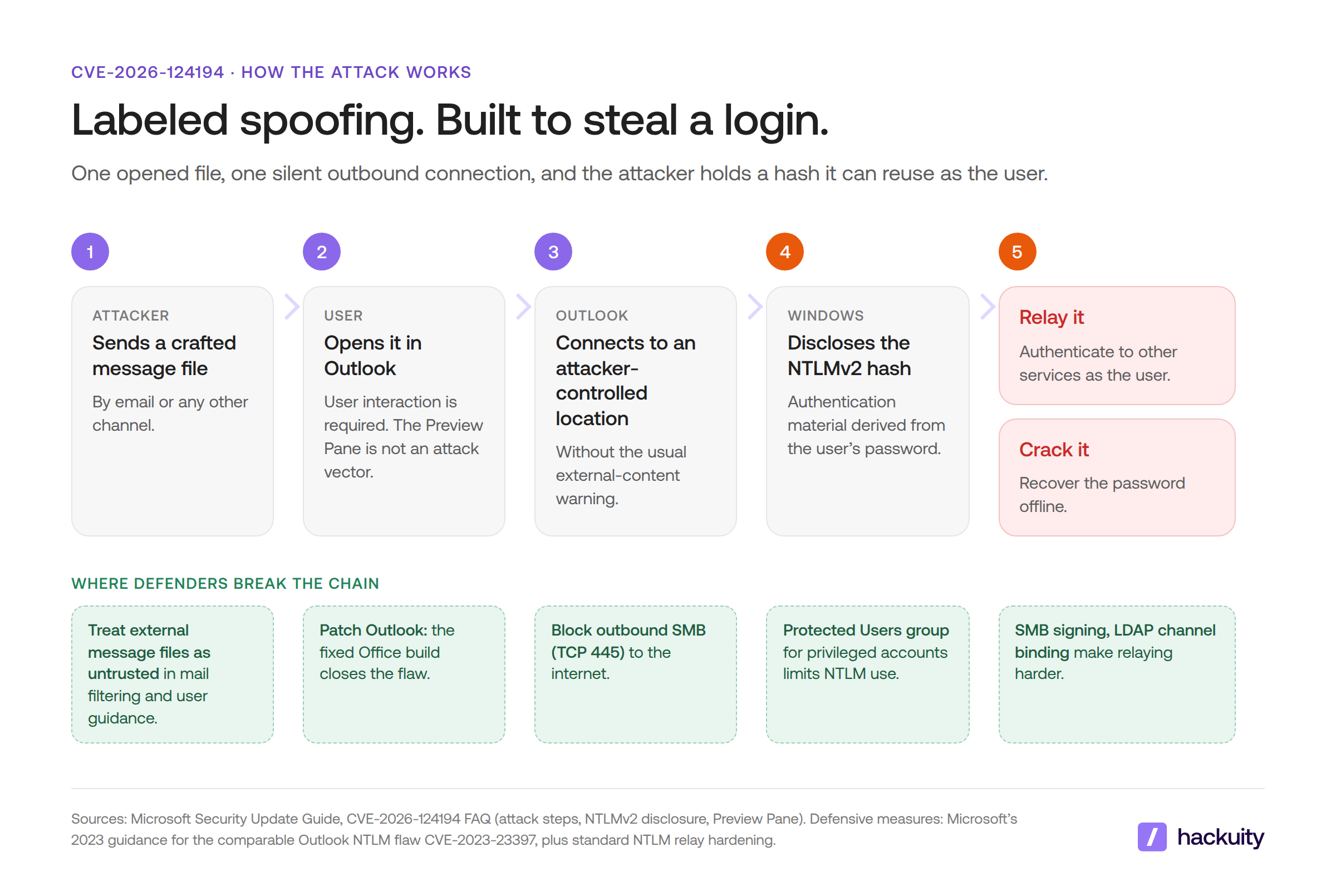
The chain is short. An attacker sends a specially crafted message file and convinces the user to open it in Outlook; the Preview Pane is not an attack vector. Outlook then reaches out to an attacker-controlled location without its usual external-content warning, and that connection hands over the user's NTLMv2 hash. The attacker can relay the hash to sign in elsewhere as the user, or crack it offline to recover the password.
Affected products are Microsoft 365 Apps for Enterprise, Office LTSC 2021 and Office LTSC 2024. Microsoft scores the flaw 6.5 under CVSS 3.1 and rates it Moderate. CISA set a remediation deadline of November 24 for federal agencies and tied it to BOD 26-04.
Outlook hash leaks are a known pattern. In 2023, CVE-2023-23397 gave attackers the same kind of hash without a single click, and Microsoft needed a second fix two months later to close a bypass.
The discovery has a twist of its own. Microsoft credits a researcher known as nono and Benoît Sevens, whose acknowledgment mentions Anthropic's Claude. After a year in which AI-assisted research mostly inflated patch volumes, here it points at the one bug attackers were already using. The advisory does not say whether the discovery came before or after the attacks.
Severity sorted it last
Here is the release through Microsoft's own fields, pulled from the Security Update Guide. By severity rating, CVE-2026-124194 comes last: 63 Critical, 1,030 Important and a single Moderate, this one. By CVSS base score, 868 CVEs rank above it and 60 others tie at 6.5. Even among this month's 20 Outlook CVEs, 18 score higher.
The one field that stands out is exploit maturity. It is the only CVE in the release whose vector says High (E:H).
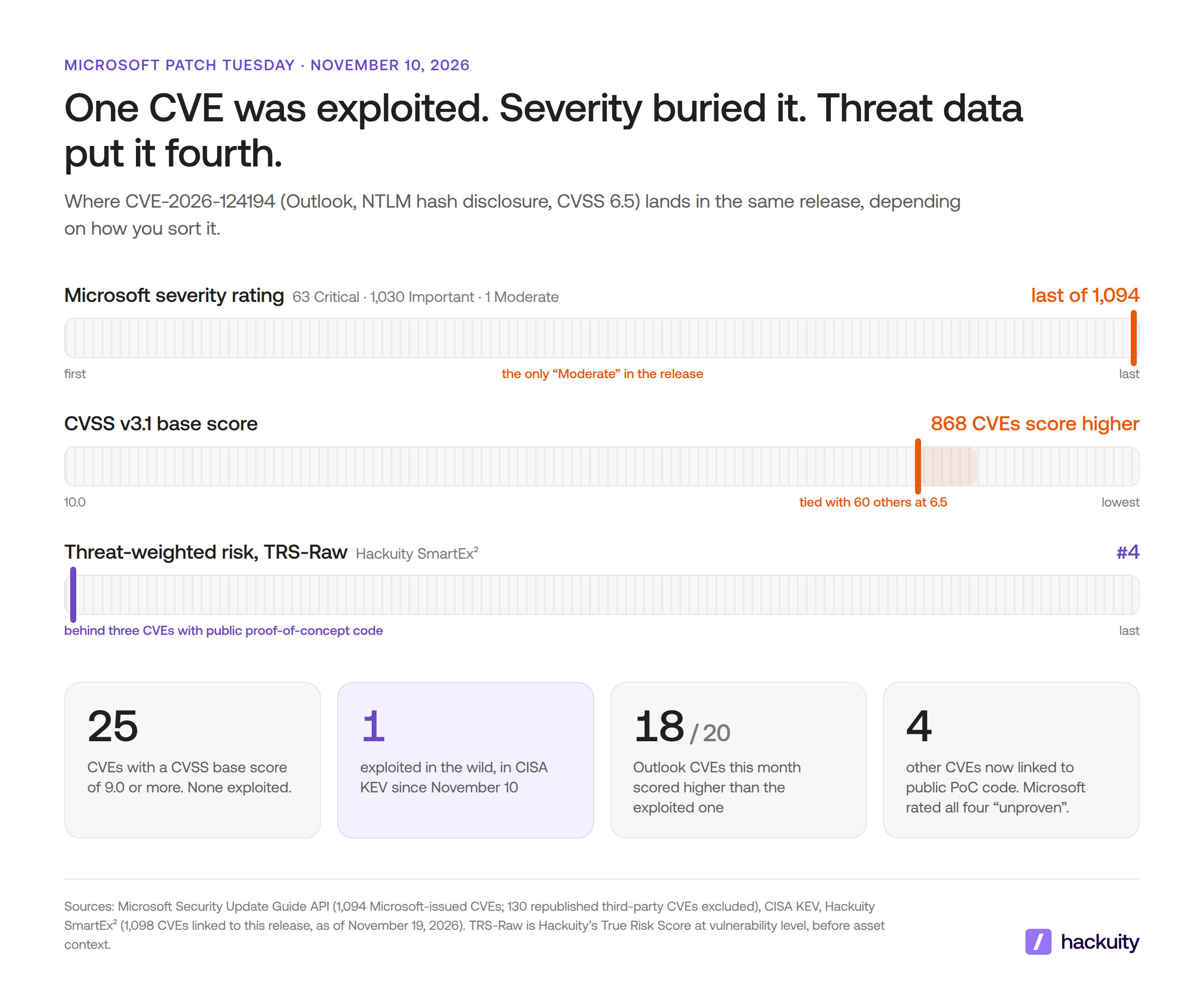
Meanwhile, 25 CVEs carry a base score of 9.0 or more. None of them was exploited at release.
Dustin Childs of the Zero Day Initiative put the trap in one line:
"It's labeled spoofing, but the impact is bigger than the name suggests."
None of this makes Microsoft's scoring wrong. CVSS describes how bad a flaw could be under stated conditions. Here a user must open a file, and the direct impact is a hash, not code execution.
The problem is using that number as a queue. As we have argued before, CVSS is necessary but not sufficient. A team that patches Critical first, then Important by score, reaches November's only exploited CVE last.
Threat data put it in fourth place
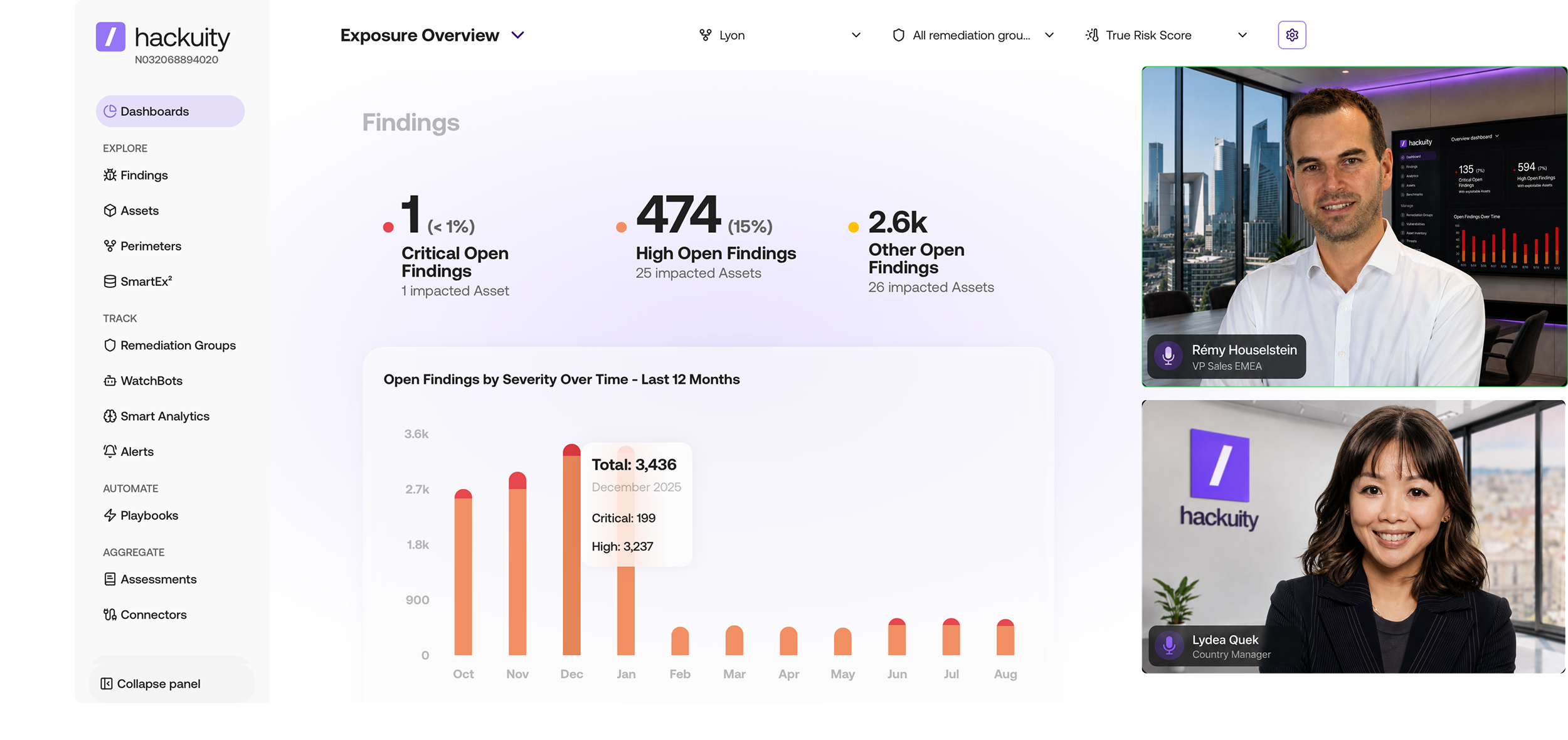
We looked at the same release in SmartEx², Hackuity's Smart Exposure Explorer, which links 1,098 CVEs to the November Patch Tuesday. The threat picture is far shorter than the CVE list.
Five CVEs have public exploit code linked to them. Four only have proof-of-concept code: two local privilege escalations, a HEIF image codec flaw and a DNS spoofing bug, all marked unproven in Microsoft's vectors on release day. One combines a weaponized exploit, confirmed exploitation and a KEV entry: CVE-2026-124194.
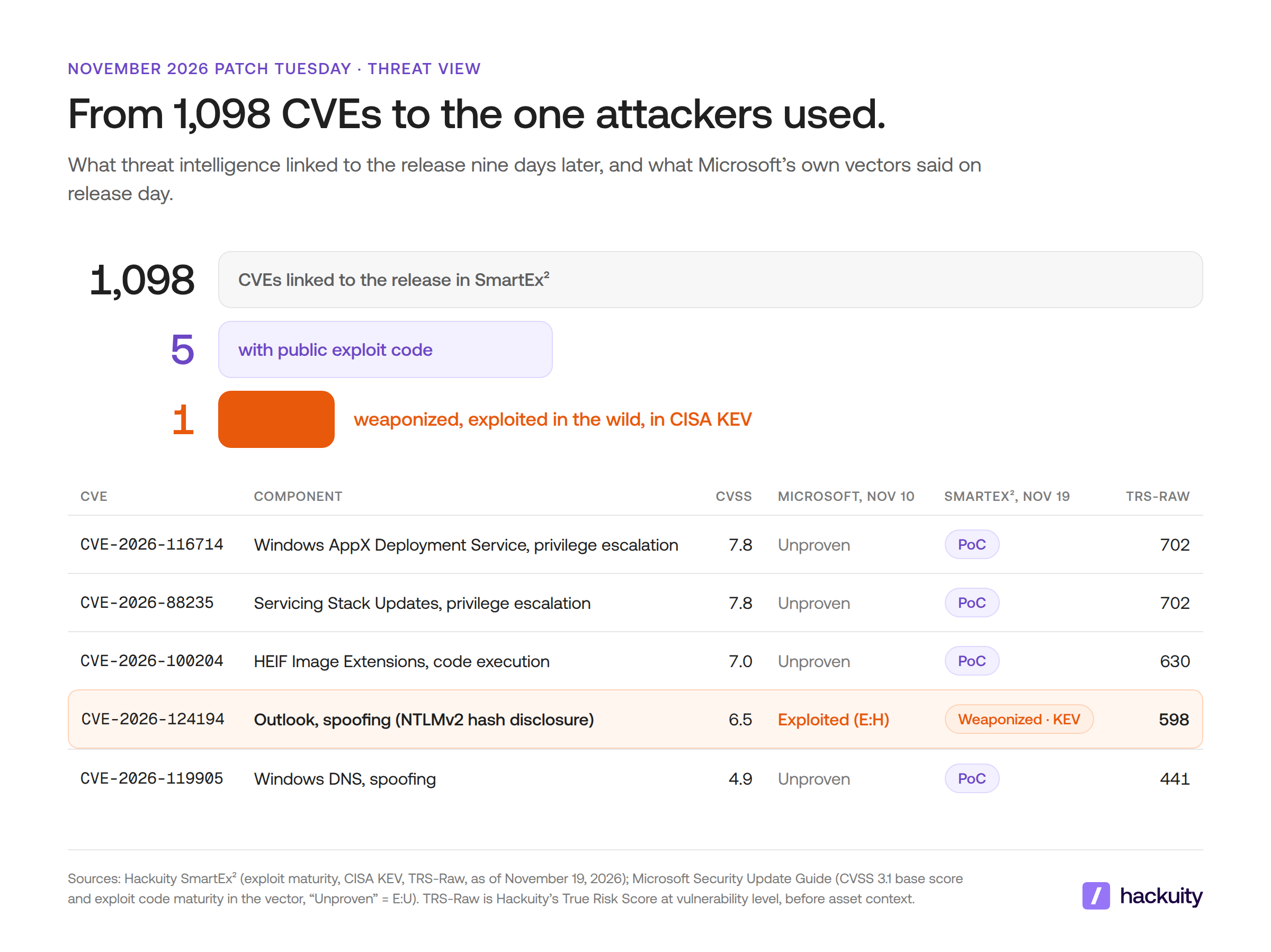
Sorted by TRS-Raw, Hackuity's True Risk Score computed at the vulnerability level, the Outlook zero-day ranks fourth out of 1,098. Only the three highest-scoring proof-of-concept CVEs sit above it.
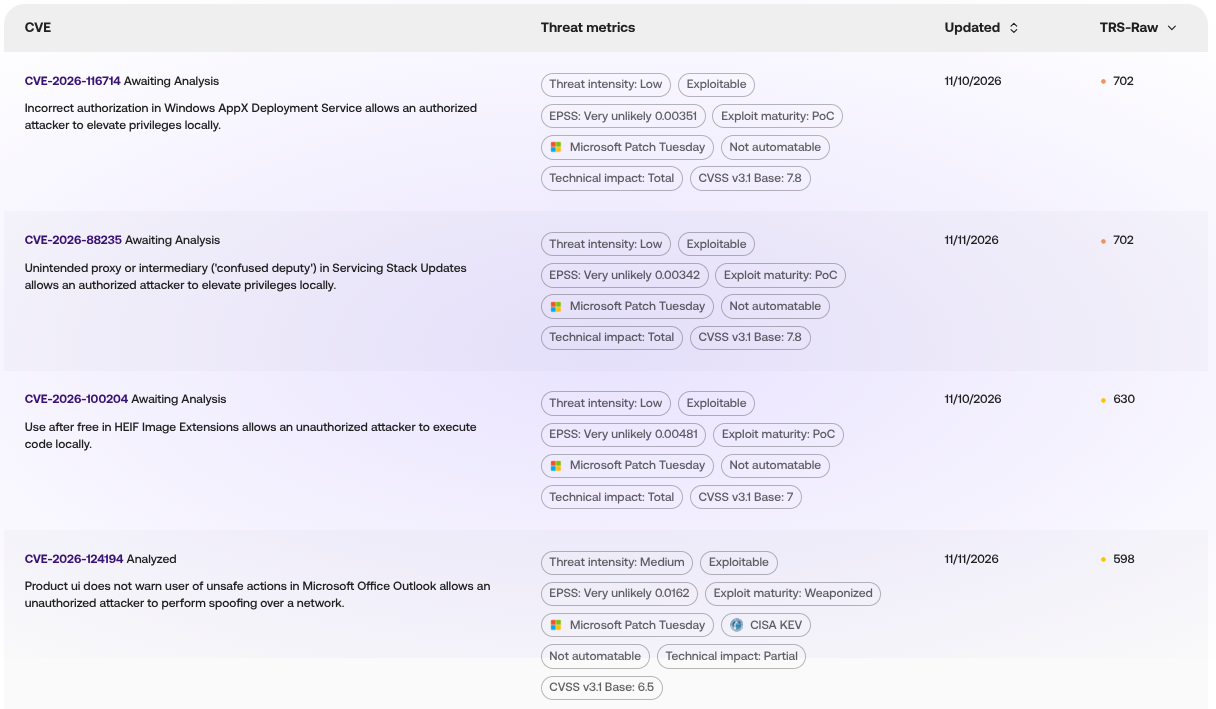
TRS-Raw is a starting point, not a verdict. Once asset context comes in, the order changes per environment: which machines run Outlook, which users hold privileged accounts, which hosts face the internet.
That matters, because November also brought two zero-click criticals rated 9.8: CVE-2026-116928 in Windows Search, reachable through Exchange, and CVE-2026-119958 in Windows LDAP. Childs advises patching Exchange servers and domain controllers first. He is right.
The goal is not to swap CVSS for threat data. It is to let exploitation evidence pull a 6.5 into the first wave.
Patched Windows, vulnerable Outlook
The second trap is delivery. Every affected Office edition is a Click-to-Run product. The fix ships as a new Office build through the Office update channel, not in the Windows cumulative update.

A dashboard that tracks Windows KB compliance can show green while Outlook stays vulnerable. The only reliable check is the Office build on each endpoint: 16.0.17932.21140 or later for Office LTSC 2024, 16.0.14334.21048 or later for Office LTSC 2021, and the build listed for each Microsoft 365 Apps update channel.
Office 2016 and 2019 do not appear in the advisory. They left support in October 2025. That does not make them safe. It means no fix is coming.
What to do now
Most of the work is not the patch itself. It is proving that the patch landed where Outlook actually runs, and limiting what a stolen hash can buy.

Start with the build check: compare each endpoint's Office build with the fixed build for its channel, not with its Windows patch status. Updates apply once Office apps are closed, so long-running Outlook sessions can delay the fix. Then look for the copies your reports miss: paused or deferred channels, VDI and golden images, and Office 2016 or 2019 installs that will never get a fix.
On the identity side, blocking outbound SMB (TCP 445) and moving privileged users into the Protected Users group were Microsoft's mitigations for the 2023 Outlook flaw, and they still apply. SMB signing and LDAP channel binding make relay harder. Microsoft has published no indicators, so hunt for Outlook opening SMB or WebDAV connections to unknown external hosts. If you find a hit, treat the account as exposed: reset its password and review its sign-ins.
None of this pushes the zero-click criticals aside. Exchange servers and domain controllers stay in the same first wave.
What this means for vulnerability operations
November shows the limit of a monthly queue built on severity. The release had more than a thousand entries and one exploited flaw. The two facts that mattered, active exploitation and a fix delivered outside the Windows channel, were invisible in a CVSS-sorted patch report.
Two questions do the real work. Which CVEs are attackers using today? And where does the affected component actually run, down to the build?
The first answer keeps moving after release day. Four CVEs that Microsoft marked unproven now have public proof-of-concept code linked to them. A ranking frozen on Patch Tuesday is stale by Friday.
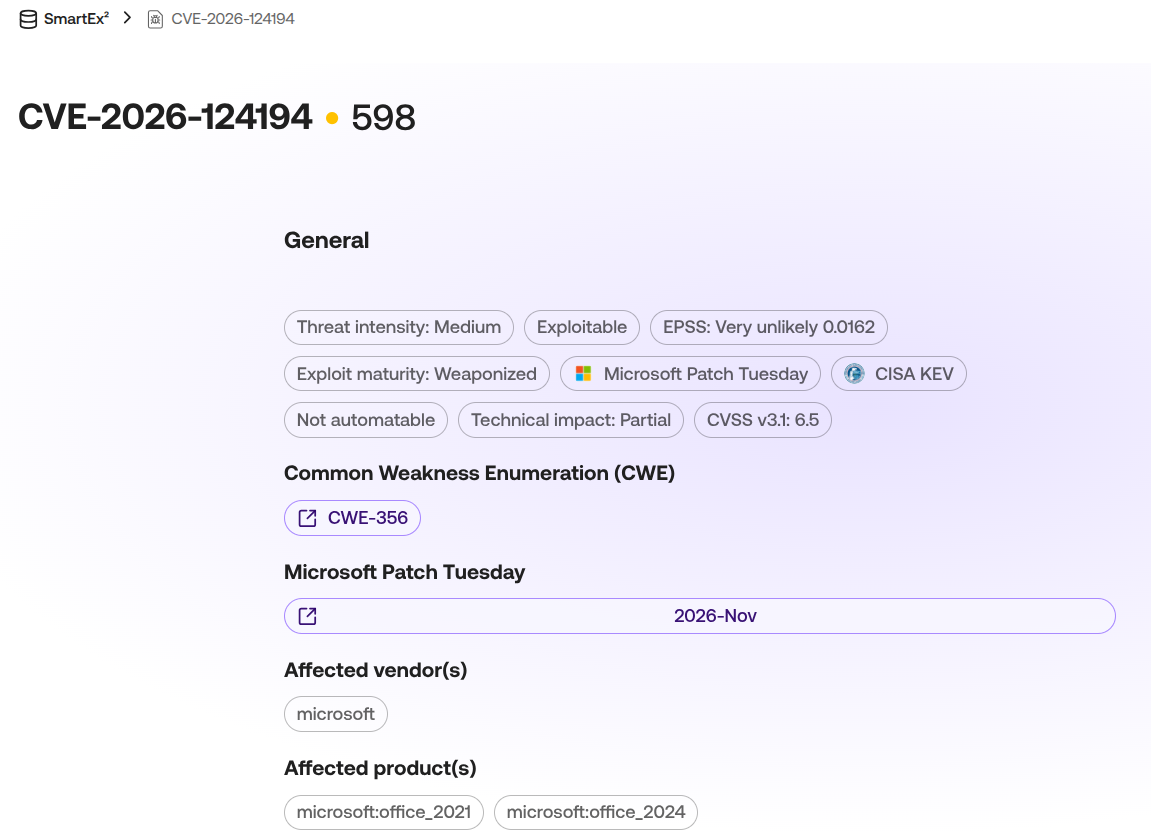
That is how we build Hackuity. In SmartEx², CVE-2026-124194 carried its CISA KEV flag from release day, its first public exploit was referenced the next day, and the whole November release can be filtered and ranked by threat-weighted risk rather than by CVSS.
Probe, our AI agent for exploit validation, takes the next question: can this vulnerability actually be exploited on this asset? Probe is available today in feature preview, with general availability planned for January 2027.
Severity tells you how bad a flaw could be. In November, only threat data told you which one was already in use.
Want to see how Hackuity ranks a thousand-CVE Patch Tuesday by what attackers actually use? Book a demo.
Sources:
- Microsoft, Security Update Guide: CVE-2026-124194 (severity, CVSS vector, FAQ, affected products and fixed builds) and Security Update Guide API (release totals)
- Microsoft, Microsoft 365 Apps security release notes
- CISA, Known Exploited Vulnerabilities catalog
- SecurityWeek, Exploited Outlook Zero-Day Among 1,094 Flaws Patched by Microsoft
- The Register, November Patch Tuesday boasts over 1,000 bugs, one already under attack
- Dark Reading, November Patch Tuesday: An Overflowing Cornucopia of CVEs
- BleepingComputer, Microsoft November 2026 Patch Tuesday fixes 1,235 flaws, Outlook zero-day
- SecurityWeek, Microsoft Makes Second Attempt to Patch Recent Outlook Zero-Day (CVE-2023-23397, 2023)
- Hackuity SmartEx², November 2026 Patch Tuesday view (as of November 19, 2026)



VR-1 | Property |
|---|---|
Model type | Post-trained cyber reasoning model |
Primary specialization | Multi-domain enterprise attack-chain discovery |
Starting condition | A scoped foothold and a concrete objective |
Operating surfaces | Cloud, identity, runtime, code, CI/CD, SaaS, and organizational context |
Success signal | Execution-verified completion of the objective |
Primary evaluation | IntrusionBench |
Preliminary result (preview) | More than 2× black-box pass@3 over the strongest evaluated frontier baseline |
Trajectory budget | Two-hour wall-clock limit per trajectory, or 250 agent turns (whichever comes first) |