


















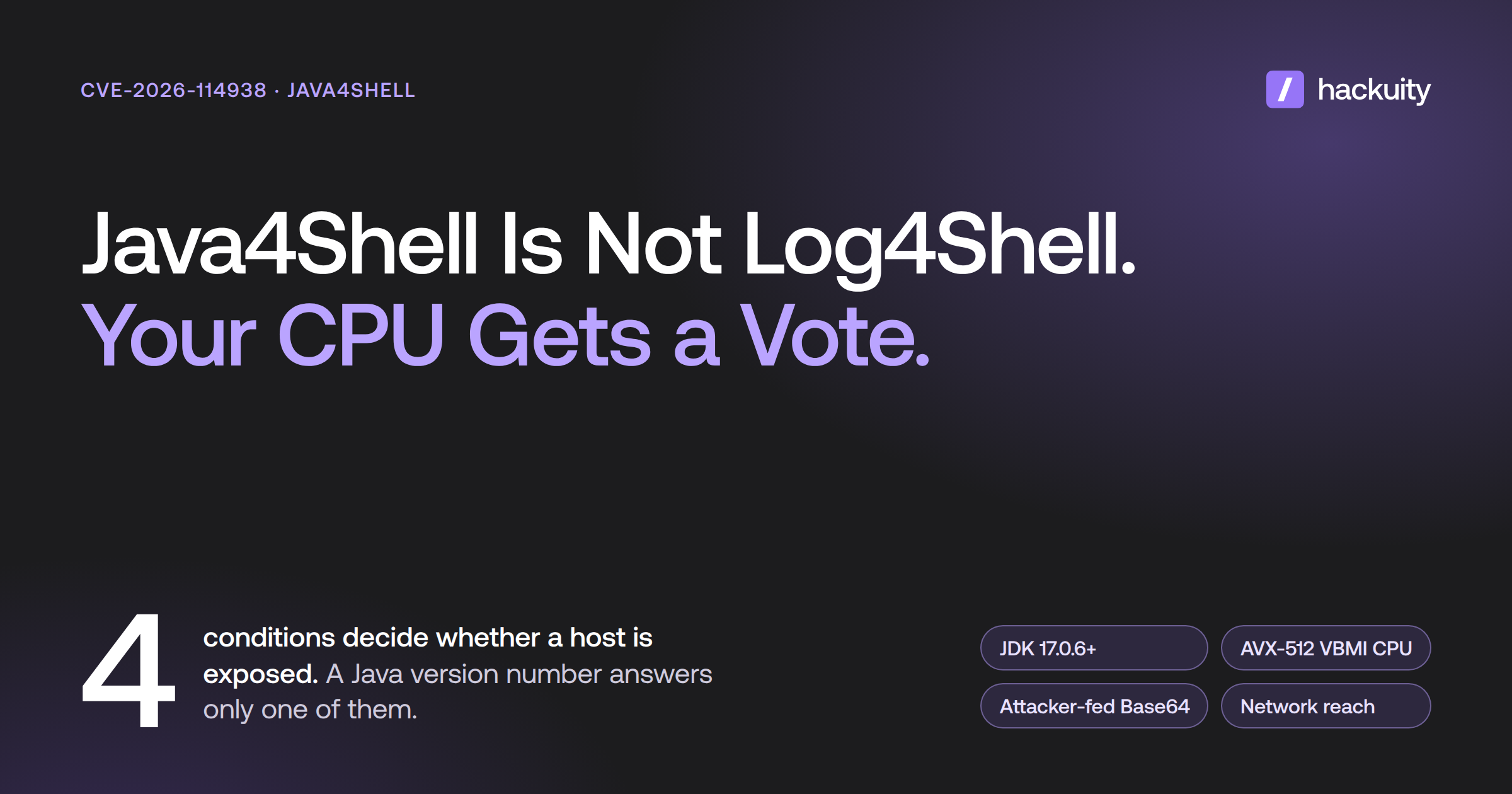
On November 17, Oracle and the OpenJDK project patched CVE-2026-114938, a memory-corruption flaw in Java's Base64 decoder that its finders call Java4Shell. The name invites a Log4Shell playbook. That playbook will send you to the wrong servers, and miss some of the right ones.
On November 17, 2026, Oracle shipped its November patch update and the OpenJDK Vulnerability Group published an advisory for CVE-2026-114938. Fixed builds are 17.0.21.1, 21.0.13.1, 25.0.5.1 and 27.0.1.1. Calif, the firm that reported it, scores it 9.2 under CVSS 4.0. Oracle rates it 8.1 under CVSS 3.1, with high attack complexity.
It is the same team that brought us PHP2Shell a month ago, and the story rhymes. Calif went public saying details had leaked before the fix, and the bug was found with AI: one Calif researcher and a coding agent, about an hour to find it, two more for a first exploit, less than $200 in tokens.
But Java4Shell is not Log4Shell, and treating it like one is the fastest way to waste a week.
What Java4Shell actually is
To decode Base64 faster, the HotSpot JVM swaps the Java code for hand-written assembly that uses AVX-512 VBMI instructions on recent x86-64 processors. That assembly miscomputes the output mask when a short tail ends with padding. The result is a 64-byte write that lands up to 62 bytes past the end of the output buffer. The trigger is almost comically small: 64 "A" characters followed by a single "=".
The attacker controls where the stray bytes land, not what they are. That is enough. Calif enlarges a neighboring array, reads heap memory back ("JavaBleed", in the spirit of Heartbleed), then escalates to code execution.
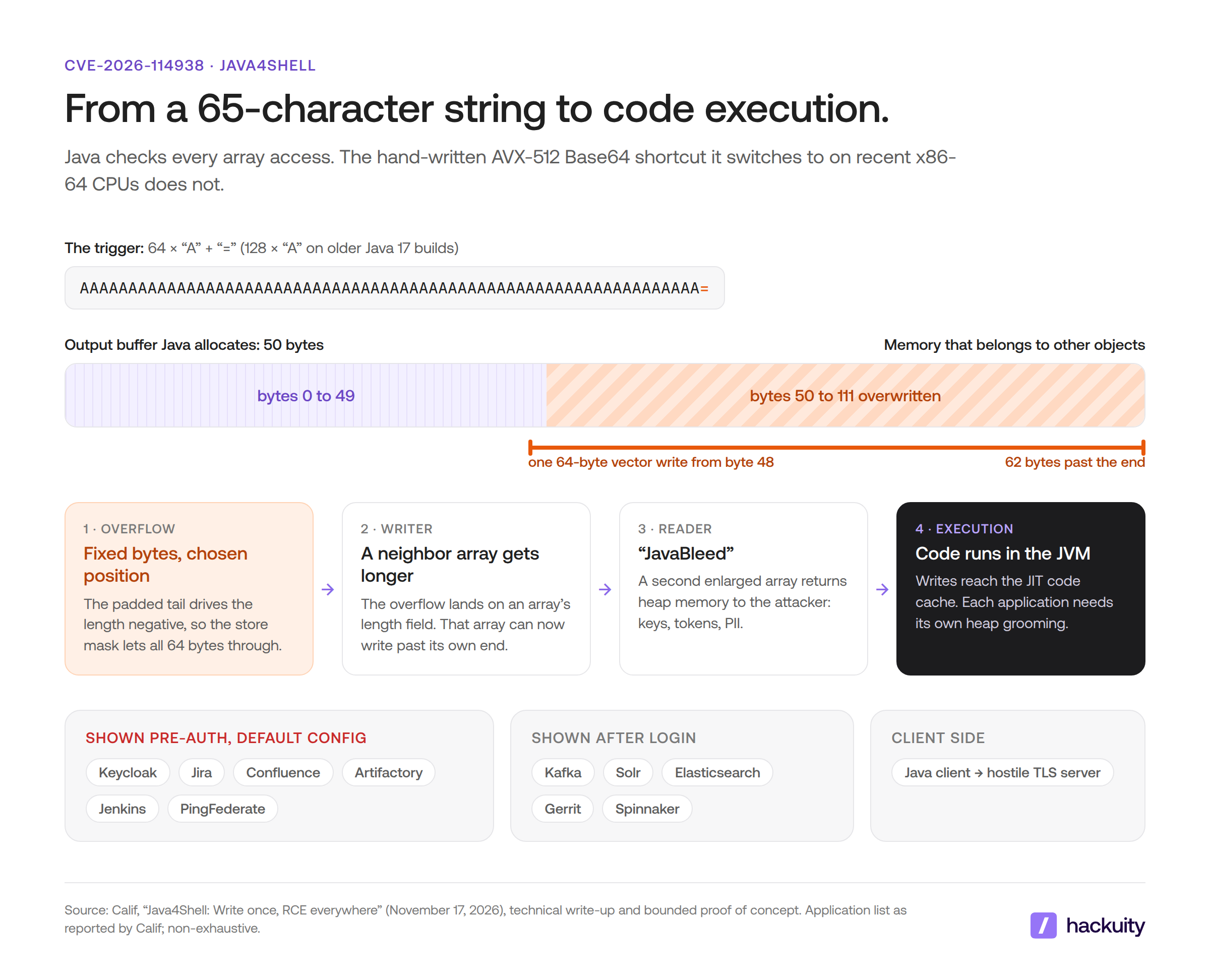
Calif reports remote code execution in the default configuration of six widely deployed applications before login, five more after login, and a client-side variant over TLS.
Four conditions, not one version number
Log4Shell came down to one question: is a vulnerable log4j-core JAR in the application? Java4Shell needs four things to be true on the same host at the same time.
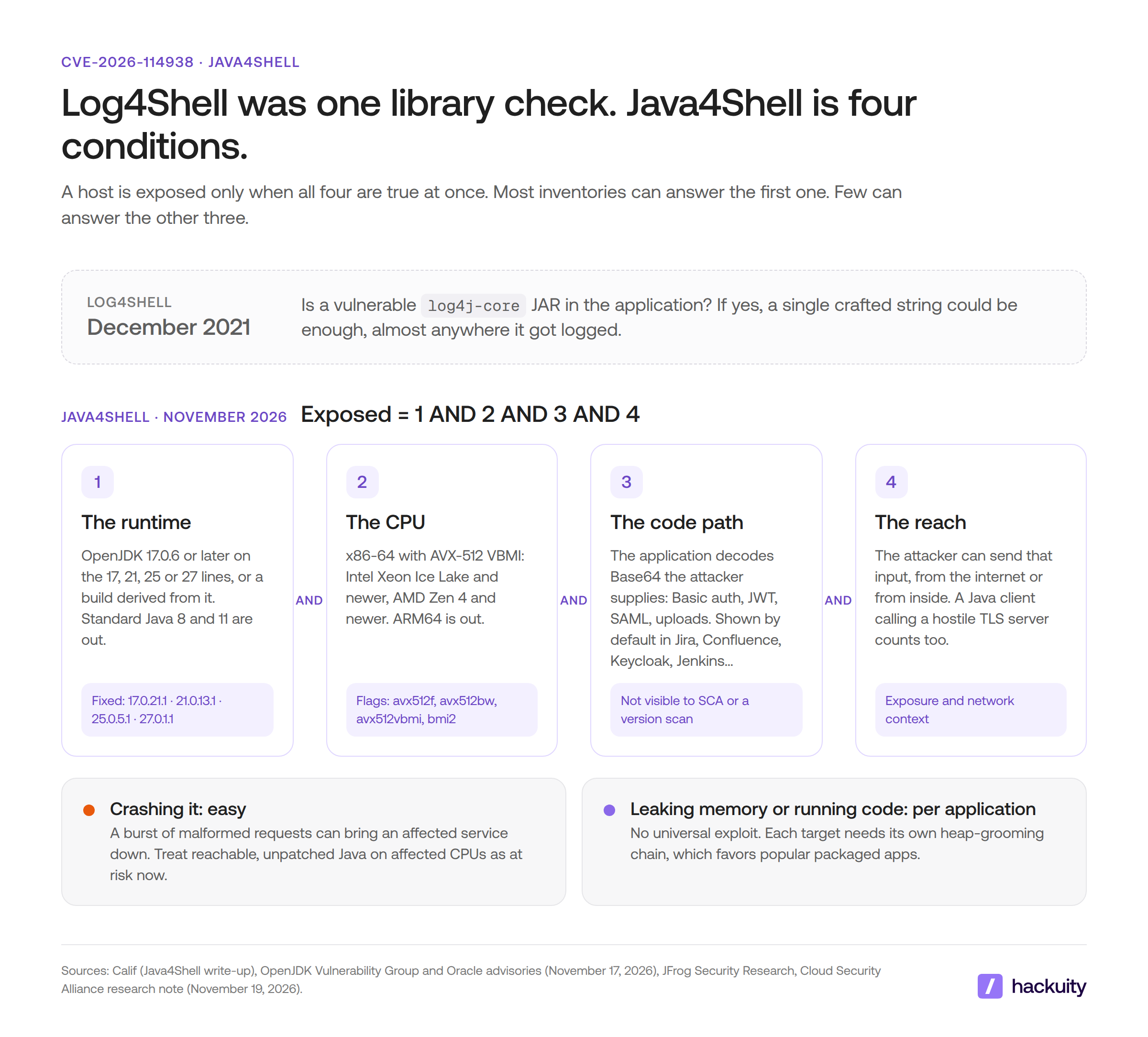
- The runtime. OpenJDK 17.0.6 or later on the 17, 21, 25 or 27 lines, or a distribution built from it. Standard Java 8 and 11 are not affected. Oracle's Java 8 Enterprise Performance Pack is.
- The CPU. x86-64 with AVX-512 VBMI, which means Intel Xeon Ice Lake and newer or AMD Zen 4 and newer. ARM64 is not affected.
- The code path. The application has to decode Base64 that an attacker controls. That sounds narrow until you list what is Base64: HTTP Basic authentication, JSON Web Tokens, SAML artifacts, file uploads.
- The reach. The attacker has to be able to send that input, from the internet or from a foothold inside.
Condition 2 is the one nobody has in their CMDB. As JFrog points out, many cloud instance families do not expose AVX-512, and ARM instances never do. The same container image can be exploitable on one node and safe on the next, depending on where the scheduler puts it.
Condition 3 is the one your tools can't see. The vulnerable code only runs once the JIT compiler has made the decoder hot, on the right hardware. It doesn't appear in a library manifest, so software composition analysis won't flag it.
The JDK you patch isn't the one your vendors ship
Updating the operating system's OpenJDK package does nothing for the runtime inside an application. Jira, Confluence, Keycloak containers and many appliances bring their own Java, fixed on their vendor's schedule.
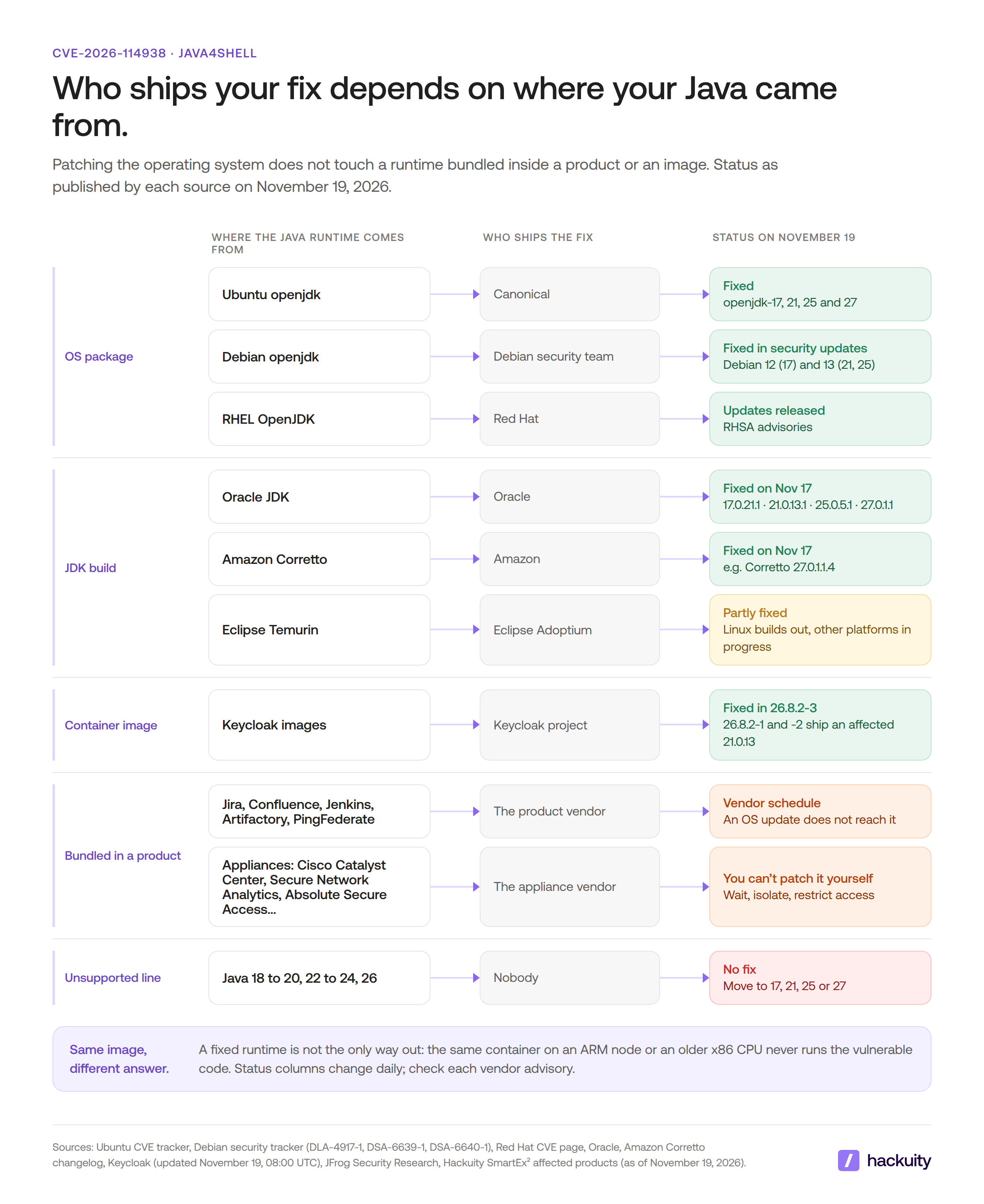
The distributions moved fast: Oracle and Amazon Corretto on November 17, Ubuntu on November 18, Debian security updates for releases 12 and 13 by November 19. Keycloak rebuilt its container images on a fixed runtime. Java 18 to 20, 22 to 24 and 26 get nothing.
The vendor list is the slow part. In SmartEx², affected products include Cisco Catalyst Center, Secure Network Analytics and Smart Software Manager On-Prem, Absolute Secure Access and the Red Hat build of Keycloak. Those are boxes you can't update yourself.
Exploitation will come one application at a time
Java4Shell does not have a one-line exploit. Each target needs its own way to groom the heap, and the remote chains are sensitive to network timing.
"There is no universal payload."
That cuts both ways. Remote code execution is hard, but crashing a service is not. Blackpoint Cyber took down a test Spring Boot application with about 28,300 malformed login requests in roughly 20 seconds, according to the Cloud Security Alliance. Any reachable, unpatched Java service on affected hardware is a denial-of-service target today.
And the hard part is getting easier. VulnCheck and a researcher at Immersive report working, application-specific exploits. Calif is holding back its own product chains for now. The Cloud Security Alliance expects weaponized exploits for the most common targets to surface, publicly or in criminal circles.
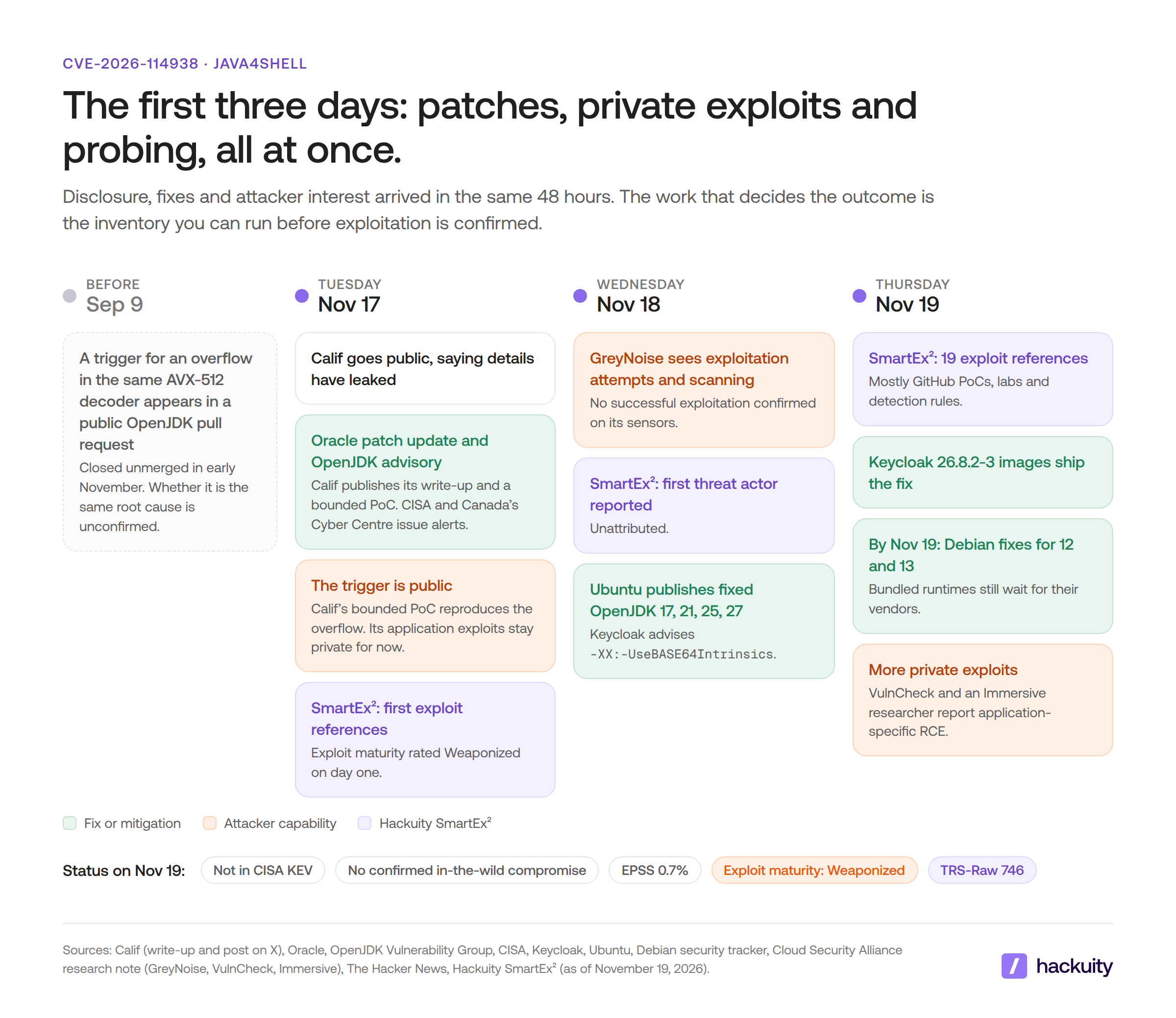
There is one more uncomfortable detail. A trigger for an overflow in the same decoder sat in a public OpenJDK pull request from September 9 until it was closed unmerged in early November. Whether it is the same root cause has not been established.
As of November 18, GreyNoise had seen exploitation attempts and scanning, but no successful exploitation on its sensors. CVE-2026-114938 is not in CISA's KEV catalog. That's the window. It won't stay open.
What to do now
Triage per host, not per application. Four questions decide whether a server is exposed, and the answer decides how fast you move.
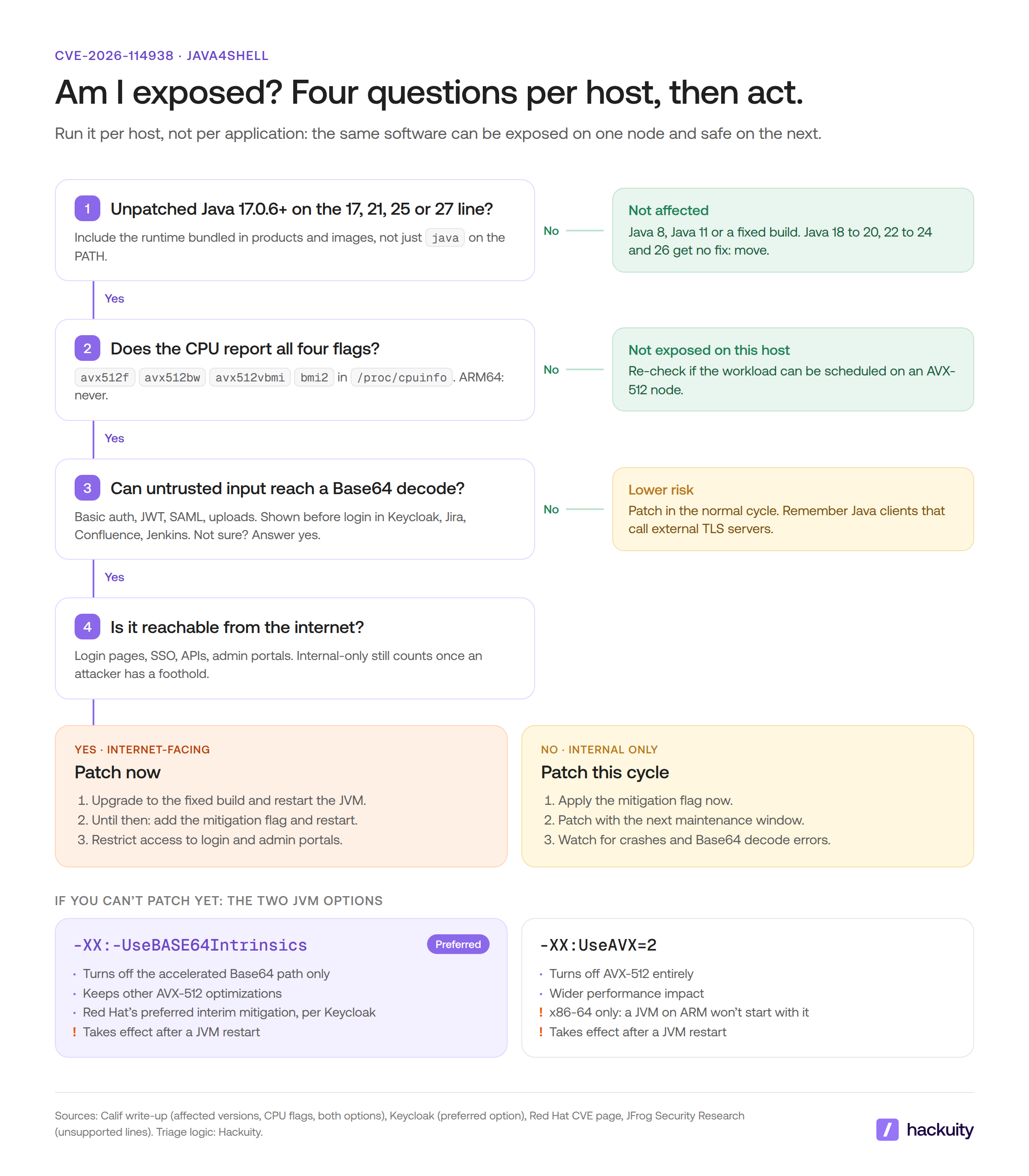
- Find every Java runtime, not just the OS packages. Include container images, vendor products and appliances that bundle their own JRE.
- Check the hardware. Keep only hosts whose CPU reports
avx512f,avx512bw,avx512vbmiandbmi2. ARM hosts and older x86 generations drop out. - Patch the LTS lines to 17.0.21.1, 21.0.13.1, 25.0.5.1 or 27.0.1.1, or your distribution's equivalent, and restart every JVM. Move anything on an unsupported line.
- Start with internet-facing packaged applications: Keycloak, Jira, Confluence, Jenkins, Artifactory, PingFederate. Restrict access to their admin and login portals until they are fixed.
If you can't patch yet, Calif documents two JVM startup options. Keycloak calls -XX:-UseBASE64Intrinsics Red Hat's preferred interim mitigation, because it keeps the other AVX-512 optimizations. -XX:UseAVX=2 works too, but only on x86-64: a JVM on ARM won't start with it.
For detection, watch for Base64 tokens of 32 characters or more that end in "=" and whose length is not a multiple of four, especially in Authorization headers. Also watch for bursts of IllegalArgumentException from java.util.Base64$Decoder, and for unexplained hs_err_pid crash files or restart loops. None of them proves a compromise. Their absence proves nothing.
What this means for vulnerability operations
Java4Shell is a test of whether your program can answer questions about assets, not about CVEs.
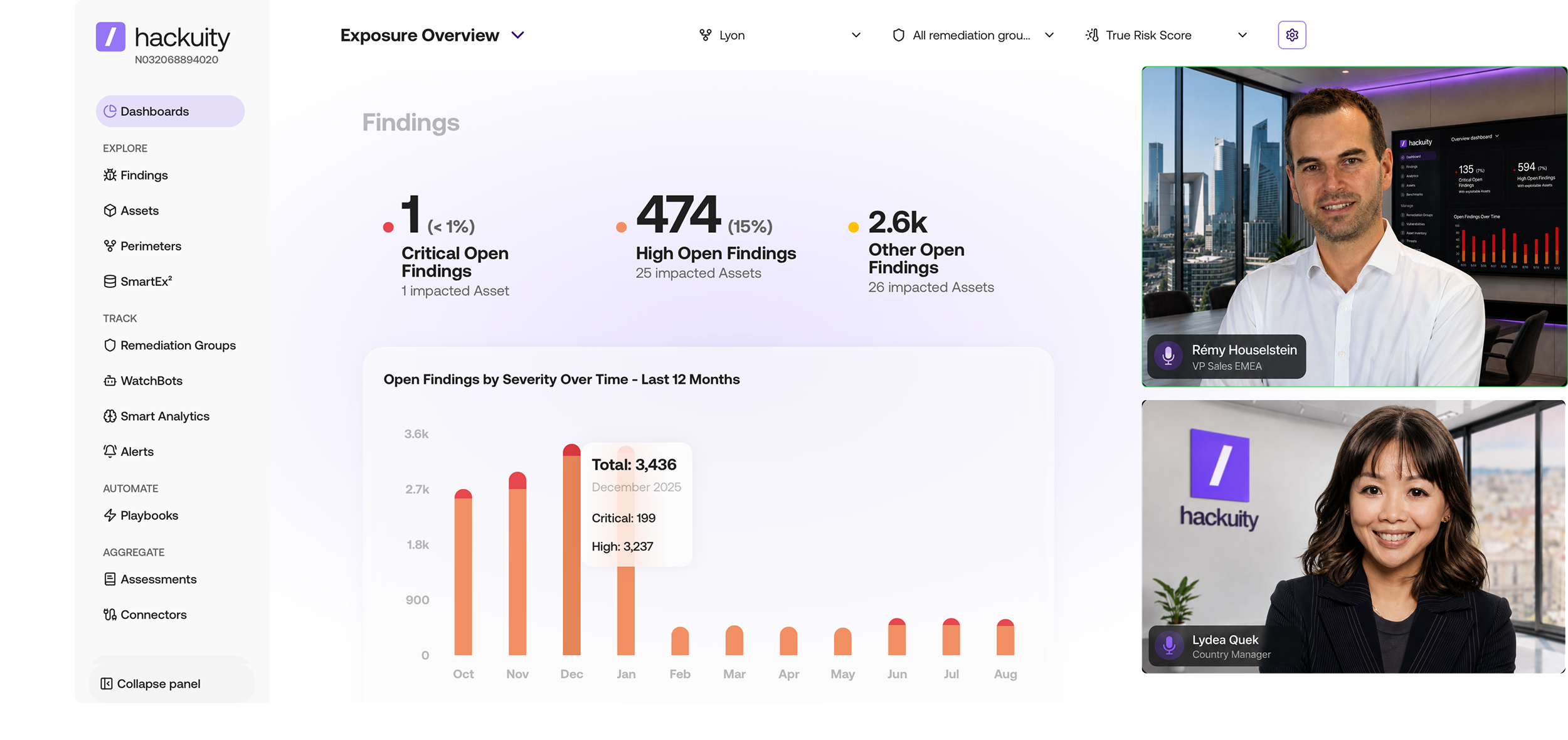
The scores don't agree, and they don't settle anything. CVSS says 8.1 or 9.2 depending on who you ask. EPSS put the probability of exploitation at 0.7% on November 19. Meanwhile, SmartEx², our Smart Exposure Explorer, rated exploit maturity as Weaponized from day one, logged a first threat actor report on November 18, and listed 19 exploit references by November 19.
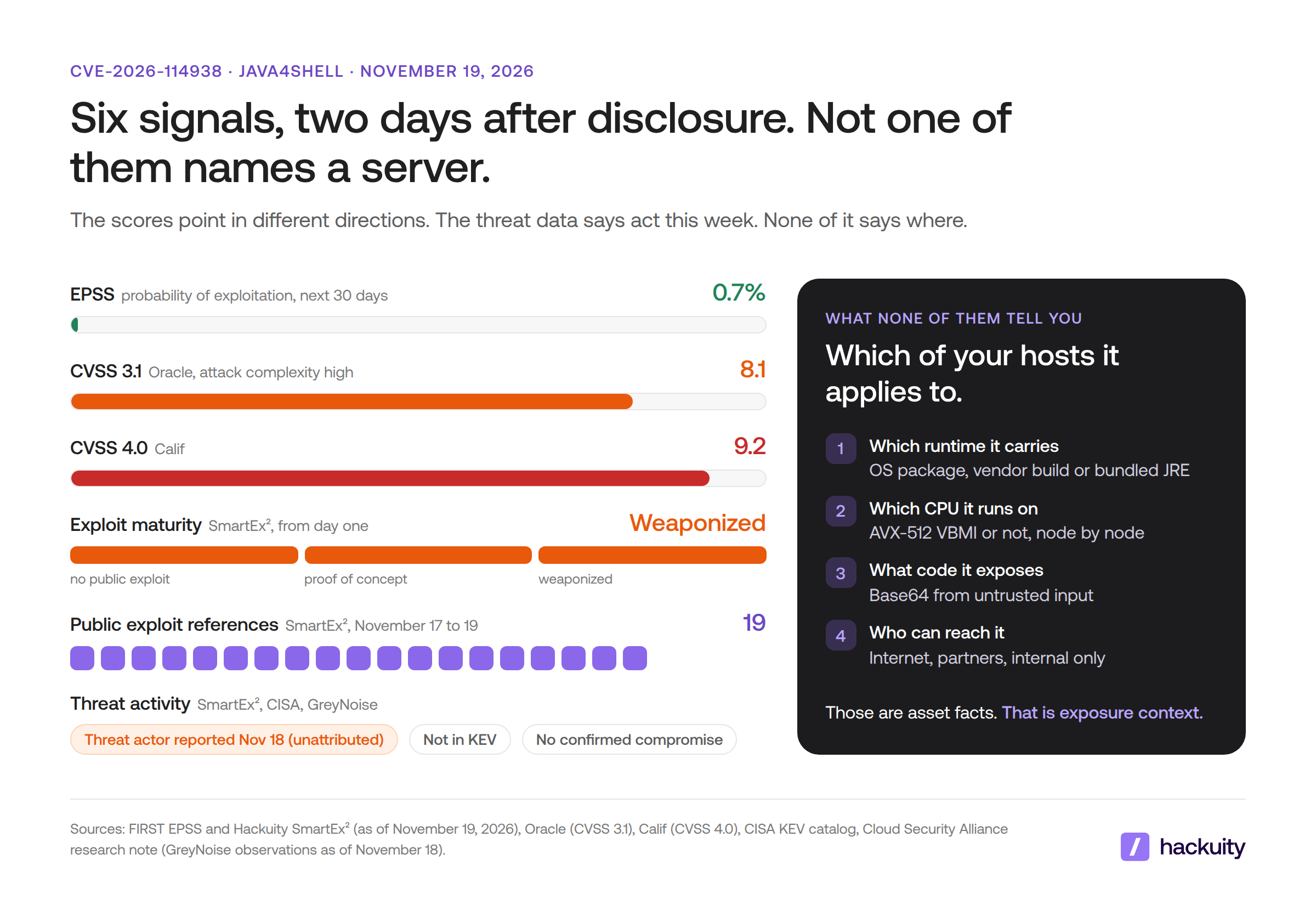
Those signals say the CVE deserves attention this week. They can't say which of your servers it applies to. That depends on the four conditions above, and every one of them is a fact about an asset: which runtime it carries, which CPU it runs on, what code it exposes, and who can reach it.
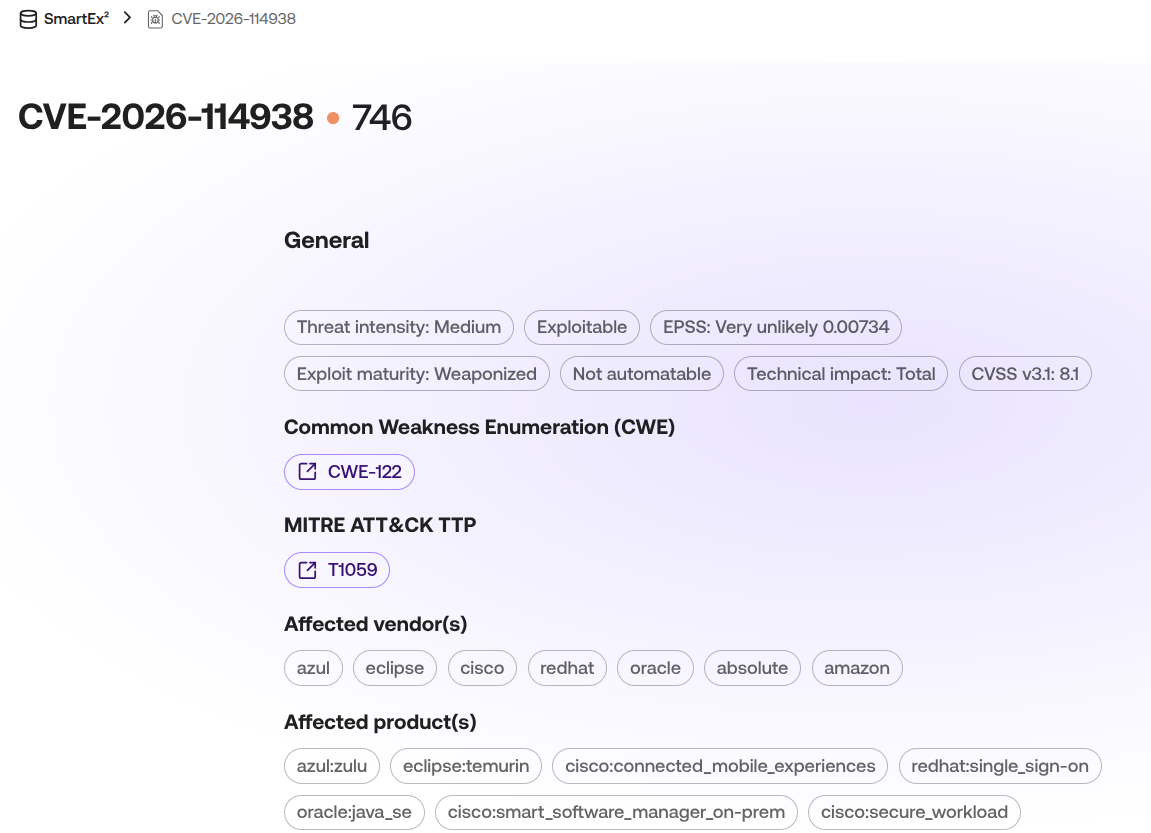
CVE-2026-114938 in Hackuity SmartEx²: TRS-Raw 746, exploit maturity Weaponized, EPSS 0.7%
That's why we build Hackuity around exposure context first. SmartEx² brings the vulnerability and exploit intelligence, including the vendor products that bundle an affected runtime. Answering "can this actually be exploited on this server?" is the job of Probe, our AI agent for exploit validation, available today in feature preview with general availability planned for January 2027.
A version number tells you where Java4Shell could be. Only context tells you where it is.
Want to see how Hackuity turns the first signal into a short list of servers that matter? Book a demo.
Sources:
- Calif, Java4Shell: Write once, RCE everywhere and post on X (November 17)
- Oracle, Critical Security Patch Update, November 2026
- OpenJDK Vulnerability Group, advisory of November 17, 2026
- CISA, Critical Java Vulnerability Requires Immediate Patching
- Ubuntu, CVE-2026-114938
- Debian, security tracker: CVE-2026-114938
- Red Hat, CVE-2026-114938
- Amazon Corretto, Corretto 27.0.1.1.4 changelog
- JFrog Security Research, Java4Shell: What We Know About the Critical OpenJDK RCE Vulnerability
- Keycloak, Java4Shell: What Keycloak admins need to do
- Cloud Security Alliance, Research note: Java4Shell
- The Hacker News, Java4Shell Flaw Enables Pre-Auth RCE in Jira, Jenkins, Keycloak and More
- Hackuity SmartEx², CVE-2026-114938 (as of November 19, 2026)



VR-1 | Property |
|---|---|
Model type | Post-trained cyber reasoning model |
Primary specialization | Multi-domain enterprise attack-chain discovery |
Starting condition | A scoped foothold and a concrete objective |
Operating surfaces | Cloud, identity, runtime, code, CI/CD, SaaS, and organizational context |
Success signal | Execution-verified completion of the objective |
Primary evaluation | IntrusionBench |
Preliminary result (preview) | More than 2× black-box pass@3 over the strongest evaluated frontier baseline |
Trajectory budget | Two-hour wall-clock limit per trajectory, or 250 agent turns (whichever comes first) |