



















On November 18, 2026, CISA added CVE-2026-90436 to its Known Exploited Vulnerabilities catalog. The flaw lives in Apache Axis 1.x, a SOAP library that reached end of life years ago and will never get a fixed release. Attackers found it first inside Confluence Data Center and N-able N-central.
On November 6, the Apache Software Foundation disclosed a critical flaw in Axis 1.x, rated 9.8 under CVSS 3.1 by CISA and 9.3 under CVSS 4.0 by Atlassian. The advisory carried an unusual label: "unsupported when assigned." There is a patch on GitHub. There is no release, and there won't be one.
A week later, a managed detection team watched attackers exploit it on a Confluence server. N-able reported attacks on N-central the same day.
Few vulnerability teams had "Apache Axis" in their inventory. That is the real story.
What CVE-2026-90436 actually is
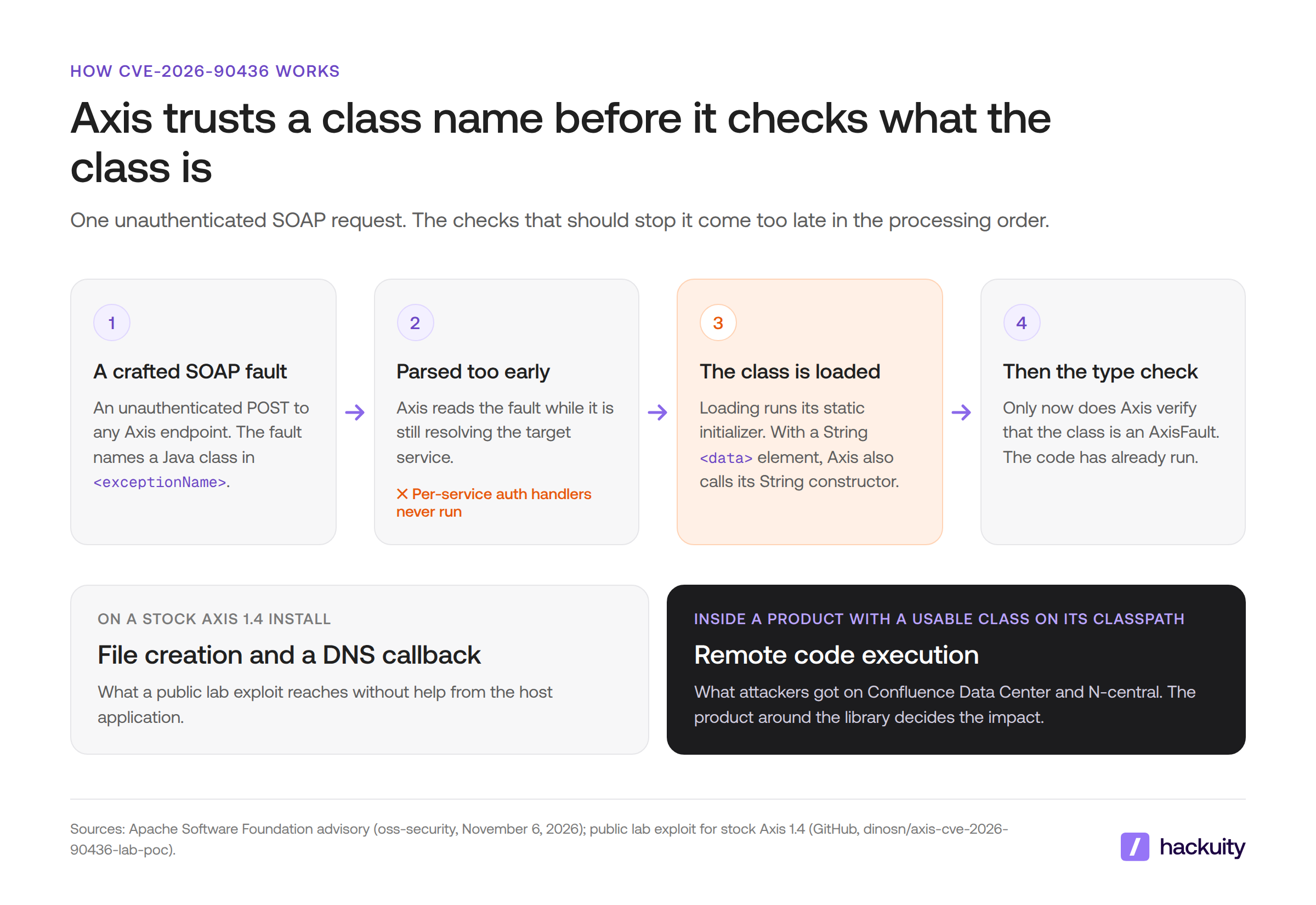
Axis 1.x is a Java engine for SOAP web services. When it receives a SOAP fault that names an exception class, it loads that class, and can instantiate it, before checking that it really is an Axis fault. Loading a class runs its static initializer. With a suitable class on the application's classpath, that becomes remote code execution.
Two details make it worse:
- No authentication stands in the way. Axis parses the fault while it is still resolving the target service, before any per-service handler runs. Authentication handlers configured on a service don't help.
- Every version is affected. All releases through 1.4, the last one, carry the bug.
On a bare Axis install, the impact is narrower. A public lab exploit against stock Axis 1.4 reaches file creation and a DNS callback, and needs a gadget class from the host application for full code execution. In other words, the danger depends on the product wrapped around the library.
Apache's guidance is short: migrate to another SOAP engine such as Axis2, or use a build with the patch applied. The project:
"does not expect to create an Axis 1.x release fixing this problem."
The vulnerable code isn't in the product you patch
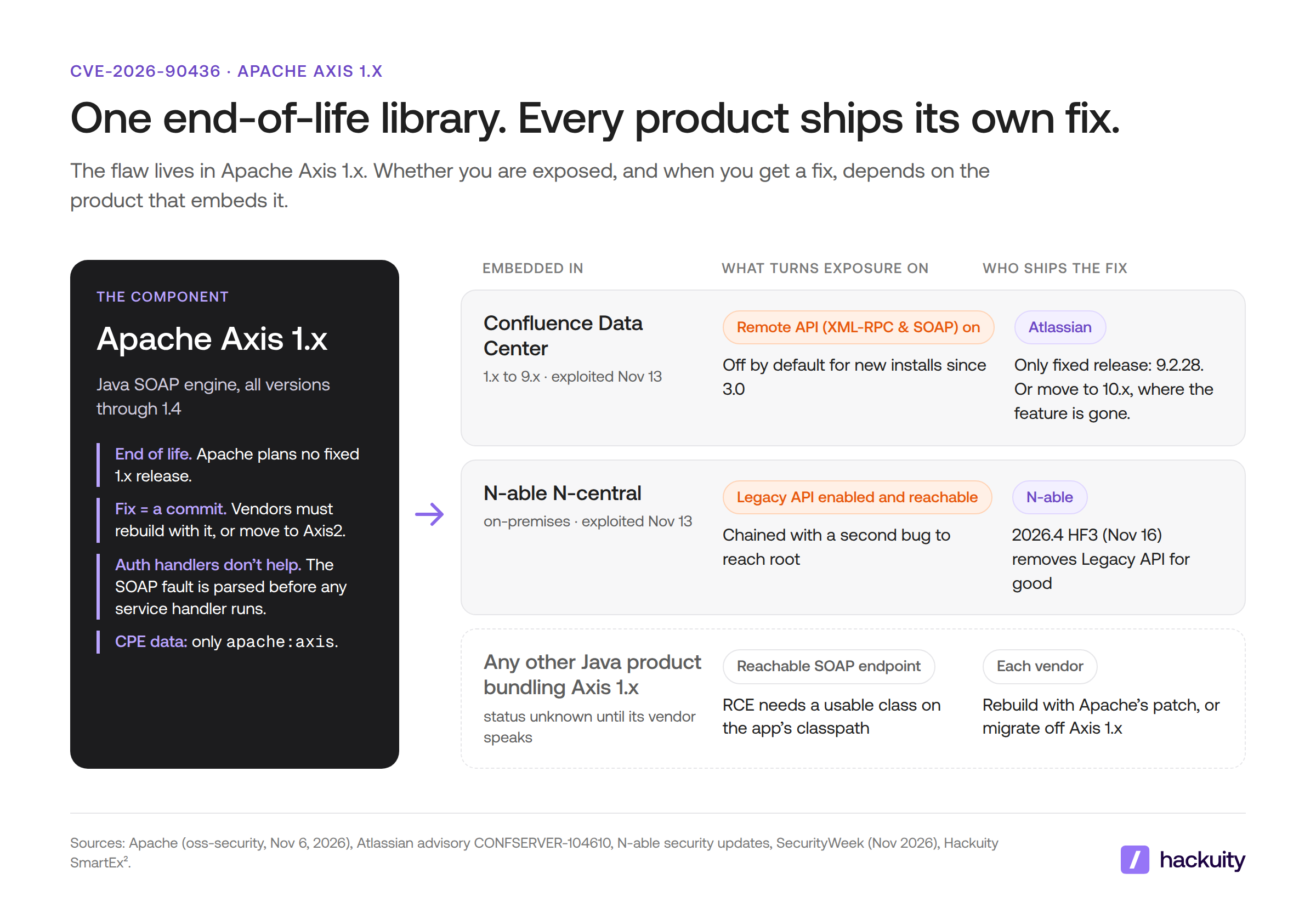
Confluence Data Center uses Axis for its XML-RPC and SOAP remote API. N-central exposed it through its Legacy API. Neither product name appears in the CVE record, and its CPE data lists only apache:axis.
That creates three problems for a vulnerability program.
- Most scanners match products, not the libraries inside them. Confluence gets flagged because Atlassian published an advisory under the same CVE ID. Any other product carrying an Axis 1.x JAR stays invisible until its vendor speaks.
- The fix depends on someone else's release train. Apache ships a commit. Atlassian ships one fixed version, 9.2.28, and points everyone else to 10.x, which removed the feature. N-able removed its Legacy API.
- One checkbox decides exposure. Two Confluence servers on the same version can carry opposite risk. Version data alone can't tell them apart.
Log4Shell taught the industry to look inside Java applications in 2021. But Log4j was still maintained, and fixed releases shipped within days. Axis 1.x has no maintainer to ship anything. The patch exists as a commit, and every vendor has to pick it up, test it and release it on its own schedule.
Twelve days from disclosure to the KEV catalog
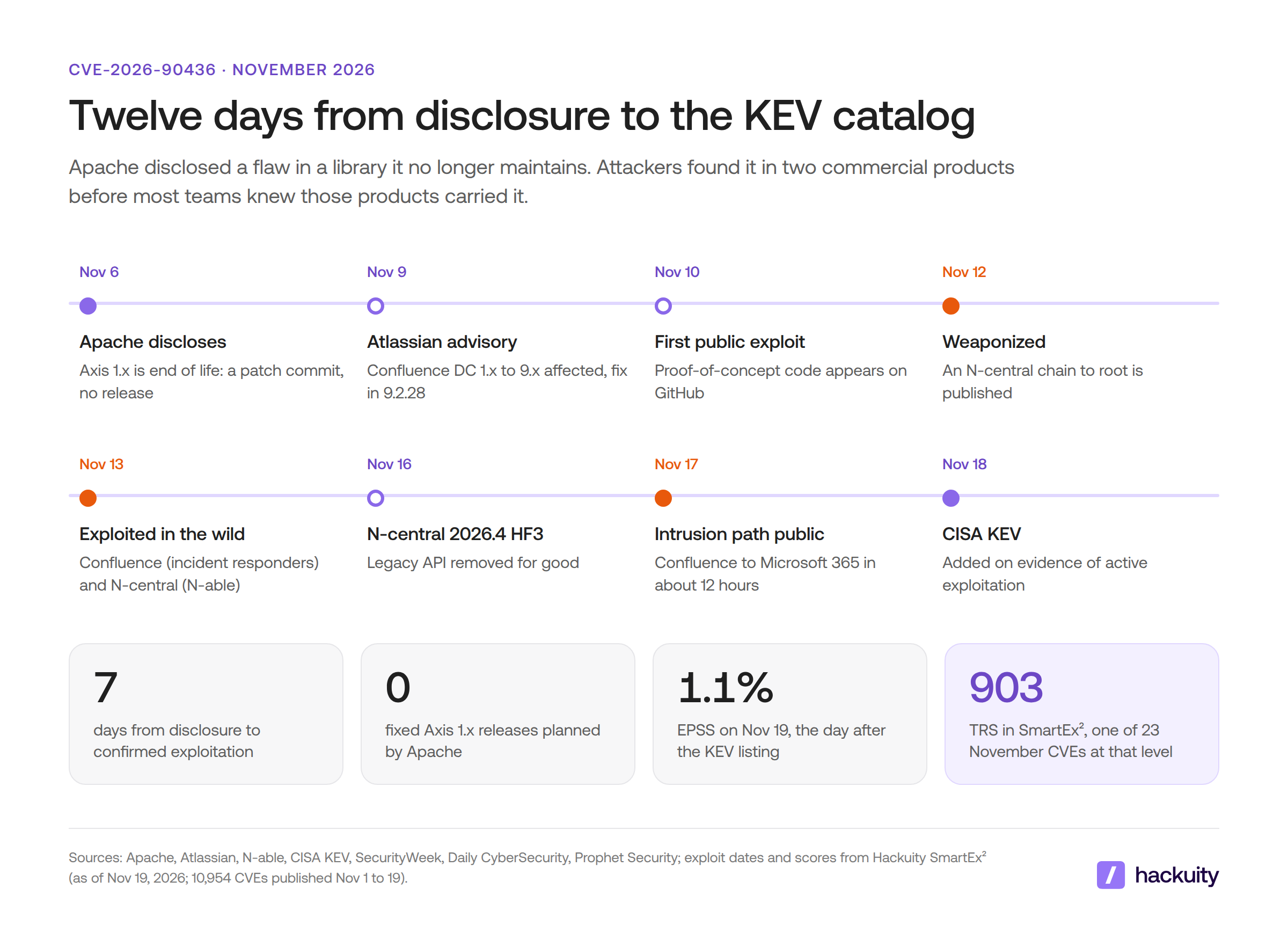
Atlassian published its advisory on November 9. Public proof-of-concept code appeared on November 10, and a weaponized exploit on November 12. That same day, a researcher released an N-central exploit chain as part of a series of zero-day disclosures against the product. Press reports call it 4EverAble2Shell: the Axis flaw for code execution, a second N-central bug for root.
On November 13, exploitation was confirmed on both fronts. Incident responders caught it on a Confluence server. N-able published indicators of compromise for N-central the same day without naming a CVE, and responders tied that activity to the Axis flaw. On November 16, N-able shipped N-central 2026.4 HF3, which removes the Legacy API for good. The full Confluence intrusion path went public on November 17, and CISA added the CVE to KEV on November 18.
One number barely moved. On November 19, the day after the KEV listing, the EPSS score was still 1.1%. Probability models learn from observed activity, and observed activity trails the first signal.
An HTTP 500 that wasn't a failure
The account of one Confluence intrusion, published by the responders and relayed by threat intelligence outlets, shows what "unauthenticated RCE" means in practice.
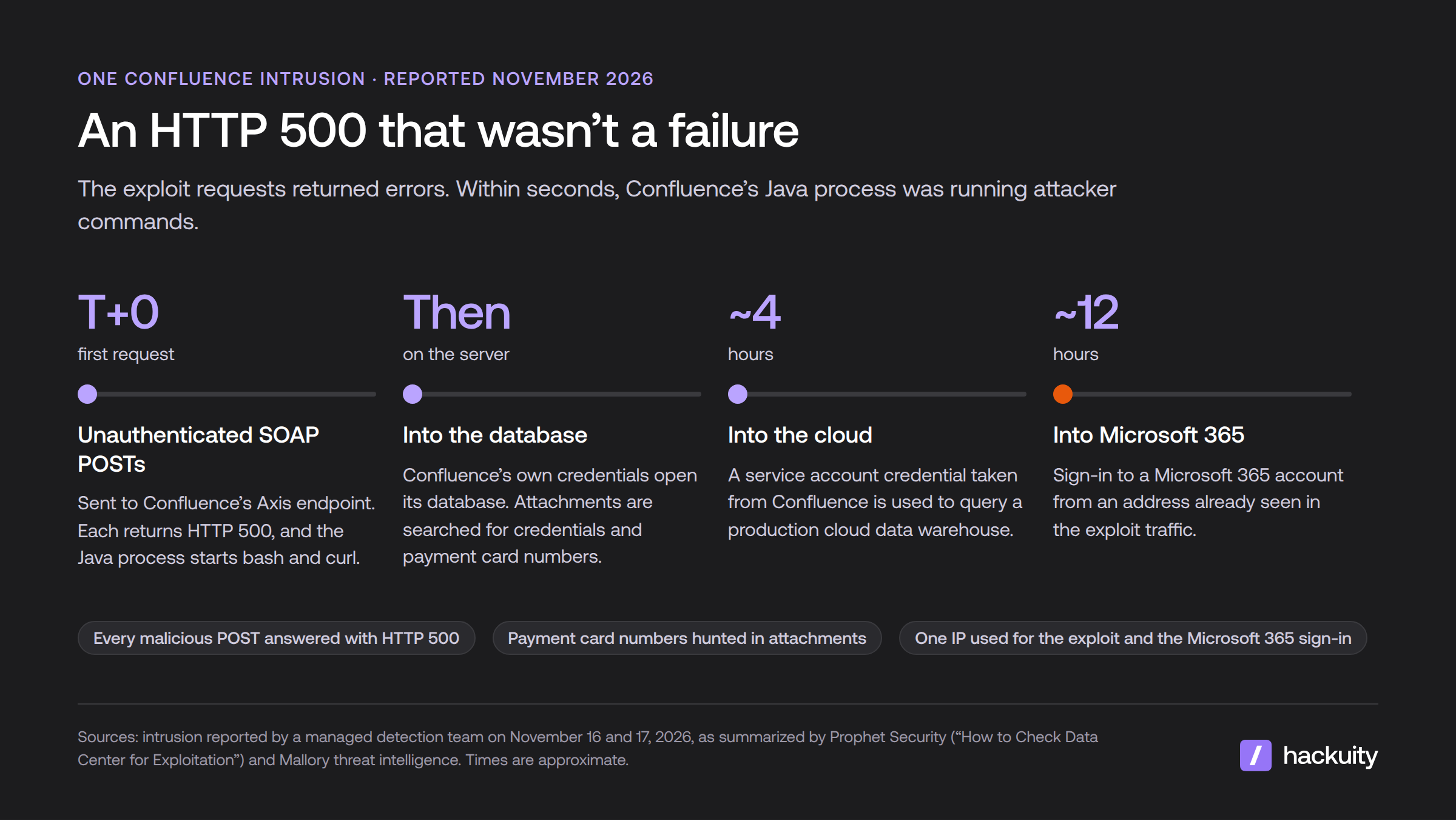
The exploit requests hit Confluence's Axis endpoint, and each returned HTTP 500. Within seconds, the Confluence Java process launched bash and curl. The attacker then opened the Confluence database with the application's own credentials and searched attachments for credentials and payment card numbers. Around four hours in, a service account credential taken from Confluence was querying a production cloud data warehouse. Around twelve hours in, the attacker signed in to Microsoft 365 from an address already seen in the exploit traffic.
The lesson is simple. A wiki is a credential store with a search bar, and the blast radius of a Confluence RCE is everything its pages and attachments can unlock.
What to do now
Start with the question version data can't answer: is the vulnerable feature switched on?
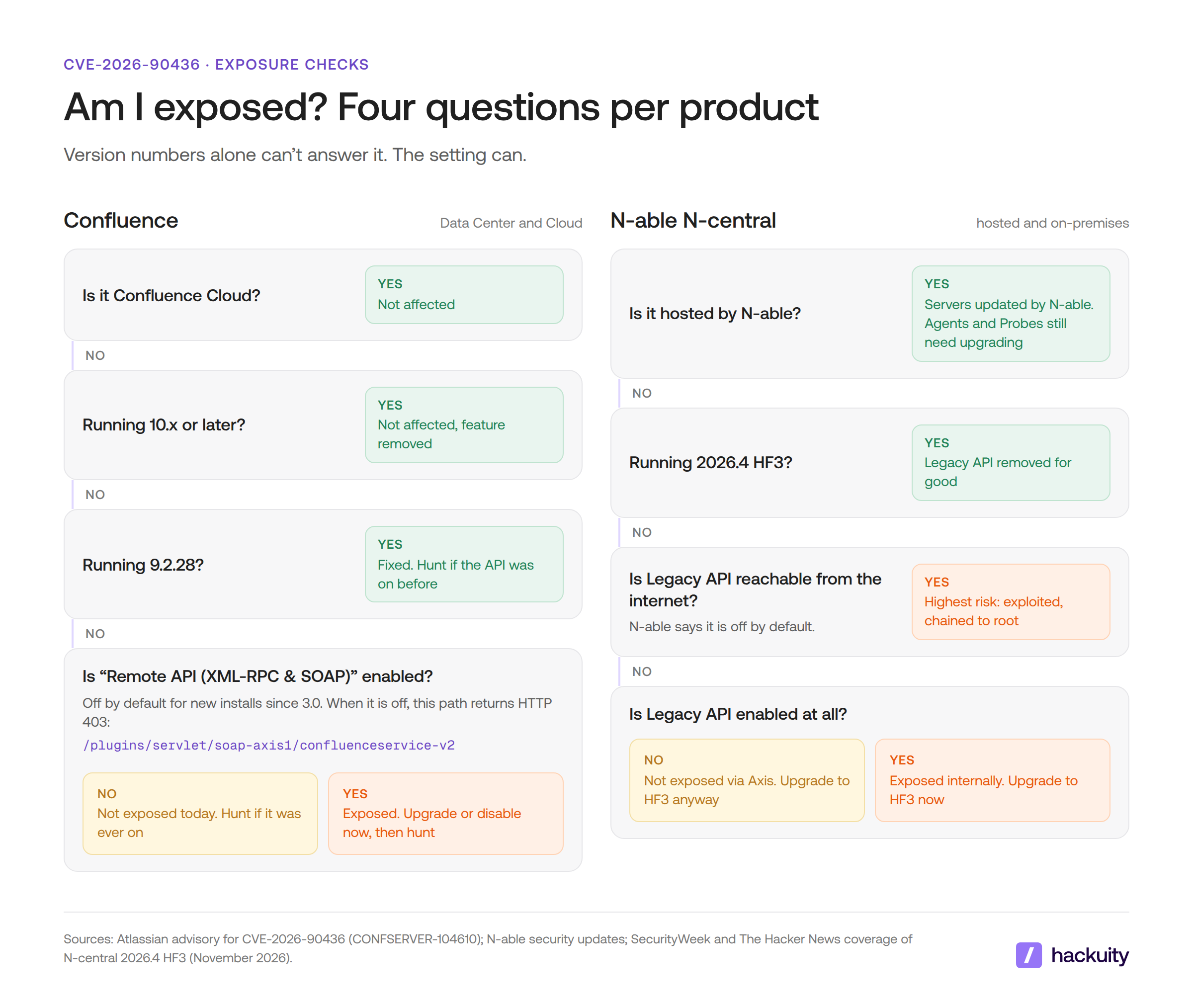
Then work through five moves, in this order.
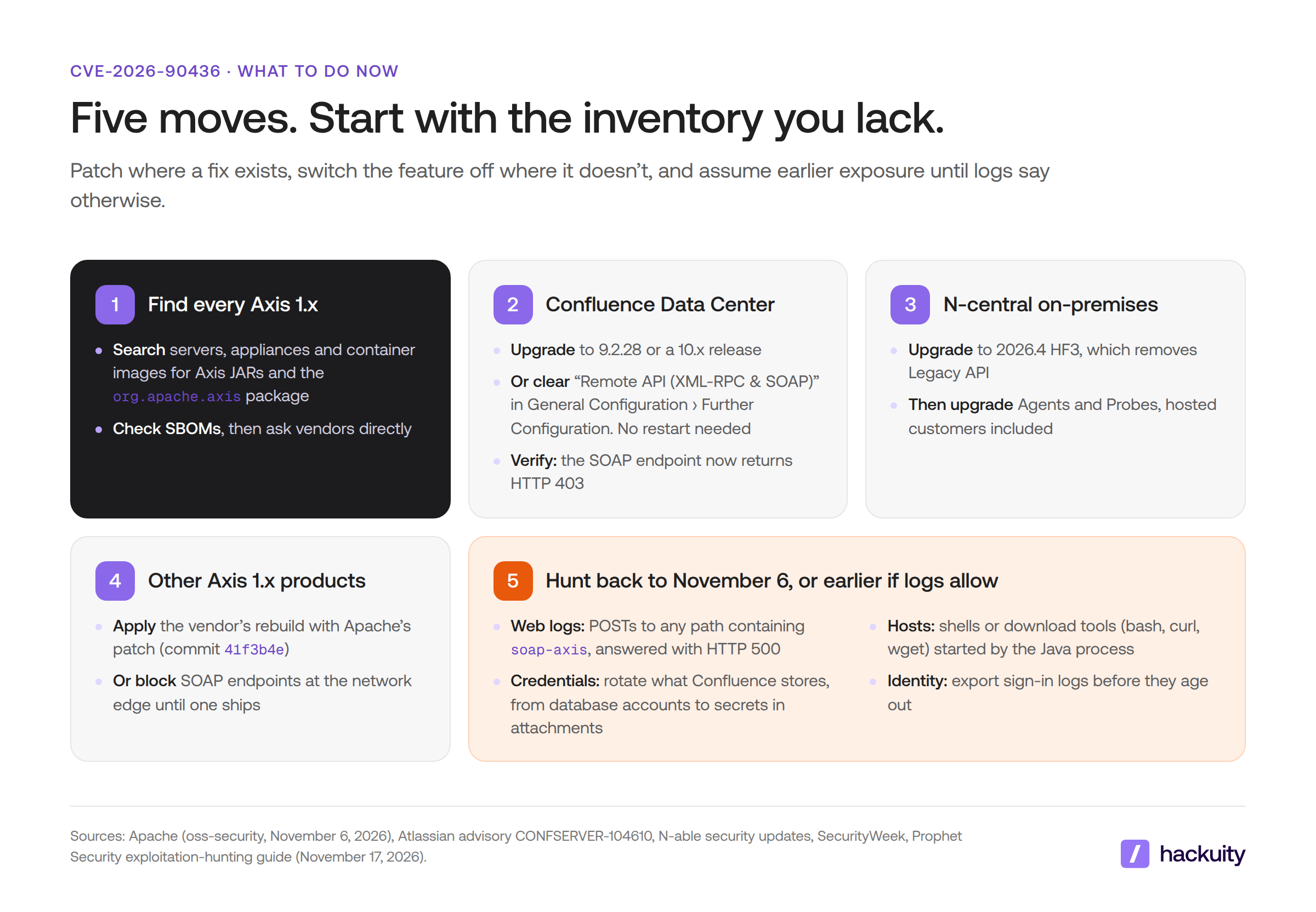
- Find every Axis 1.x, not just Confluence. Search servers, appliances and container images for Axis JARs or the
org.apache.axispackage, check your SBOMs, and ask vendors directly. - Patch Confluence or switch off its remote API. Move to 9.2.28 or a 10.x release, or clear "Remote API (XML-RPC & SOAP)" in General Configuration. No restart is needed, but scripts and add-ons that rely on the API may stop working.
- Upgrade on-premises N-central to 2026.4 HF3, then upgrade Agents and Probes.
- Fence off SOAP endpoints elsewhere until a vendor rebuild with Apache's patch ships.
- Hunt back to November 6. Look for POSTs to Axis endpoints answered with HTTP 500, followed by shells spawned by the Java process, and rotate the credentials Confluence stores.
What this means for vulnerability operations
CVE-2026-90436 is a mapping problem before it is a patching problem.
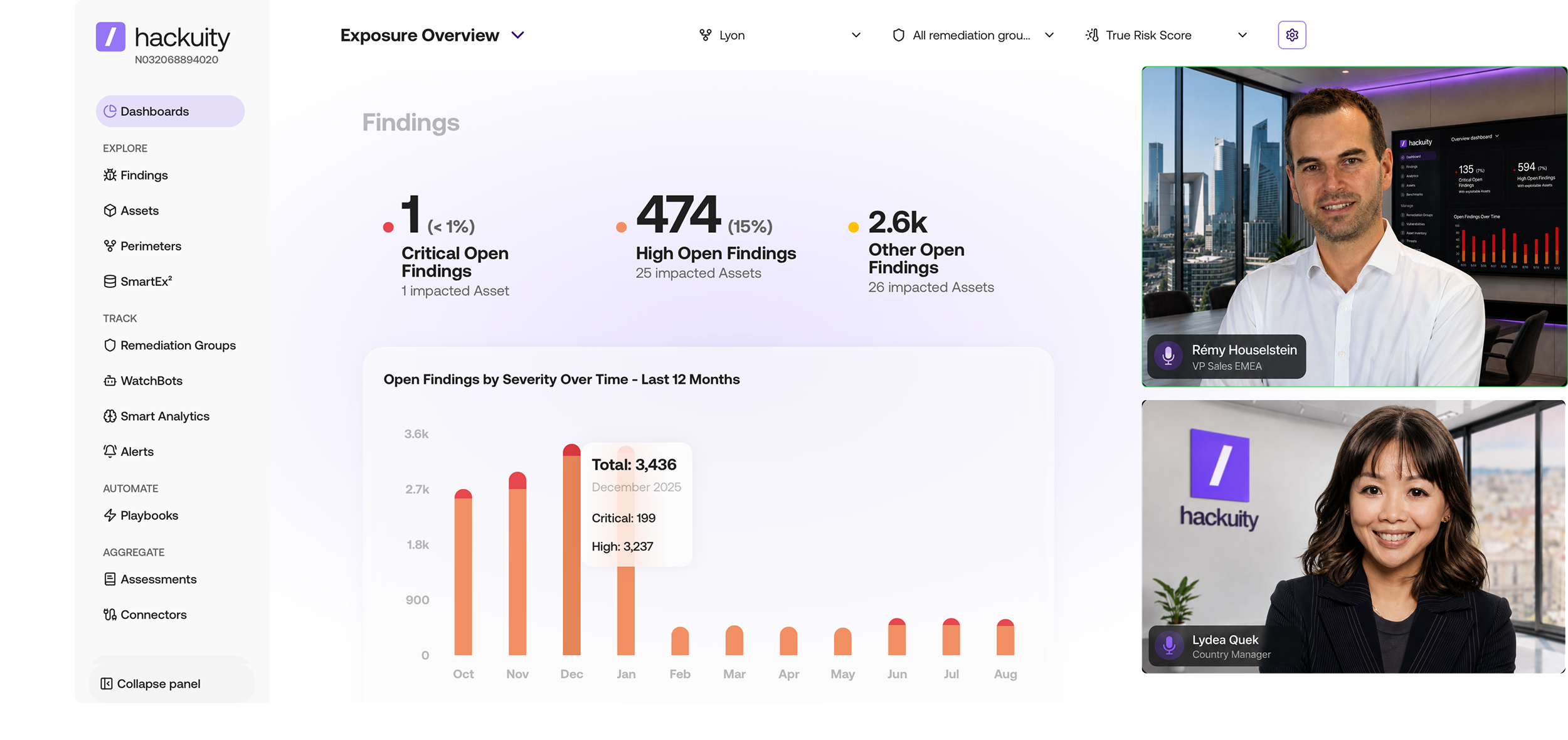
The threat intelligence was clear early. In SmartEx², our Smart Exposure Explorer, the CVE scores 903 on Hackuity's True Risk Score, one of only 23 CVEs published since November 1 to reach that level. It is flagged as in KEV, automatable, and backed by a weaponized exploit.
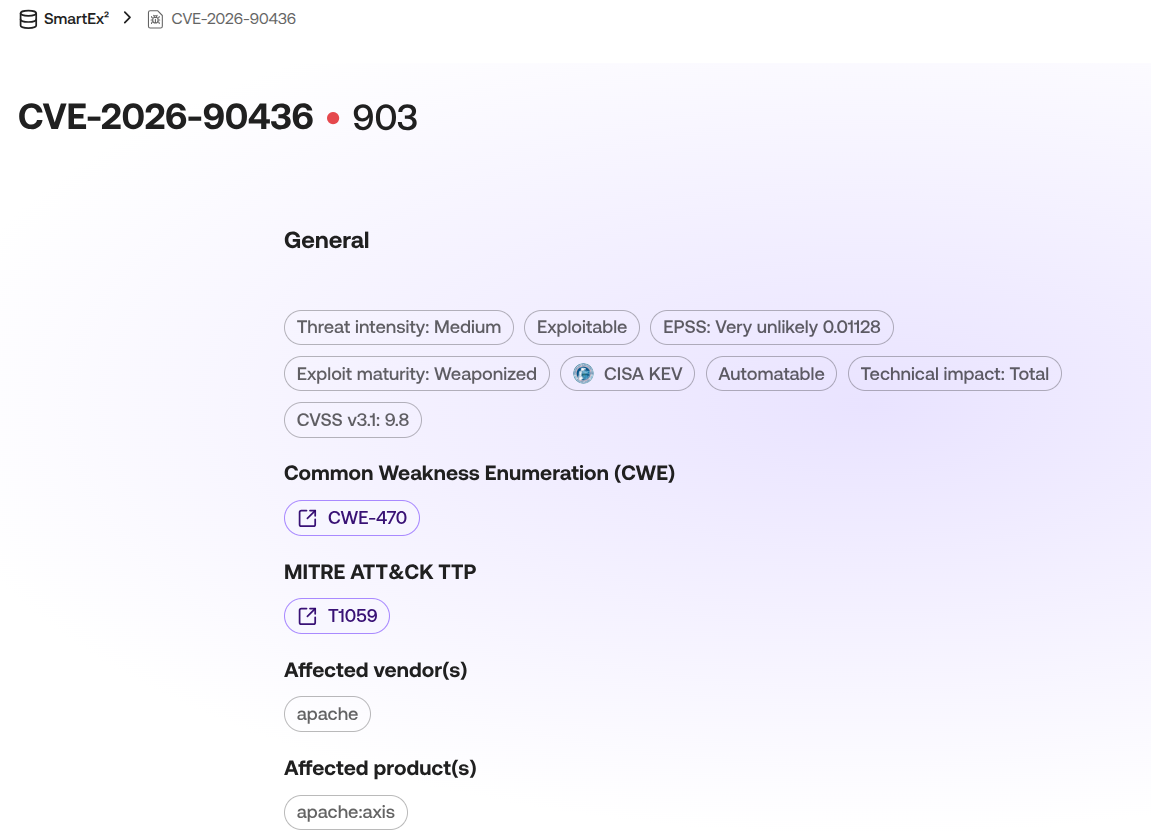
The same record shows the limit of public data. The only product listed is apache:axis, and no patch covers it. Closing that gap takes context the CVE record doesn't carry: which assets embed the library, which features are switched on, which instances face the internet. That's why we build Hackuity around exposure context first.
Then the question changes. Not "is this CVE critical?", but "can it actually be exploited on this server?" That's the question Probe, our AI agent for exploit validation, is built to answer. Probe is available today in feature preview, with general availability planned for January 2027.
Confluence teams won't get much rest this month. The product is also on the list of applications that researchers showed to be exploitable through Java4Shell, a flaw in the Java runtime itself.
End-of-life code doesn't disappear. It ships inside products you didn't know were carrying it.
Want to see how Hackuity helps teams act on the first signal? Book a demo.
Sources:
- Apache Software Foundation, CVE-2026-90436 advisory on oss-security (November 6, 2026) and patch commit 41f3b4e
- Atlassian, CVE-2026-90436: Remote Code Execution in Confluence Data Center and CONFSERVER-104610
- CISA, Known Exploited Vulnerabilities catalog, CVE-2026-90436
- N-able, Vulnerability Remediation Update
- SecurityWeek, N-able kills legacy APIs, patches 17 N-central zero-days and The Hacker News, N-able patches 17 N-central flaws
- BleepingComputer, New N-able 4EverAble2Shell zero-day exploited hours after PoC released
- Daily CyberSecurity, CVE-2026-90436: Confluence Data Center RCE Actively Exploited and Cyber Daily, Hackers targeting critical vulnerability impacting Atlassian, N-able products
- Prophet Security, Confluence Vulnerability CVE-2026-90436: How to Check Data Center for Exploitation (November 17, 2026) and Mallory, Apache Axis RCE Exploited in Confluence; N-central Attacks Linked to Same Flaw
- dinosn, Axis CVE-2026-90436 lab and PoC (impact on stock Axis 1.4)
- JFrog Security Research, Java4Shell: What We Know
- Hackuity SmartEx², CVE-2026-90436 record (as of November 19, 2026)



VR-1 | Property |
|---|---|
Model type | Post-trained cyber reasoning model |
Primary specialization | Multi-domain enterprise attack-chain discovery |
Starting condition | A scoped foothold and a concrete objective |
Operating surfaces | Cloud, identity, runtime, code, CI/CD, SaaS, and organizational context |
Success signal | Execution-verified completion of the objective |
Primary evaluation | IntrusionBench |
Preliminary result (preview) | More than 2× black-box pass@3 over the strongest evaluated frontier baseline |
Trajectory budget | Two-hour wall-clock limit per trajectory, or 250 agent turns (whichever comes first) |