















Short answer: No single vulnerability management platform is best for every organization. The right choice is the one that turns findings into verified fixes in your environment: broad coverage, risk-based prioritization you can explain, clear ownership, remediation workflows and proof that exposure went down. Scanner-led suites suit teams standardizing on one vendor; vendor-neutral platforms suit enterprises running several scanners.
The market is hard to compare for three reasons. First, the same label covers very different products: scanners, endpoint agents, cloud security platforms and aggregation layers all call themselves vulnerability management. Second, most listicles that rank these tools are written by vendors that rank themselves first, without a published method. Third, the bottleneck has moved. The CVE Program published 48,244 CVE records in 2025 (CVE Program), and Verizon's 2026 Data Breach Investigations Report found that 31% of breaches began with the exploitation of a software vulnerability (Verizon DBIR 2026). Finding more vulnerabilities is rarely the problem. Deciding which ones to fix, getting them fixed by the right team and proving it is.
The best vulnerability management platform is therefore not the one that finds the most vulnerabilities. It is the one that combines coverage, contextual risk prioritization, ownership, remediation orchestration, verification and measurable risk reduction for a specific organization. This guide gives you a transparent framework to make that choice, then shows which platforms fit which environments.
Vulnerability management platforms at a glance
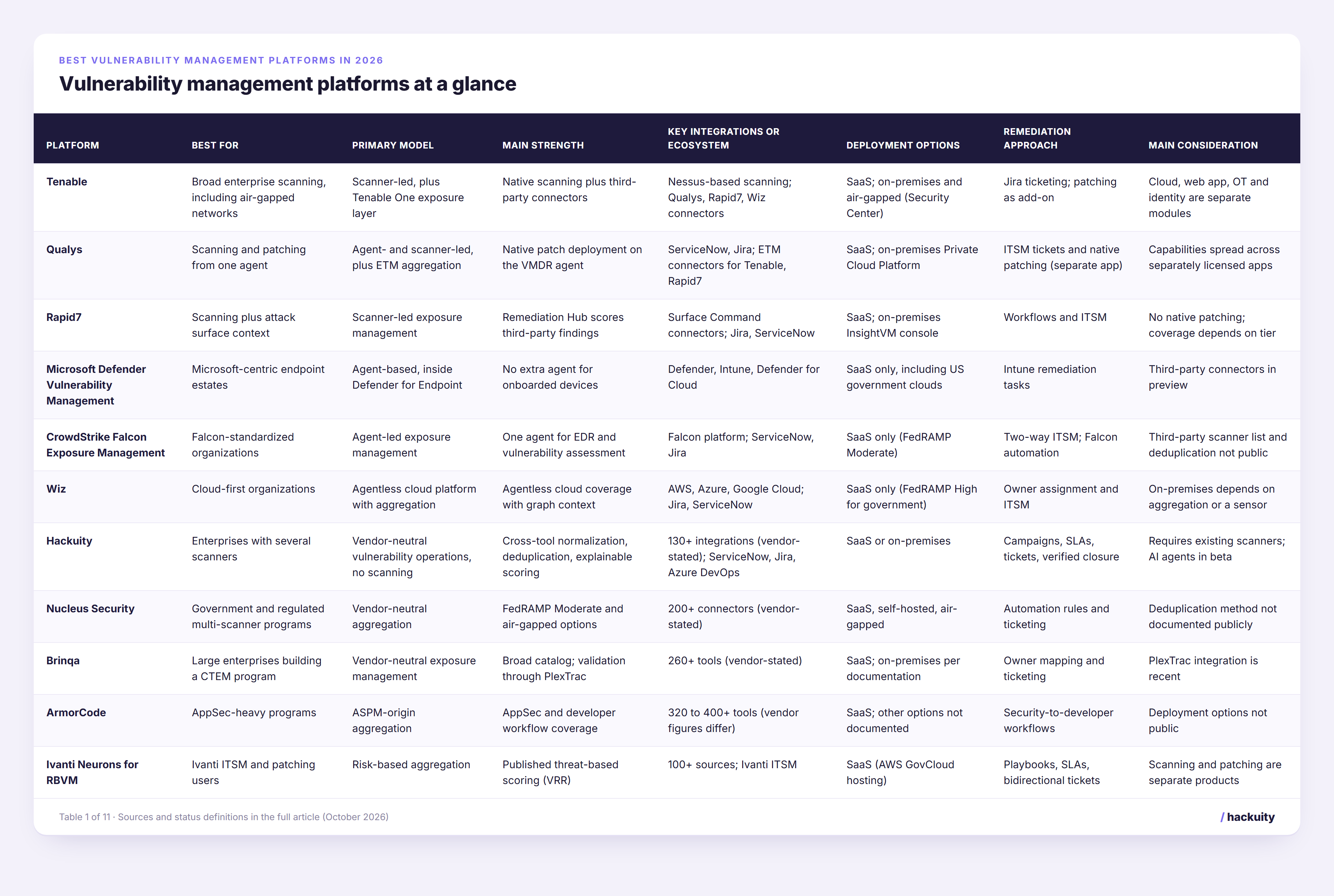
The table below summarizes eleven platforms by best fit. It is not a ranking. Capabilities come from each vendor's public documentation as of October 27, 2026; the detailed comparison and sources follow later in this guide.
Other vendors appear in this market and were reviewed: Seemplicity and Zafran (remediation and exposure operations), Orca Security (agentless cloud security) and Armis Centrix for VIPR Pro (now part of ServiceNow). Vulcan Cyber, often listed in older comparisons, was acquired by Tenable in February 2025 and its technology now powers Tenable One connectors (Tenable).
What is a vulnerability management platform?
A vulnerability management platform is software that runs the full lifecycle of known weaknesses: it collects findings about assets, decides which ones matter most, assigns them to the people who can fix them, tracks the fixes against deadlines and reports whether risk went down. Some platforms detect vulnerabilities themselves; others aggregate findings from existing scanners. What defines the category is the management of the lifecycle, not the detection alone.
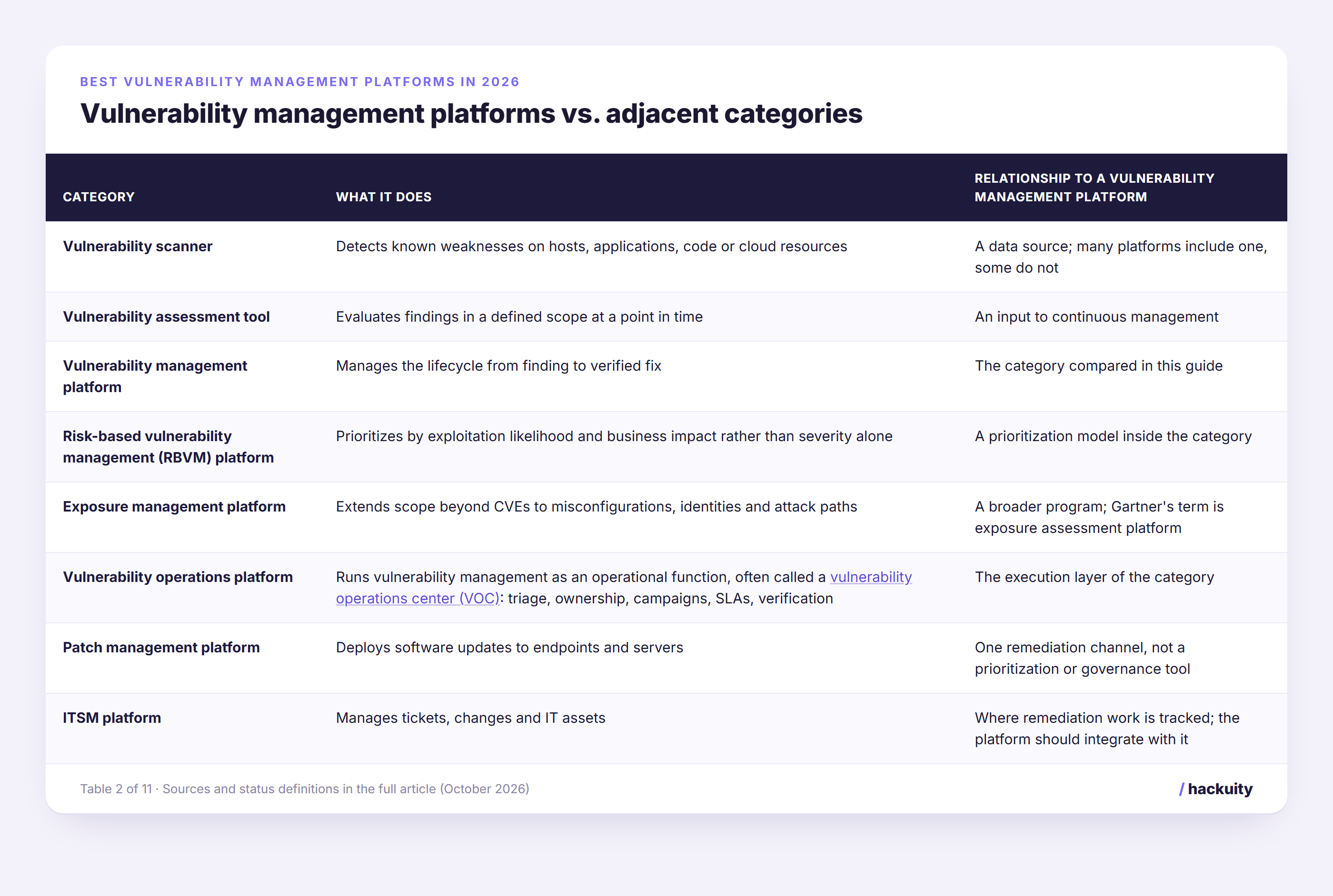
Adjacent categories overlap with it but are not the same:
A vulnerability management platform also differs from a SOC, a SIEM and a GRC platform. A SOC and a SIEM detect and investigate active threats in real time; a vulnerability management platform reduces latent exposure before it is exploited, which is why vulnerability management needs its own operating model. A GRC platform documents controls and risk acceptance; a vulnerability management platform produces the operational evidence those controls rely on.
The complete vulnerability management lifecycle
A complete platform, or a combination of tools, covers eleven steps:
- Discover assets and vulnerabilities.
- Collect findings from multiple sources: network, cloud, application, container and penetration-test results.
- Normalize and deduplicate the data, so one weakness on one asset becomes one finding.
- Enrich findings with threat context (for example CISA's Known Exploited Vulnerabilities catalog and FIRST's EPSS) and business context.
- Prioritize remediation.
- Assign ownership to an accountable team.
- Orchestrate remediation through tickets, campaigns or patching.
- Track SLAs and exceptions, including documented risk acceptance.
- Verify closure with fresh scan or test data, not ticket status.
- Measure risk reduction over time.
- Report to technical and executive stakeholders.
Most scanner-led products are strongest on steps 1 to 5. Most buying mistakes happen on steps 6 to 11.
What makes a vulnerability management platform effective?
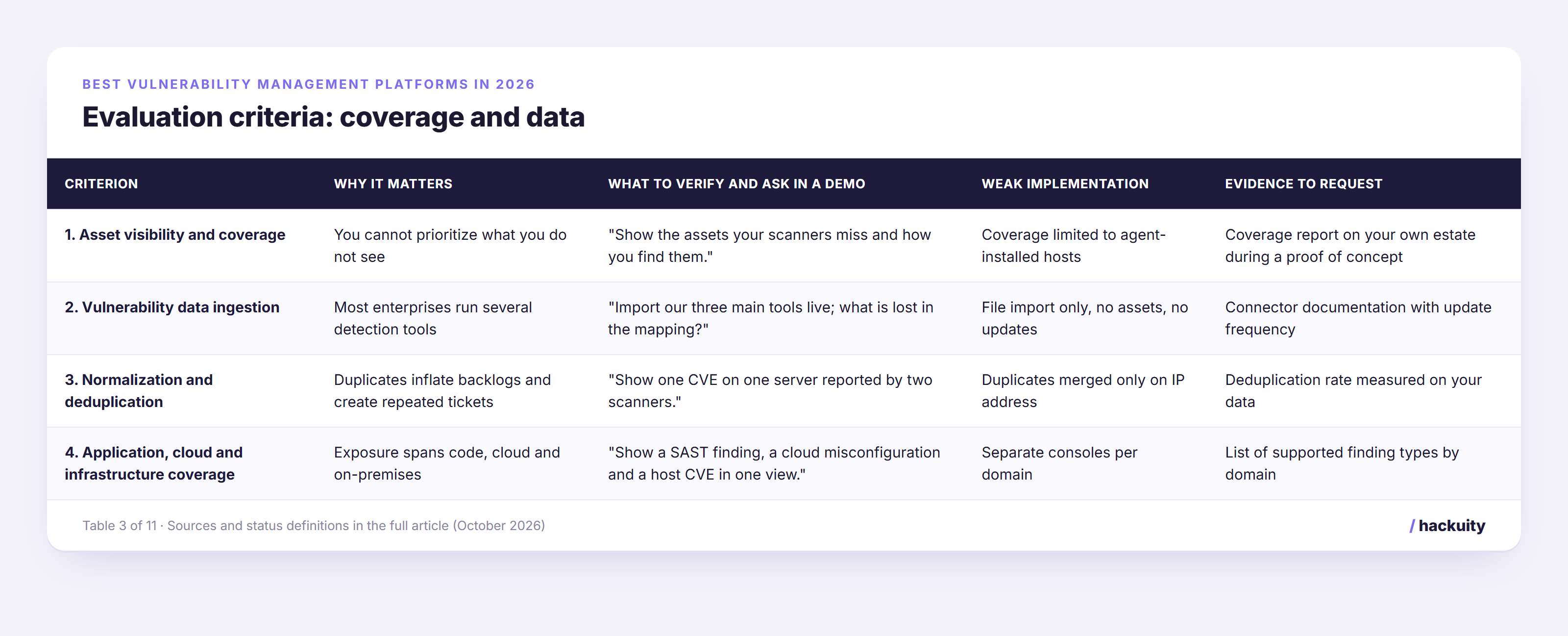
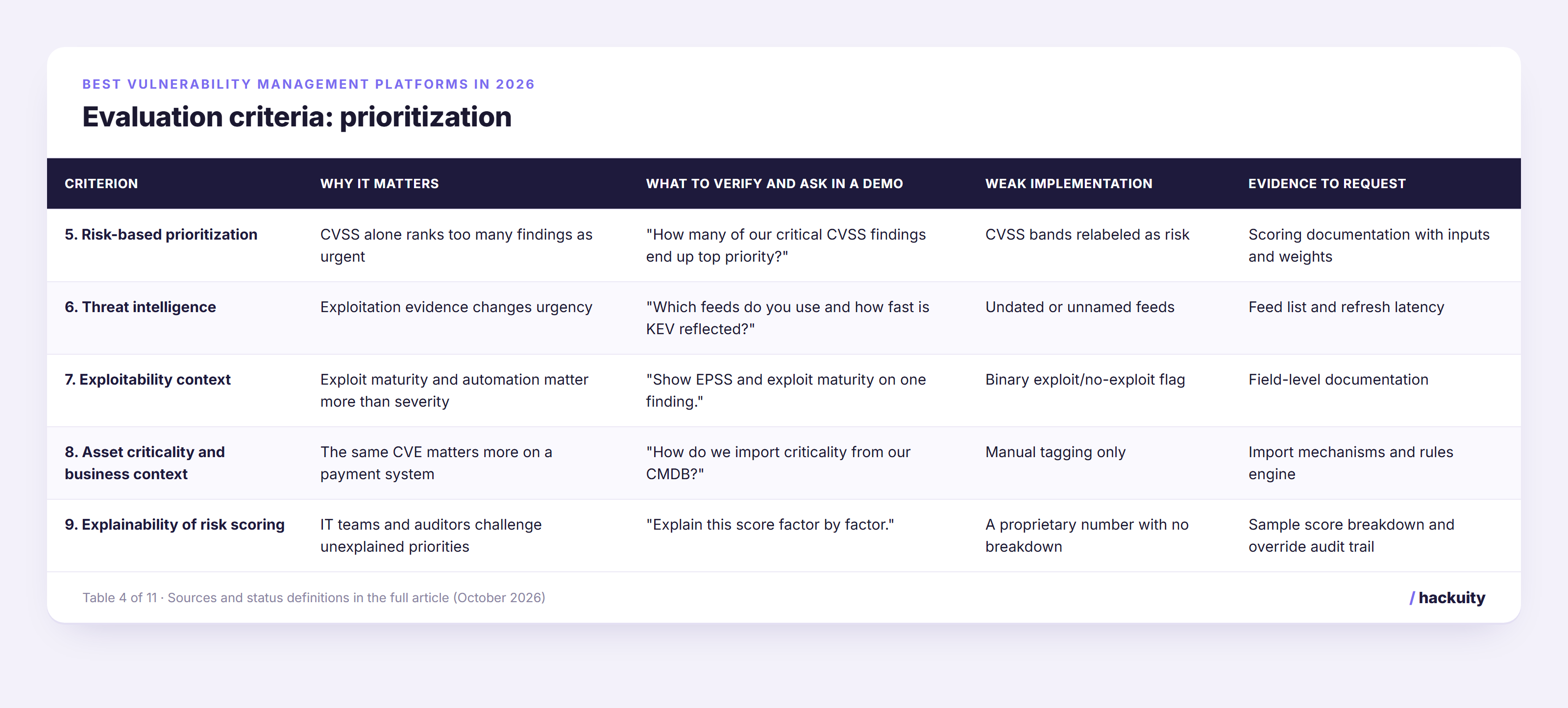
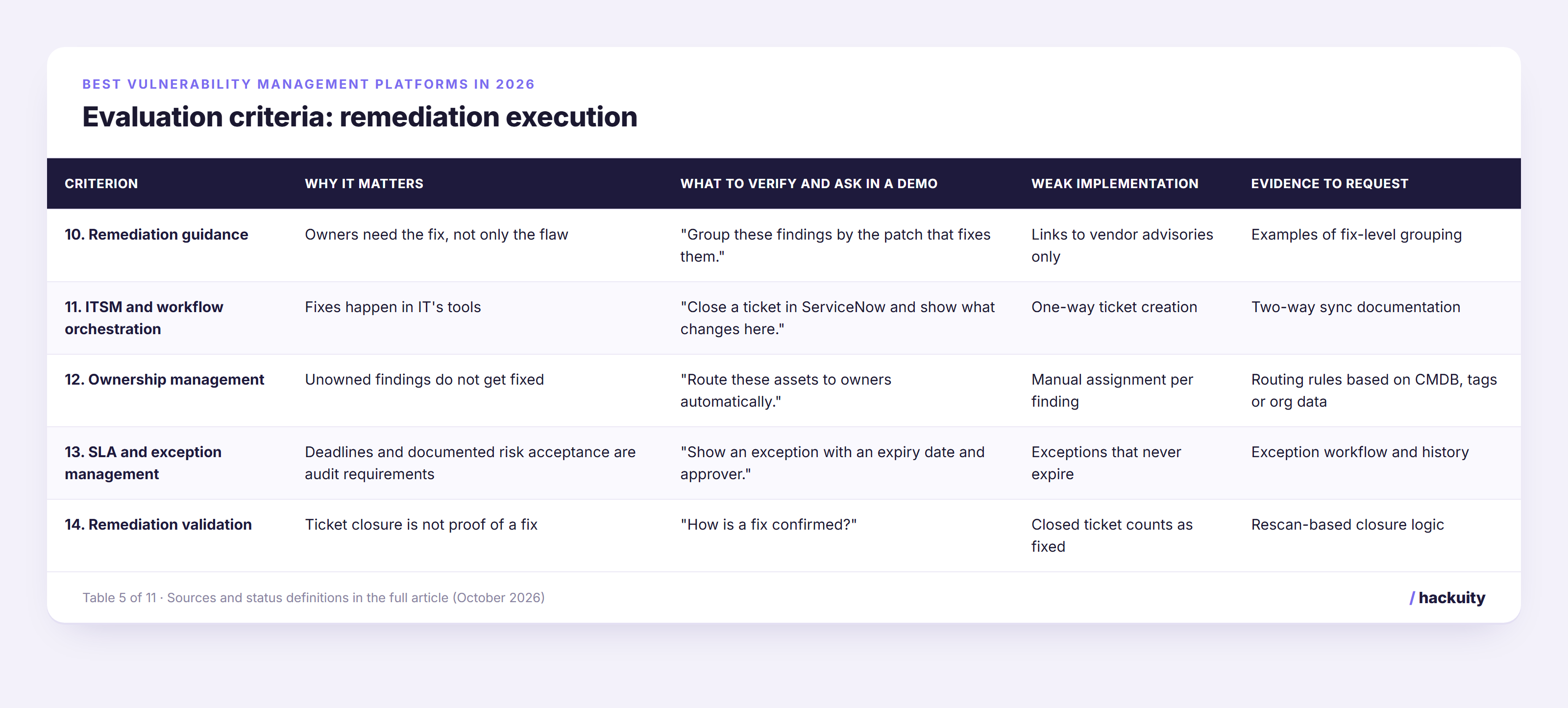
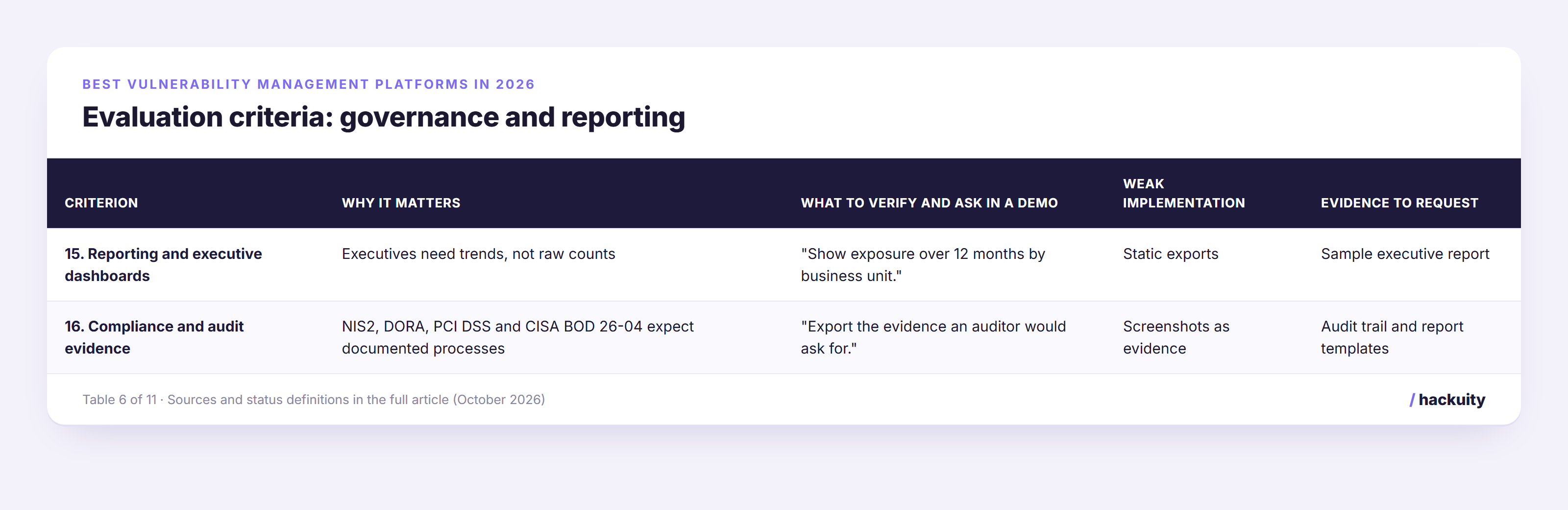
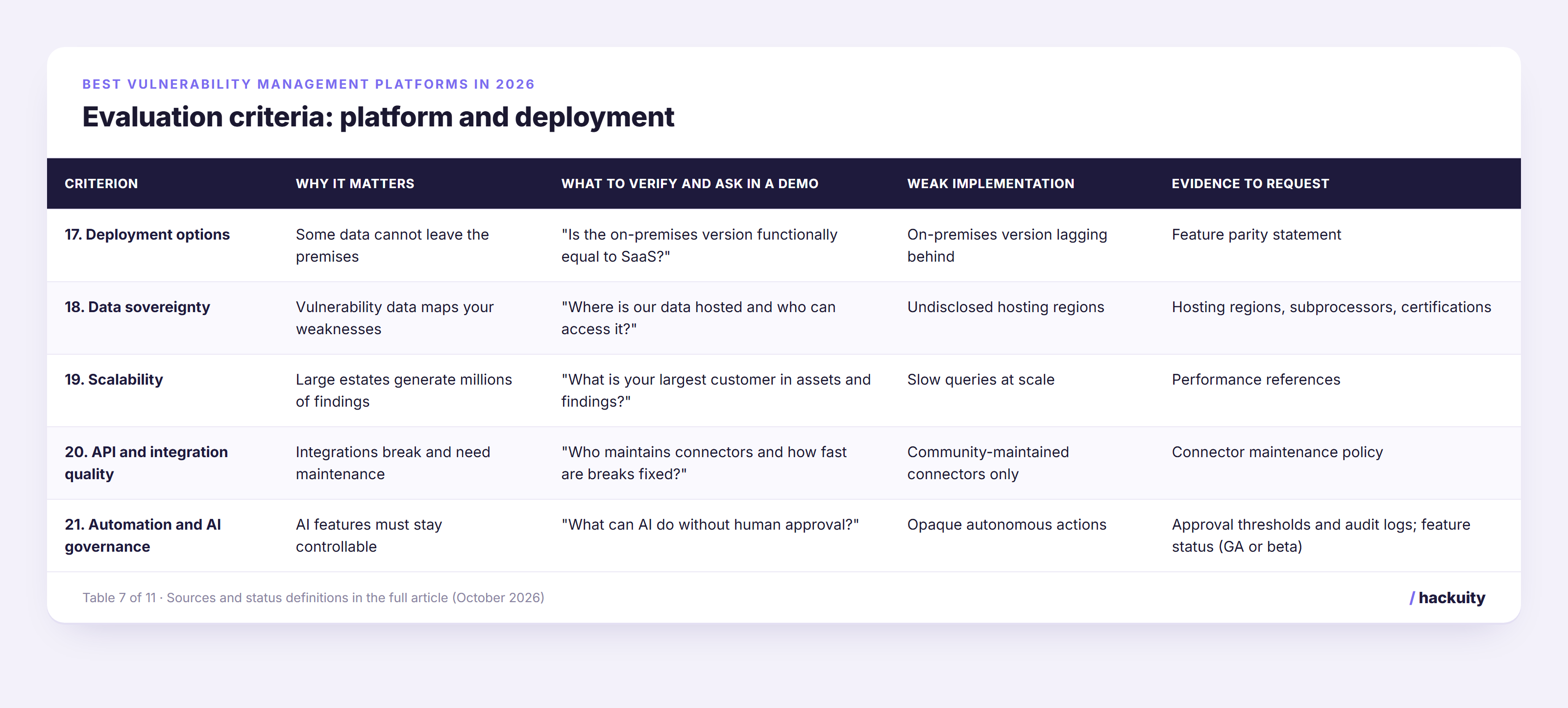
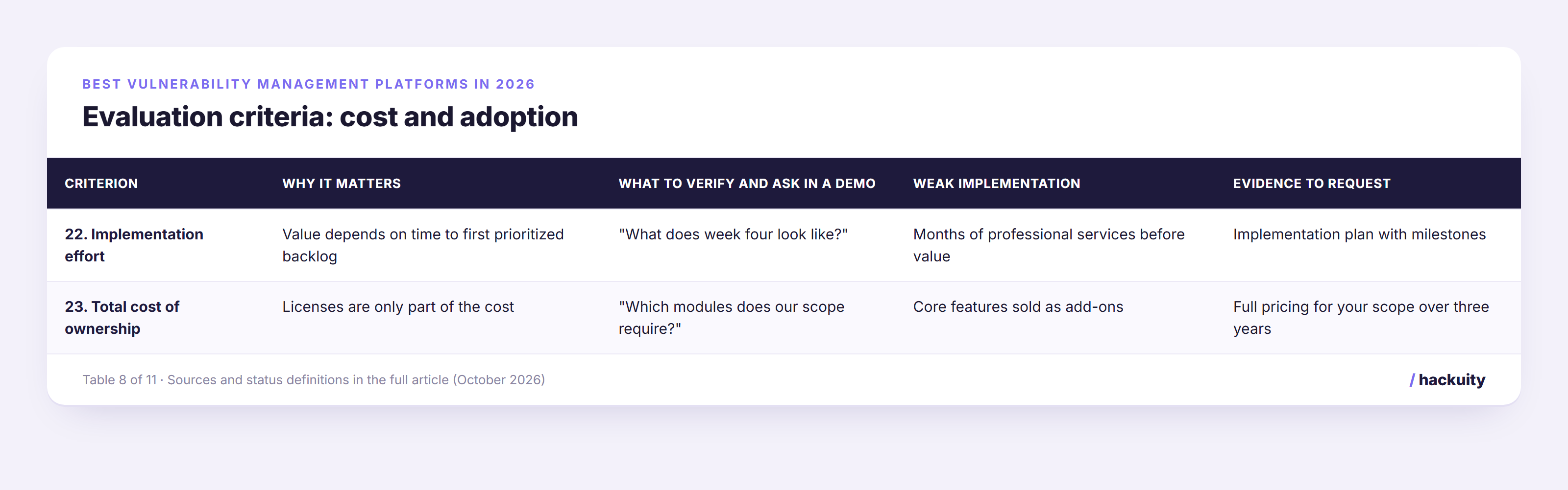
An effective platform reduces exploitable exposure faster than new exposure appears, and can prove it. The 23 criteria below make that testable. They are grouped in six families; for each one, the table says why it matters, what to verify in a demo, what a weak implementation looks like and what evidence to request.
Coverage and data
Prioritization
Remediation execution
Governance and reporting
Platform and deployment
Cost and adoption
How should you compare vulnerability management platforms?
Compare platforms on outcomes in your environment, not on headline numbers. The following are weak comparison criteria on their own: number of CVEs detected, number of integrations, dashboard design, marketing claims, scanner plugin count, raw CVSS coverage and number of compliance templates. Integration counts illustrate the problem: vendors' own pages often give different figures for the same catalog, and a connector that imports findings without assets or status updates counts as one integration all the same.
Compare instead:
- Quality of asset coverage: the share of your real estate the platform sees and correlates.
- Data freshness: how quickly new findings, KEV additions and fixes are reflected.
- Deduplication accuracy: how many duplicates remain after merging your tools' data.
- Risk scoring methodology and explainability: whether your IT teams accept the priorities.
- Remediation ownership: the share of findings with an accountable owner.
- Automation depth: what happens without manual work, and under which approvals.
- Closure verification: whether fixes are confirmed by data.
- Reporting quality and workflow fit: whether reports answer executive questions and tickets land where IT works.
- Impact on measurable exposure: whether exploitable exposure goes down during the proof of concept.
Comparison methodology
This guide uses an editorial framework, not an official analyst ranking. Each criterion family carries a default weight that a buyer should adjust to their context:
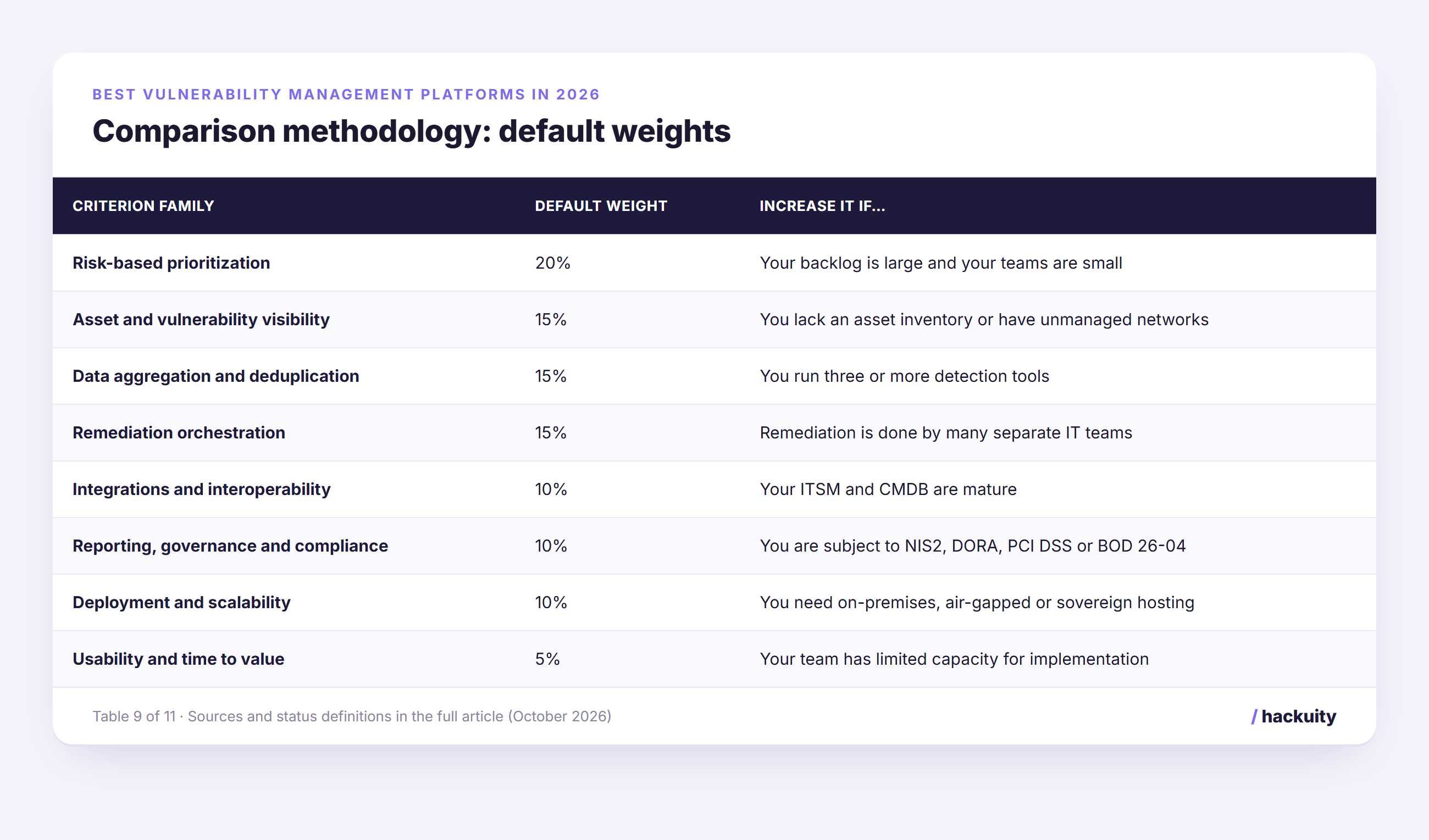
Score each platform from 1 to 5 per family during your own proof of concept, using your data. This guide deliberately does not publish vendor scores: public documentation is enough to establish what a platform offers, but not how well it performs on a given estate. Statements in the vendor tables are marked as native, via integration, module-dependent, requiring a separate product, limited or not publicly verified, based on official documentation reviewed on October 27, 2026.
Best vulnerability management platforms by use case
The best platform depends on what you already run and where your bottleneck is. These categories reflect documented capabilities, not performance tests.
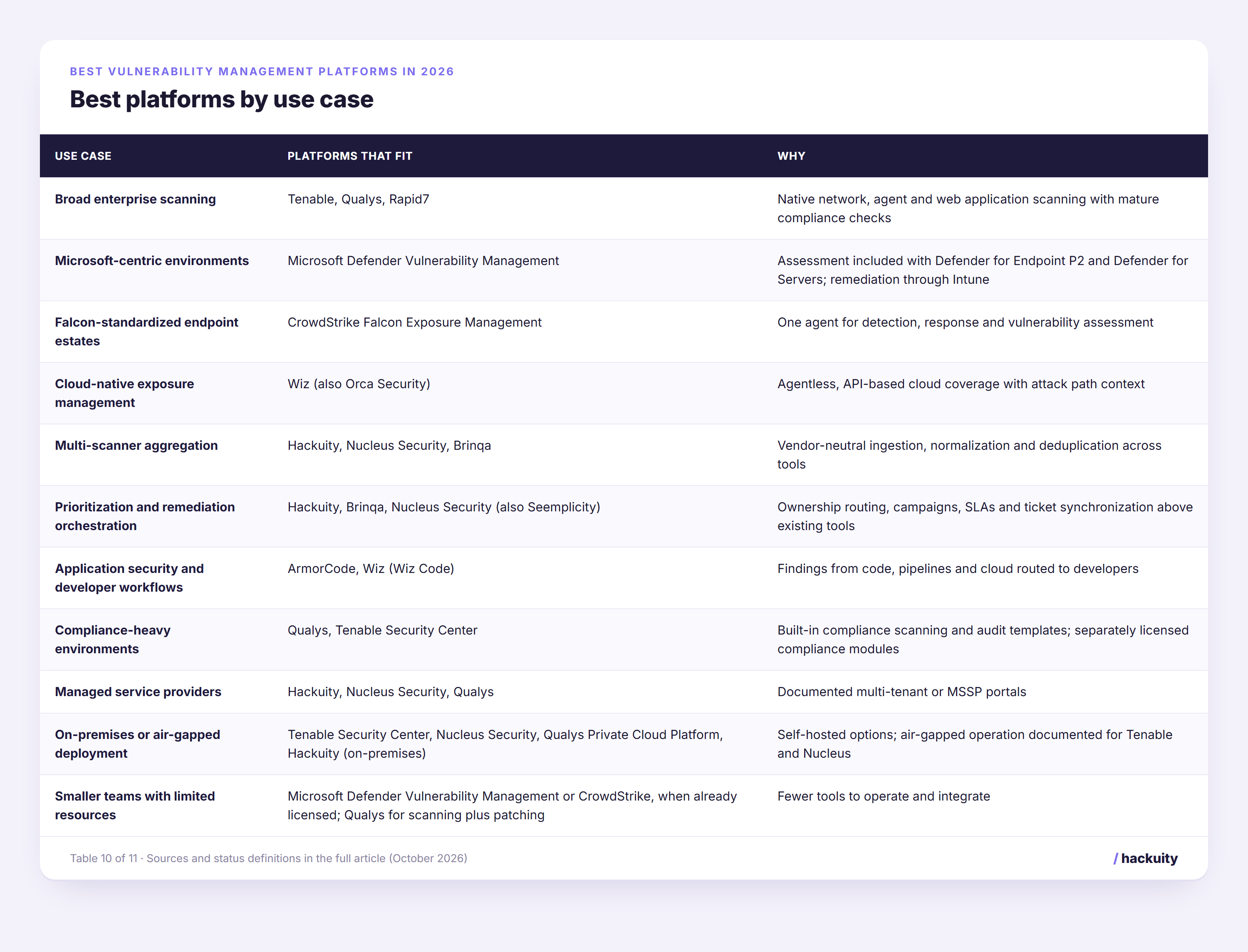
Scanner-led suites now also aggregate third-party data: Tenable One connectors, Qualys Enterprise TruRisk Management (ETM) and Rapid7 Remediation Hub all ingest competitors' findings. For a buyer with several scanners, the question is not whether a suite can ingest other tools, but whether it treats them as equals: deduplication rules, scoring of third-party findings and independence from one vendor's scanning roadmap.
Detailed capability comparison
This table uses deliberately cautious terms. "Native" means the capability is documented as part of the product; "module-dependent" means it requires a specific module or tier; "not publicly verified" means we could not confirm it in official documentation, not that it is absent.
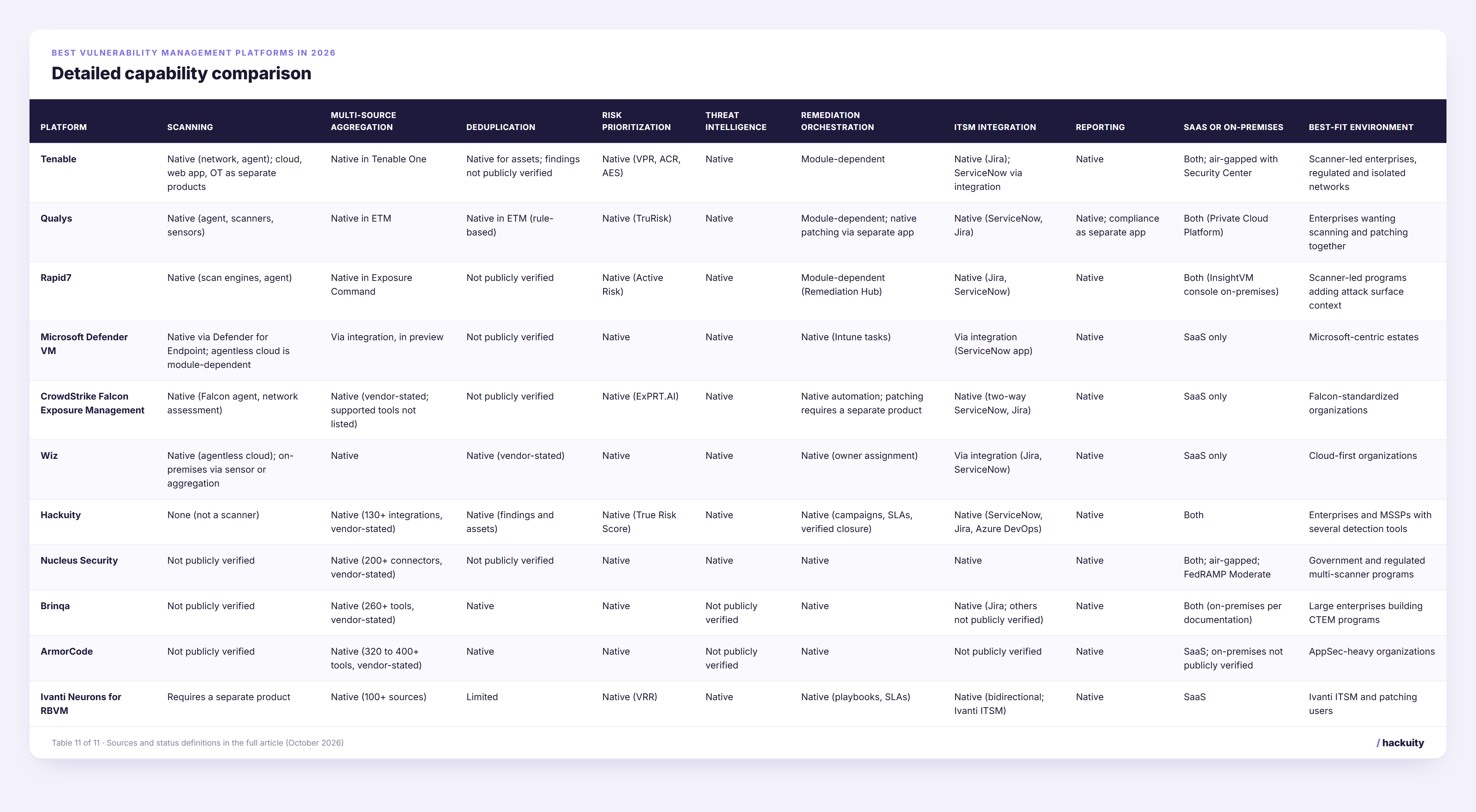
Vulnerability management platform profiles
Each profile follows the same structure. Statements come from vendor documentation unless marked otherwise; editorial verdicts are our judgment. Hackuity is profiled with the same structure in the next section.
Tenable (Tenable Vulnerability Management, Security Center, Tenable One)
Best for: enterprises that want native scanning across a broad estate, including isolated or air-gapped networks, with an exposure management layer on top.
What it does well
- Native scanning built on Nessus technology, with continuous asset discovery (Tenable).
- Third-party connectors in Tenable One that ingest asset and weakness data from tools such as Qualys, Rapid7 and Wiz (Tenable Docs).
- On-premises and air-gapped options through Security Center (Tenable).
Important limitations or trade-offs
- Cloud, web application, OT and identity coverage are separate products; patching is an add-on.
- Third-party asset merge rules cannot be customized, and finding-level deduplication is not documented (Tenable Docs).
Key capabilities: coverage through native scanners and modules; prioritization with Vulnerability Priority Rating (VPR), Asset Criticality Rating (ACR) and Asset Exposure Score (AES); integrations through Tenable One connectors; remediation through Jira ticketing; reporting including PCI ASV; SaaS, on-premises and air-gapped deployment.
Questions to validate in a proof of concept
- How are findings from a non-Tenable scanner deduplicated against Tenable findings?
- Which modules does our coverage scope require, and at what cost?
- Is ServiceNow ticket synchronization generally available for our deployment?
Editorial verdict: a strong fit for organizations that want one vendor for scanning across hybrid and isolated environments, and accept a module-based scope.
Qualys (VMDR, Enterprise TruRisk Management)
Best for: enterprises that want detection, prioritization and patch deployment from one agent and one vendor.
What it does well
- Native patch deployment on the same agent as VMDR, including third-party applications (Qualys).
- Documented rule-based deduplication of third-party findings in ETM, with connectors for Tenable and Rapid7 (Qualys Docs).
- On-premises Private Cloud Platform and an MSSP portal.
Important limitations or trade-offs
- Capabilities are spread across separately licensed apps (VMDR, Patch Management, TotalCloud, ETM, Policy Compliance).
- Connector counts differ between documentation (about 64 listed) and marketing ("100+").
Key capabilities: coverage through scanners, Cloud Agent and passive sensors; prioritization with the TruRisk score (asset criticality plus detection and vulnerability scores); integrations with ServiceNow and Jira; remediation through tickets and native patching; reporting and compliance modules; SaaS and on-premises deployment.
Questions to validate in a proof of concept
- Which apps does our scope need, and how are they licensed together?
- How are third-party findings scored compared with Qualys detections?
- Is our deployment target supported for air-gapped operation?
Editorial verdict: a strong fit where patching and vulnerability management should share one agent and one vendor.
Rapid7 (InsightVM, Exposure Command)
Best for: scanner-led programs that want attack surface context and third-party findings scored in one place.
What it does well
- Remediation Hub ingests findings from Qualys, Tenable, Wiz and CrowdStrike, among others (Rapid7 Docs).
- Active Risk scoring draws on named threat sources, including Metasploit and CISA KEV.
- Choice between an on-premises InsightVM console and SaaS Exposure Command (Rapid7).
Important limitations or trade-offs
- No native patching; remediation runs through workflows and ITSM.
- Cross-tool deduplication and multi-tenancy for vulnerability management are not publicly documented.
Key capabilities: coverage through scan engines, the Insight Agent and Surface Command discovery; prioritization with Active Risk; Jira and ServiceNow integrations; remediation through Remediation Hub workflows; CIS and PCI reporting; SaaS and on-premises deployment.
Questions to validate in a proof of concept
- How are duplicate findings from two scanners merged in Remediation Hub?
- Which Exposure Command tier covers our cloud and application scope?
- How is a fix verified before a remediation is closed?
Editorial verdict: a good fit for teams already invested in Rapid7 scanning that want exposure context without adding a separate aggregation layer.
Microsoft Defender Vulnerability Management
Best for: organizations whose endpoints and servers already run Microsoft Defender for Endpoint and are managed with Intune.
What it does well
- Assessment is built into Defender for Endpoint P2 and Defender for Servers, without an extra agent (Microsoft Learn).
- Remediation tasks created directly in Intune.
- Multitenant management, including US government clouds (Microsoft Learn).
Important limitations or trade-offs
- Third-party scanner connectors in Microsoft Security Exposure Management are in preview, with consumption-based billing planned at general availability (Microsoft Learn).
- Premium capabilities depend on the add-on or standalone license; Windows authenticated scanning is deprecated.
Key capabilities: coverage of onboarded devices plus agentless cloud scanning through Defender for Cloud; prioritization with threat intelligence, breach likelihood and business context; Intune and ServiceNow integration; remediation through Intune and application blocking; SaaS deployment only.
Questions to validate in a proof of concept
- How are devices without Defender for Endpoint covered?
- What will third-party connectors cost once generally available?
- How are non-Microsoft remediation teams routed and tracked?
Editorial verdict: the natural starting point for Microsoft-centric estates; less suited as the single operations layer for a multi-vendor environment today.
CrowdStrike Falcon Exposure Management
Best for: organizations standardized on the CrowdStrike Falcon agent that want exposure management without scan appliances.
What it does well
- One agent for detection, response and vulnerability assessment, plus network assessment of unmanaged devices (CrowdStrike).
- ExPRT.AI prioritization trained on CrowdStrike exploit intelligence, with adversary context.
- Two-way ServiceNow and Jira integrations.
Important limitations or trade-offs
- The list of supported third-party scanners and the deduplication logic are not public.
- Risk-based patching relies on Falcon for IT, announced in September 2025 with a general-availability caveat (CrowdStrike).
Key capabilities: coverage through the Falcon agent, passive discovery and external attack surface management; prioritization with ExPRT.AI and asset criticality; ServiceNow and Jira integrations; remediation through Falcon Fusion automation; SaaS only, with FedRAMP Moderate authorization.
Questions to validate in a proof of concept
- Which third-party scanners can be ingested, and how are duplicates handled?
- How are assets without the Falcon agent assessed?
- Which remediation actions run automatically, and under which approvals?
Editorial verdict: compelling for Falcon customers consolidating agents; buyers with heterogeneous scanners should test third-party ingestion carefully.
Wiz
Best for: cloud-first organizations that want agentless coverage of AWS, Azure and Google Cloud, with code-to-cloud context.
What it does well
- Agentless onboarding through cloud APIs, with an optional runtime sensor (Wiz).
- Third-party aggregation of scanner, penetration-test, SAST and DAST findings, with deduplication stated by the vendor (Wiz).
- FedRAMP High authorization for its government offering (Wiz).
Important limitations or trade-offs
- On-premises coverage depends on third-party aggregation or the sensor.
- Detailed documentation is behind a login, so deduplication and connector depth cannot be checked publicly. Google completed its acquisition of Wiz on March 11, 2026 (Alphabet); the managed service provider program is in public preview.
Key capabilities: cloud coverage through APIs and the Wiz Security Graph; prioritization with graph context and attack surface validation; Jira and ServiceNow integrations; remediation through owner assignment and guided fixes; developer workflows through Wiz Code; SaaS only.
Questions to validate in a proof of concept
- How are on-premises findings from our existing scanners prioritized next to cloud findings?
- How are duplicates merged between Wiz and third-party tools?
- Which capabilities require Wiz Code or the sensor?
Editorial verdict: a strong fit when most exposure lives in public cloud; hybrid enterprises should test on-premises coverage explicitly.
Nucleus Security
Best for: government and regulated organizations that need vendor-neutral aggregation with self-hosted or air-gapped deployment.
What it does well
- FedRAMP Moderate authorization for Nucleus for Government, listed on the FedRAMP Marketplace (independent source: FedRAMP).
- AWS GovCloud, self-hosted and air-gapped options (Nucleus).
- A documented tenancy model for managed service providers.
Important limitations or trade-offs
- The deduplication method is not publicly documented.
- Licensing is per project, so an asset present in several projects is counted more than once (vendor documentation).
Key capabilities: coverage through 200+ connectors (vendor-stated); prioritization with asset context and Nucleus Insights threat intelligence; automation rules and ticketing; dashboards and compliance reporting; SaaS, self-hosted and air-gapped deployment.
Questions to validate in a proof of concept
- How are duplicate findings and assets merged across our tools?
- How does project-based licensing apply to our structure?
- Which AI features are generally available?
Editorial verdict: a credible option for public sector and regulated buyers that need neutrality plus government-grade deployment.
Brinqa
Best for: large enterprises building a continuous threat exposure management (CTEM) program across many tools.
What it does well
- A broad connector catalog, "over 260 tools" according to the vendor (Brinqa).
- Findings "deduplicated, attributed, and prioritized", mapped to owners.
- Validation of fixes through PlexTrac, acquired in August 2026 (Brinqa).
Important limitations or trade-offs
- The PlexTrac integration is recent; its depth should be tested.
- Threat intelligence sources and multi-tenant support are not publicly documented.
Key capabilities: coverage through connectors; prioritization with exploitability and business context; remediation through owner mapping and ticketing (Jira shown); board-level reporting; SaaS, with an on-premises option in documentation.
Questions to validate in a proof of concept
- Which threat intelligence feeds drive prioritization?
- How does PlexTrac validation connect to remediation closure?
- Which ITSM tools support two-way synchronization?
Editorial verdict: suited to mature enterprises that want a configurable exposure data model and can invest in implementation.
ArmorCode
Best for: organizations where application security findings dominate the backlog.
What it does well
- Aggregation and normalization of findings across application security and infrastructure tools.
- Named a Leader in the IDC MarketScape for application security posture management, 2025 (vendor announcement: ArmorCode).
- Workflow automation between security and development teams.
Important limitations or trade-offs
- Connector counts vary across the vendor's own sources (320 in 2025 releases, "400+" on the homepage).
- Deployment options beyond SaaS and threat intelligence sources are not publicly documented.
Key capabilities: coverage through AppSec, cloud and infrastructure integrations; AI-assisted prioritization; developer workflow automation; posture and compliance reporting; SaaS.
Questions to validate in a proof of concept
- How are infrastructure findings prioritized compared with AppSec findings?
- Which ITSM and developer tools support two-way updates?
- Which AI agents are generally available?
Editorial verdict: a natural fit for AppSec-led programs; infrastructure-heavy estates should test depth on host and network findings.
Ivanti Neurons for RBVM
Best for: organizations already using Ivanti service management and patching.
What it does well
- Vulnerability Risk Rating (VRR), a published threat-based score that accounts for threats as well as severity (Ivanti).
- Bidirectional integration with ticketing systems, including Ivanti ITSM.
- Playbooks and SLA tracking.
Important limitations or trade-offs
- Scanning and patching are separate Ivanti products.
- The vendor states 100+ sources, a smaller catalog than other aggregators.
Key capabilities: findings from 100+ sources; prioritization with VRR and ransomware tagging; bidirectional ticketing; dashboards from operations to executives; SaaS hosted in AWS GovCloud (US).
Questions to validate in a proof of concept
- How are duplicates handled across our scanners?
- How well does the platform work with non-Ivanti ITSM tools?
- Which Ivanti products does our remediation scope require?
Editorial verdict: strongest when Ivanti already runs IT service management and patching.
How Hackuity fits the vulnerability management platform landscape
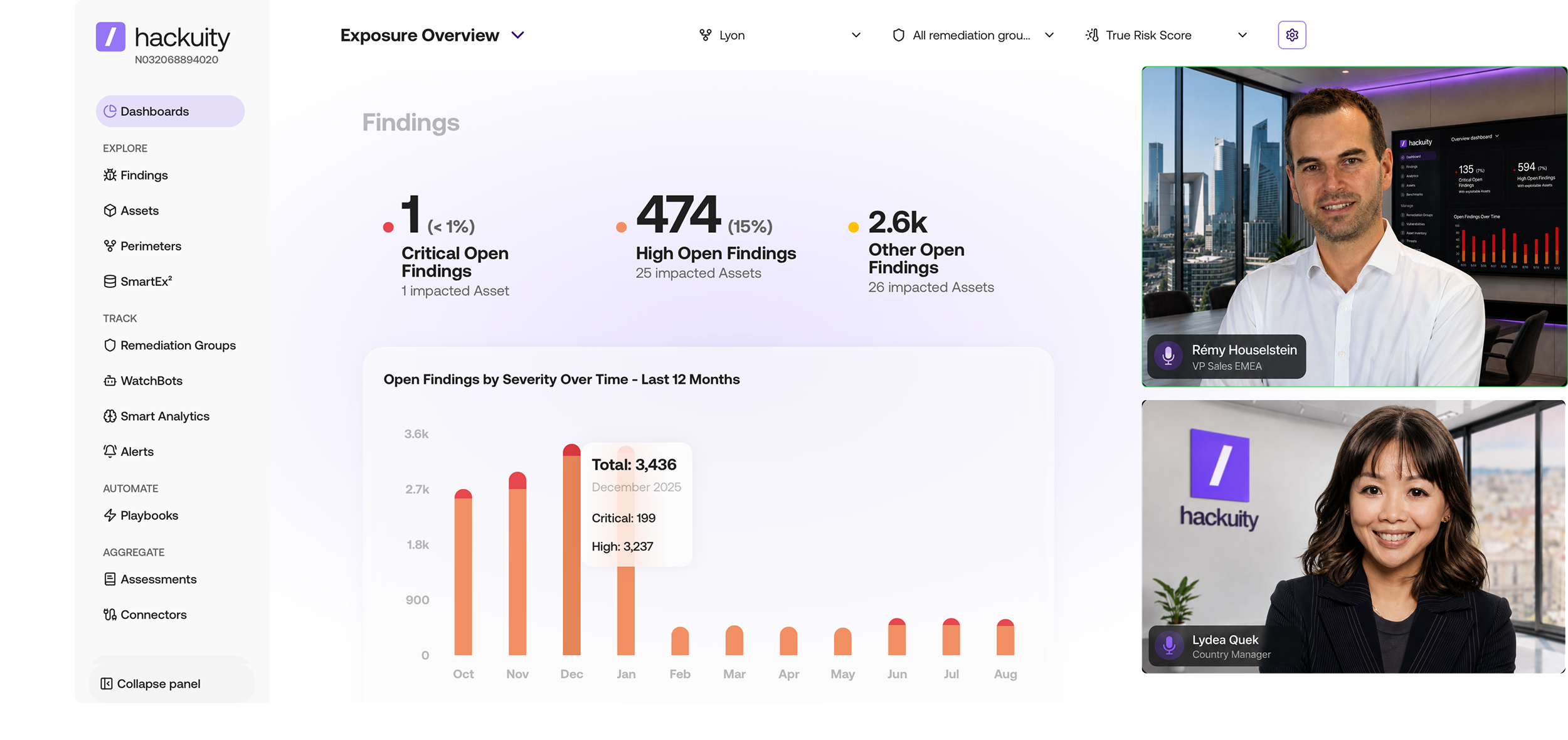
Hackuity is a vulnerability operations and risk-based vulnerability management platform that sits above existing security tools. It does not scan: in its own words, "Hackuity is not a scanner" (Hackuity FAQ). It is designed to make existing scanners and security tools work better together, by turning their combined findings into one prioritized, owned and verified remediation backlog.
Best for
Enterprises and managed security service providers that already run several scanners and security tools, and need a neutral layer for normalization, deduplication, risk-based prioritization and remediation orchestration.
What it does well
- Vendor-neutral aggregation. Hackuity states "130+ integrations" across scanners, cloud, application security, threat intelligence and ITSM tools (Hackuity Integrations). [To be validated before publication: the integration catalog counter shows 137 connectors.]
- Normalization and deduplication of findings and assets. The platform converts each tool's syntax and severity ratings into a standard format, and its Asset Correlation Engine reconciles duplicate asset reports from different scanners (Hackuity).
- Explainable prioritization. The True Risk Score combines an effective CVSS (v3.1 or v4.0 with environmental adjustments), EPSS v5, CISA KEV status, threat intensity from intelligence feeds and asset context such as business criticality. Hackuity describes the calculation as transparent and lets teams adjust asset and finding attributes through playbooks (Hackuity).
- Remediation orchestration with verified closure. Findings are grouped into remediation campaigns, synchronized with ServiceNow, Jira or Azure DevOps, tracked against SLAs and closed only when a scanner recheck confirms the fix (Hackuity).
Important limitations or trade-offs
- Hackuity needs detection tools to feed it. It is not a fit for a buyer looking only for a basic network scanner.
- It does not deploy patches. A buyer seeking native endpoint patch deployment needs a patching tool alongside it.
- A small team with a limited, homogeneous environment and a single scanner may get enough from that scanner's own prioritization.
- Its AI agents (Probe for exploit validation, Remediation Advisor and VOC Copilot) are in beta as of October 2026; the MCP server is available (Hackuity). [To be validated before publication: current status and dates of each agent.]
Key capabilities
- Coverage: aggregates infrastructure, cloud, application security and penetration-test findings through integrations; coverage depends on the tools connected.
- Prioritization: True Risk Score with threat intelligence from sources including EPSS, CISA KEV, MITRE ATT&CK mappings and commercial feeds when licensed.
- Integrations: scanners, cloud and AppSec tools, CMDBs, and ITSM tools including ServiceNow, Jira and Azure DevOps.
- Remediation: campaigns, owner routing, SLA tracking and scanner-based closure verification.
- Reporting: SLA compliance, overdue critical findings and exposure trends for operational and executive audiences.
- Deployment: SaaS or on-premises; SOC 2 Type II certified (Hackuity).
- Scalability and tenancy: multi-tenant architecture with scope-based access control for MSSPs (Hackuity for MSSPs).
Questions to validate in a proof of concept
- Import our main scanners: how many findings remain after deduplication, and how is each merge explained?
- Show the True Risk Score breakdown for five of our findings, and change one asset's criticality.
- Close a ticket in our ITSM tool without fixing the vulnerability: what happens at the next scan?
Editorial verdict
Hackuity may be particularly relevant for organizations that already operate multiple scanners and security tools, but need a neutral layer for normalization, deduplication, risk-based prioritization and remediation orchestration. It is not a replacement for detection or patching tools.
What sets this approach apart
Vendor neutrality. When findings from Tenable, Qualys, a cloud platform and an application security tool are scored by one model, a critical weakness is ranked the same way whichever tool found it. A suite that also sells scanners can ingest competitors' data, but buyers should check whether third-party findings are deduplicated and scored on equal terms.
Explainable risk prioritization. Buyers should be able to see which factors drove a score, how threat intelligence is used, how asset criticality changes priority, and whether teams can configure or challenge the result. An explainable score is one an IT team, an auditor and an executive can all follow.
Multi-source normalization and deduplication. Without it, the same CVE on the same server appears twice with conflicting severities, different asset identifiers and two tickets, and ownership data stays incomplete. Each duplicate costs triage time and erodes IT's trust in security's requests.
Remediation orchestration. Sending an alert, creating a ticket and assigning an owner are not the same as remediating. Orchestration adds grouping into campaigns (one patch, hundreds of servers), tracking against SLAs, verifying closure with fresh scan data and measuring the resulting change in exposure.
Existing stack compatibility. Organizations that have invested in scanners rarely want to replace them. A layer that complements them protects those investments and lets teams change scanners later without losing history.
How to run a proof of concept
A proof of concept should last two to four weeks and use your own data. Shortlist two or three platforms from the use cases above, then:
- Connect the same data sources to each platform: at least two scanners, your CMDB and your ITSM tool.
- Measure the backlog before and after normalization and deduplication.
- Compare the top 50 priorities of each platform with your team's own judgment and with CISA KEV.
- Run one remediation campaign end to end, from ticket creation to verified closure.
- Ask each vendor to state which features you tested are generally available, in beta or planned.
- Score each platform with the weighted framework above, adjusted to your context.
Conclusion: choose for your environment, not for a ranking
The best vulnerability management platform is the one that fits your environment and operating model. If you run one scanner vendor across a mostly homogeneous estate, that vendor's suite may be enough. If your endpoints are standardized on Microsoft or CrowdStrike, their built-in capabilities are a sensible starting point. If most of your exposure is in public cloud, an agentless cloud platform fits. If you run several scanners and security tools across hybrid environments, and your bottleneck is deciding, assigning and verifying fixes, a vendor-neutral vulnerability operations layer deserves a place on your shortlist.
For security leaders: See how Hackuity helps enterprise teams unify vulnerability data, prioritize real risk and orchestrate remediation across their existing security stack.
For vulnerability management teams: Explore how Hackuity can connect your scanners, threat intelligence, asset context and remediation workflows in one operational layer.
Frequently asked questions
What is the best vulnerability management platform?
There is no single best vulnerability management platform for every organization. The best choice is the one that turns findings into verified fixes in your environment. Scanner-led suites such as Tenable, Qualys and Rapid7 suit teams standardizing on one vendor. Microsoft and CrowdStrike suit estates built on their agents. Vendor-neutral platforms such as Hackuity, Nucleus Security and Brinqa suit enterprises running several scanners that need one prioritized, owned backlog.
What are the best vulnerability management tools for enterprises?
Enterprises usually need two things: broad detection and an operational layer that prioritizes, assigns and verifies fixes. Tenable, Qualys and Rapid7 provide broad native scanning. Hackuity, Nucleus Security and Brinqa aggregate findings from many tools. Microsoft Defender Vulnerability Management and CrowdStrike fit estates standardized on their agents, and Wiz fits cloud-first environments. The right combination depends on asset volume, number of scanners, deployment constraints and ITSM maturity.
How do vulnerability management platforms differ from vulnerability scanners?
A scanner detects weaknesses; a vulnerability management platform manages them until they are fixed. Scanners identify known vulnerabilities on hosts, applications or cloud resources. A platform adds prioritization with threat and business context, assigns findings to owners, tracks remediation against deadlines, verifies closure and reports on risk reduction. Some platforms include their own scanners; others, such as Hackuity, aggregate findings from scanners an organization already uses.
What should I look for in a vulnerability management platform?
Look for evidence that the platform reduces exploitable exposure, not for the longest feature list. Key criteria are asset coverage, ingestion of all your detection tools, deduplication accuracy, explainable risk-based prioritization, ownership routing, two-way ITSM integration, SLA and exception management, closure verification and executive reporting. Deployment options, data sovereignty and total cost matter as much as features. Test these on your own data during a proof of concept.
Which vulnerability management platform is best for risk-based prioritization?
The best platform for risk-based prioritization is one whose score you can explain and adjust. Most major platforms combine severity with exploitation evidence: Tenable uses VPR, Qualys uses TruRisk, Rapid7 uses Active Risk, CrowdStrike uses ExPRT.AI, Ivanti uses VRR and Hackuity uses its True Risk Score. Compare which inputs each uses, such as EPSS and CISA KEV, how asset criticality is applied, and whether your IT teams accept the resulting priorities.
Which platform is best for multiple vulnerability scanners?
Organizations with multiple scanners generally benefit from a vendor-neutral aggregation platform such as Hackuity, Nucleus Security or Brinqa. These platforms ingest findings from different vendors, normalize them, deduplicate them and score them with one model. Scanner suites such as Tenable One, Qualys ETM and Rapid7 Exposure Command also ingest third-party data. Test how each one deduplicates and scores findings from tools it does not sell.
What is the best vulnerability management platform for hybrid environments?
For hybrid environments, the best platform covers on-premises networks, endpoints and public cloud in one prioritized view. Options include scanner suites with cloud modules, such as Tenable, Qualys and Rapid7, or a vendor-neutral layer such as Hackuity that combines on-premises scanners with cloud security tools. Cloud-native platforms such as Wiz extend to on-premises mainly through third-party aggregation or sensors, so test that coverage explicitly.
Which vulnerability management platforms support ITSM integrations?
Most enterprise platforms integrate with ServiceNow and Jira, but the depth varies. Qualys, Rapid7, CrowdStrike and Hackuity document ServiceNow and Jira integrations; Hackuity also lists Azure DevOps, and Ivanti integrates with Ivanti ITSM. The key question is whether synchronization is two-way: status changes in the ITSM tool should update the platform, and a fix should be verified by scan data rather than by ticket closure alone.
Is CVSS enough to prioritize vulnerabilities?
No. CVSS measures technical severity, not the likelihood of exploitation or the importance of the affected asset. Large numbers of CVEs receive high or critical base scores, while far fewer are known to be exploited. Effective prioritization adds exploitation evidence such as the CISA Known Exploited Vulnerabilities catalog, exploitation probability such as FIRST's EPSS, internet exposure and business criticality. CISA's BOD 26-04 also sets remediation timelines using exposure, KEV status, exploit automation and technical impact.
What is risk-based vulnerability management?
Risk-based vulnerability management (RBVM) prioritizes remediation by real-world risk rather than by severity alone. It combines technical severity with threat intelligence, exploitation evidence, exploit availability, asset exposure and business criticality. The goal is to fix the small share of vulnerabilities most likely to be exploited on important assets first. RBVM is a prioritization model; it still needs ownership, remediation workflows and verification to reduce exposure in practice.
What is vulnerability remediation orchestration?
Vulnerability remediation orchestration is the coordination of fixes across the teams that apply them. It goes beyond sending alerts: it groups findings that share a fix into campaigns, routes them to accountable owners, creates and synchronizes tickets in ITSM tools, tracks deadlines and exceptions, verifies closure with fresh scan data and measures the change in exposure. It matters most in large organizations where many IT teams handle remediation.
How important is vulnerability deduplication?
Deduplication is essential when an organization runs more than one detection tool. Without it, the same vulnerability on the same asset appears several times, with different severities and asset identifiers, and can generate several tickets for one fix. That inflates the backlog, distorts metrics and erodes IT teams' trust. Ask vendors to demonstrate deduplication of findings and assets on your own data, and to explain how each merge is made.
Should a vulnerability management platform include patch management?
It depends on your environment. Native patching, as offered by Qualys and through separate products from Tenable, Ivanti and CrowdStrike, helps teams that want detection and deployment in one place. Many enterprises already deploy patches with tools such as Microsoft Intune or other endpoint management systems. In that case, a platform that prioritizes and orchestrates remediation through existing tools may matter more than built-in patch deployment.
What is the difference between vulnerability management and exposure management?
Vulnerability management focuses on known software vulnerabilities, usually identified by CVE. Exposure management widens the scope to misconfigurations, identity weaknesses, attack paths and external attack surface. Gartner's continuous threat exposure management (CTEM) framework organizes this as a program in five stages: scoping, discovery, prioritization, validation and mobilization. Vulnerability management remains a core part of exposure management, and many platforms now position themselves across both.
Does a vulnerability management platform replace scanners?
Not necessarily. Some platforms include scanners, such as Tenable, Qualys and Rapid7, so they can replace standalone scanning tools. Aggregation platforms such as Hackuity, Nucleus Security and Brinqa do not scan; they consume scanner output and add prioritization, ownership and remediation workflows. Many enterprises keep several specialized scanners for networks, cloud and applications, and add a management layer above them rather than replacing them.
How should companies compare vulnerability management vendors?
Compare vendors on outcomes measured with your own data. Define weighted criteria first, for example prioritization, visibility, aggregation, remediation orchestration, integrations, reporting, deployment and time to value. Then run a two- to four-week proof of concept with the same data sources for each vendor. Measure deduplication, the quality of top priorities, ticket round-trips and closure verification, and ask vendors which tested features are generally available.
What metrics should a vulnerability management platform provide?
A platform should report time to remediate by priority tier, SLA compliance, the number of open exploitable vulnerabilities on critical assets, backlog trends, ownership coverage, exception volume and age, and reopened findings. Executive reporting should show the trend in exploitable exposure over time, not only raw counts. Each metric should state its definition, such as where remediation time starts, so results can be compared over time.
How does AI support vulnerability management?
AI can help with triage, deduplication, summarizing findings for asset owners, mapping vulnerabilities to attack techniques, suggesting fixes and validating exploitability. Its value depends on governance: which actions require human approval, how decisions are logged and how errors are corrected. Many AI features in this market are announced or in beta. Ask vendors which AI capabilities are generally available, and test them on your own data.
Is Hackuity a vulnerability scanner?
No. Hackuity is not a vulnerability scanner. It is a vulnerability operations and risk-based vulnerability management platform that ingests findings from scanners and security tools an organization already uses. It normalizes and deduplicates those findings, prioritizes them with its True Risk Score, routes them to owners through ITSM tools and verifies closure with scanner data. Organizations still need detection tools to feed it.
How does Hackuity compare with traditional vulnerability management platforms?
Traditional platforms such as Tenable, Qualys and Rapid7 combine their own scanners with prioritization and remediation features. Hackuity does not scan; it sits above several detection tools and treats their findings with one vendor-neutral model. It suits organizations that run multiple scanners and need normalization, deduplication, explainable prioritization and remediation orchestration. Organizations using a single scanner vendor may find that vendor's suite sufficient.
Sources, methodology and editorial notes
Research date: October 27, 2026. Author: [Author name, job title]. Technical reviewer: [Reviewer name, job title].
Methodology. Each platform was assessed against the same 23 criteria using official product pages and documentation. Capabilities are labeled native, via integration, module-dependent, requiring a separate product, limited or not publicly verified. No numeric vendor scores are published, because public documentation does not show how a platform performs on a given estate. Analyst reports were checked for inclusion only; their findings are not quoted.
Basis of statements. Capability statements are based on official product documentation unless marked otherwise. Independent evidence is limited to the FedRAMP Marketplace, standards bodies and government sources. Customer reviews were not used as evidence. Best-fit categories and editorial verdicts are our judgment.
Limitations. Documentation changes often, several vendors keep details behind logins, and AI features are evolving quickly. A capability marked "not publicly verified" may exist; ask the vendor. Hackuity, the publisher, is one of the compared platforms.
Industry and standards sources
- CVE Program, CVE metrics
- Verizon, 2026 Data Breach Investigations Report
- CISA, Known Exploited Vulnerabilities catalog (1,758 entries as of October 27, 2026)
- CISA, BOD 26-04: Prioritizing Security Updates Based on Risk, June 10, 2026
- CISA, Stakeholder-Specific Vulnerability Categorization
- FIRST, Exploit Prediction Scoring System (EPSS) and CVSS v4.0
- NIST, SP 800-40 Rev. 4 and Cybersecurity Framework 2.0
- FedRAMP, Nucleus for Government listing
Vendor sources: linked in each profile and in the comparison tables.


VR-1 | Property |
|---|---|
Model type | Post-trained cyber reasoning model |
Primary specialization | Multi-domain enterprise attack-chain discovery |
Starting condition | A scoped foothold and a concrete objective |
Operating surfaces | Cloud, identity, runtime, code, CI/CD, SaaS, and organizational context |
Success signal | Execution-verified completion of the objective |
Primary evaluation | IntrusionBench |
Preliminary result (preview) | More than 2× black-box pass@3 over the strongest evaluated frontier baseline |
Trajectory budget | Two-hour wall-clock limit per trajectory, or 250 agent turns (whichever comes first) |