





















The MDR paradox
Picture a familiar scene. A mid-sized manufacturer has a 24/7 MDR service, a modern EDR on every endpoint and a monthly report full of green indicators. Then it gets hit through a VPN appliance that had been missing a patch for four months.
The SOC did its job. It detected the intrusion, contained it and wrote a clean incident report. Yet the customer's first question in the post-mortem is not about detection time. It is: "Why was that door open in the first place, and why didn't anyone tell us?"
That question captures the limit of MDR. Detection and response treat symptoms, while most attacks still start with something knowable in advance: an unpatched vulnerability, a misconfiguration, an exposed service, an over-privileged identity. Verizon's 2026 Data Breach Investigations Report found that vulnerability exploitation was the top way into breached organizations in 2025, behind 31% of breaches, up from 20% a year earlier. MDR is built to see the attacker walk in. It is not built to close the doors.
This article argues that the next phase of MSSP growth lies on the other side of that line. Exposure management turns the provider from a watchman into a risk partner, and it does so on top of the MDR relationship MSSPs have already built. We look at why MDR is plateauing, what exposure management really is, why it fits the MSSP model so well, how to package it, and what it takes to deliver it profitably.
1. MDR has matured, and that is a problem
MDR is not going away. It has become table stakes, and table stakes do not drive growth. Four forces are squeezing the model at the same time.
Commoditization from above. The EDR and XDR vendors now sell their own managed detection services, bundled with the technology they already own. Large platform players do the same. An MSSP reselling the same EDR with a SOC on top increasingly competes against the vendor itself, on price.
Margin pressure at renewal. When offers look alike, procurement compares them line by line. Per-endpoint prices fall, while analyst salaries, tooling and 24/7 coverage costs do not. Many providers now grow revenue while their MDR gross margin shrinks.
Invisible value. A good MDR service produces a quiet month. Quiet months are hard to sell. The better the service works, the more it looks like an insurance premium the customer would like to cut.
A shift in what buyers measure. Boards, regulators and cyber insurers no longer ask only how fast you respond. They ask how much risk you have removed, and they want evidence over time. Alert counts and mean time to respond do not answer that.
The result is a strategic ceiling. MDR keeps the lights on, but it is a weak platform for differentiation, upsell and margin expansion. MSSPs need a second engine that sits earlier in the attack chain and produces value the customer can see.
The market leaders have read the signal. Over the past year, several of the largest MDR providers have acquired or built exposure management capabilities to bring asset and exposure intelligence into their platforms with a clear stated rationale: you cannot be proactive without managing exposure and risk.
2. Exposure management explained
Exposure management is the continuous practice of finding, prioritizing, validating and reducing every weakness an attacker could realistically exploit. That goes well beyond CVEs. It covers misconfigurations, exposed cloud services, forgotten internet-facing assets, weak identities and risky SaaS settings, all assessed in their business context.
Gartner formalized the approach as Continuous Threat Exposure Management (CTEM), a five-stage cycle:
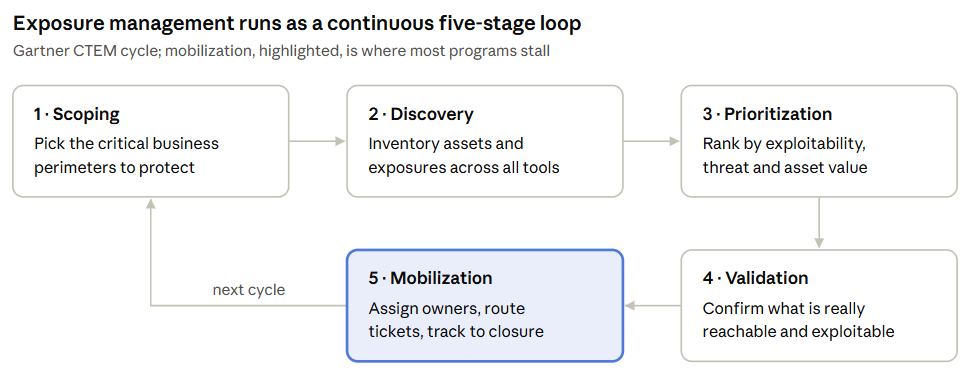
Scoping sets the perimeter, discovery fills it, prioritization ranks it, validation confirms it and mobilization gets the fix done. Then the cycle starts again, because the attack surface never stops changing.
Gartner's own prediction states the business case: by 2026, organizations that prioritize their security investments based on a CTEM program would be three times less likely to suffer a breach (Gartner, October 2023). It is a forecast rather than a measured result, but the market has followed. In November 2025, Gartner published its Magic Quadrant for Exposure Assessment Platforms, evaluating 20 vendors.
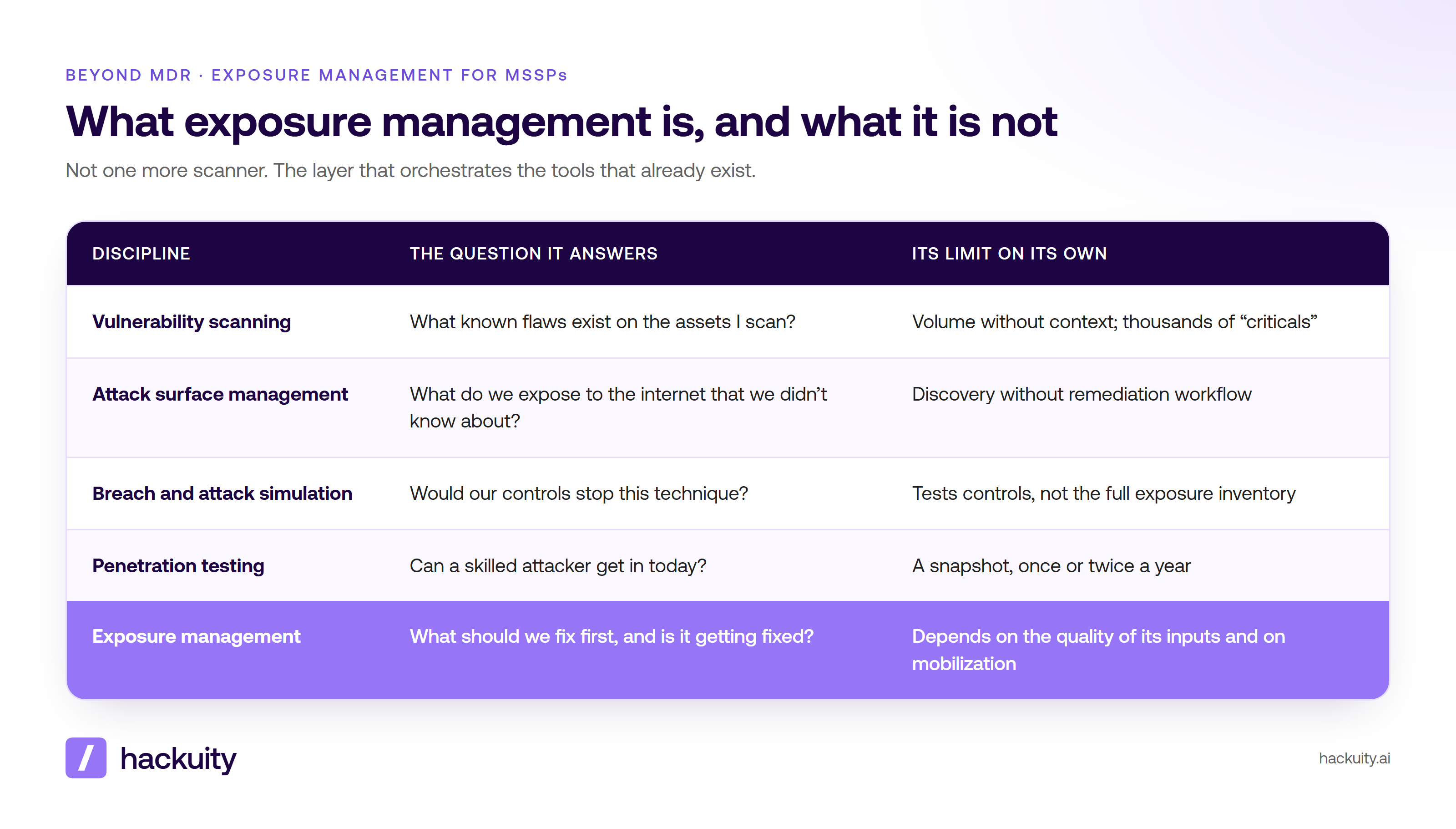
It also helps to say what exposure management is not. It is not one more scanner, and it is not an annual pentest. It is the layer that orchestrates the tools that already exist:
3. Why exposure management is a growth engine for MSSPs
Exposure management is not just another service to add to the catalog. It fits the MSSP model unusually well, for commercial, operational and regulatory reasons.
3.1 The commercial case: grow the base you already have
The cheapest customer to win is the one you already serve. Every MDR customer is a qualified prospect: the MSSP already has the trust, the contract, the asset inventory and often the scanner data. Exposure management is a natural upsell with a short sales cycle and near-zero acquisition cost.
It is recurring by design. CTEM is a cycle, not a project. Unlike a pentest or an audit sold once a year, it produces monthly value and monthly revenue.
It makes the provider harder to replace. An MSSP that knows the customer's assets, owners, business priorities and remediation history holds context a competitor cannot copy in a sales cycle. Switching MDR vendors is a procurement exercise. Switching the partner who runs your risk reduction program is a step backward.
It makes value visible. Exposure management produces the evidence MDR lacks: fewer critical exposures, faster remediation, a risk trend line going down. That is a story a CISO can take to the board, and a reason to renew at a higher price.
3.2 The operational case: MDR and exposure management make each other better
The strongest argument is not that the two services sit side by side, but more that each one improves the other.
- Exposure data sharpens detection. An alert on an internet-facing server with an actively targeted exploitable vulnerability deserves a different triage than the same alert on a hardened isolated host. Exposure context helps analysts prioritize faster and tune detection where attacks are likely.
- Incidents sharpen prioritization. Every MDR investigation shows which weaknesses attackers actually use. Fed back into exposure prioritization, that intelligence keeps the risk model grounded in reality.
- Together they close the loop. Anticipate, detect, respond, reduce. The incident that reaches the SOC becomes an exposure that gets fixed, so the same door is not used twice.
So instead of simply watching your environment, we shrink what can be attacked and we watch what remains.
3.3 The regulatory case: continuous proof is now required
Regulation is turning vulnerability and risk management from good practice into an obligation. In Europe, NIS2 lists "vulnerability handling and disclosure" among the mandatory risk management measures (Article 21). DORA puts vulnerability assessments and scans first in the testing programme financial entities must run (Article 25). Under the Cyber Resilience Act, manufacturers have had to report actively exploited vulnerabilities in their products since 11 September 2026. Frameworks such as ISO 27001 and the questionnaires of cyber insurers ask for the same evidence.
What these frameworks have in common is that they expect proof over time and not a yearly snapshot. An MSSP running a continuous exposure program can deliver that proof to their customers as a by-product of the service.
3.4 The market case: the mid-market cannot do it alone
Mid-sized organizations usually already own the tools: a vulnerability scanner, an EDR, perhaps a cloud security posture tool. What they lack is the people to consolidate the findings, separate signal from noise and chase remediation across IT teams. That gap between tools and outcomes is exactly where a managed service creates value, and it is the segment where most MSSPs already have their strongest MDR footprint.
4. The economics: where the margin is made
Before packaging anything, an MSSP leader needs to know where the money comes from. A managed exposure service has a simple P&L: recurring revenue from customers who add the service, minus the cost of delivering it. Each side breaks down into a handful of levers.
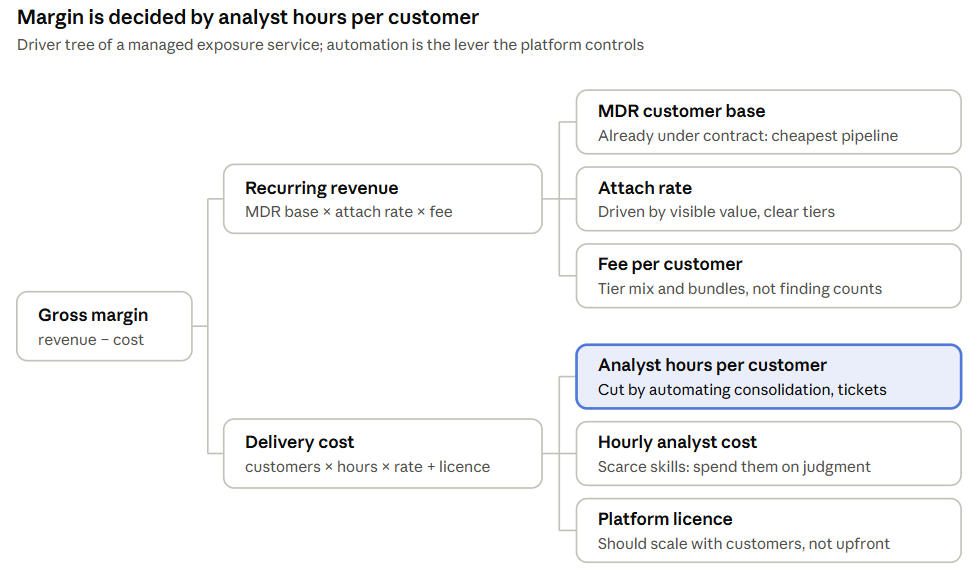
On the revenue side, MSSPs start with an advantage no new entrant has: an installed MDR base that already trusts them. The attach rate depends on how visible the value is, which is why the outcome KPIs below matter as much as the service itself.
On the cost side, the decisive lever is analyst hours per customer. If consolidating findings, prioritizing them and opening tickets is manual, delivery cost grows with every customer and the service never scales. If it is automated, each new customer adds revenue far faster than it adds cost. That is the difference between a consulting line and a platform business, and it is the first question to put to any technology partner.
5. Building the offer: tiers, pricing and KPIs
The most effective exposure management offers are built as a ladder. Each tier maps to CTEM stages, solves a clear customer problem and leads naturally to the next one.
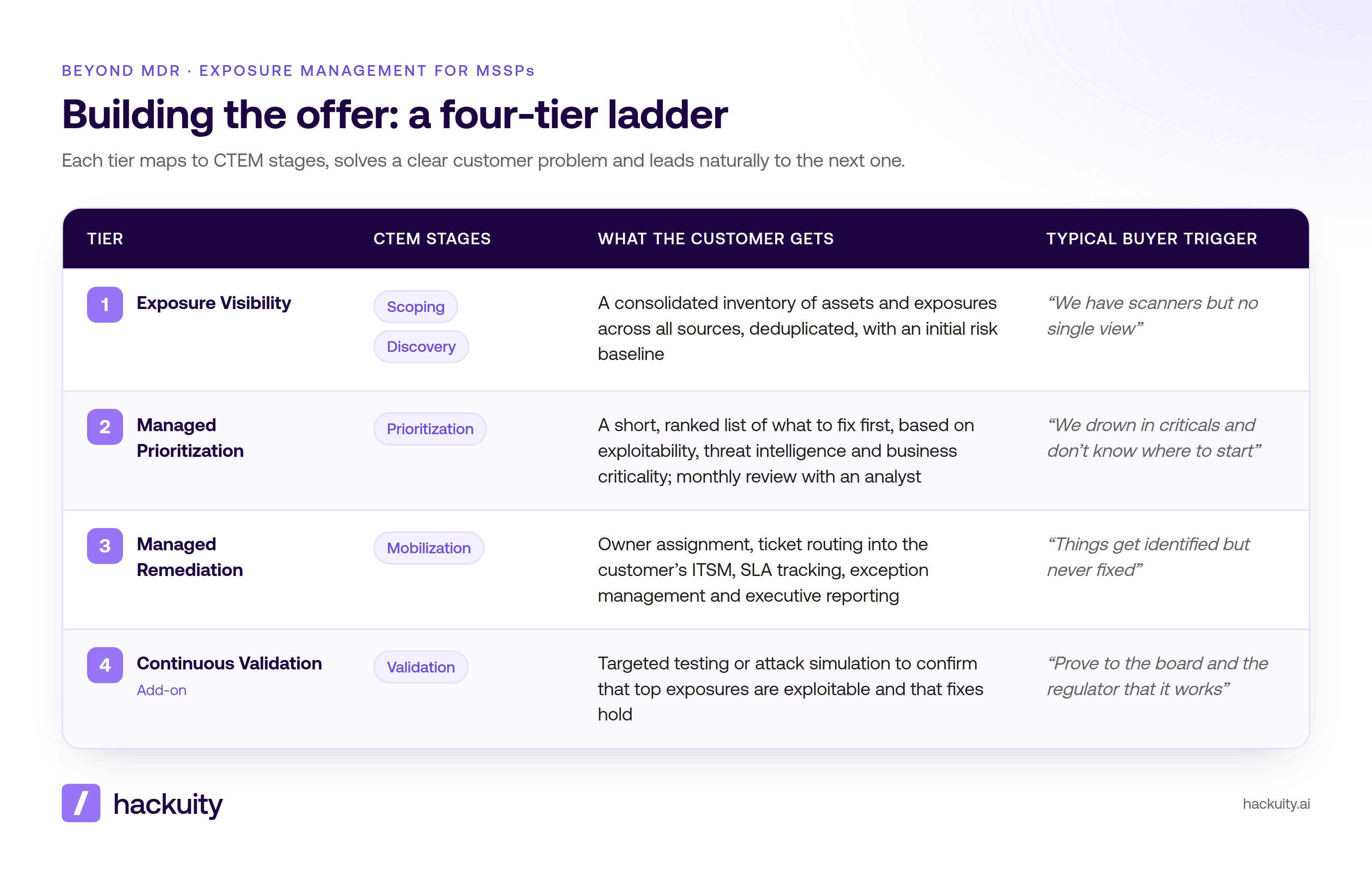
Pricing. Three models work well in practice:
- Per asset or per IP, banded by volume. Simple and aligned with how customers already think about scanning.
- Per tier, as a flat monthly fee for a defined perimeter. Easier to budget and to sell to the mid-market.
- Bundled with MDR, as a "detect and reduce" package. The strongest option for retention: the combined offer is harder to compare line by line against a vendor's MDR.
Whatever the model, avoid pricing on the number of vulnerabilities found. It rewards noise, and the goal of the service is to make that number fall.
KPIs to sell and report. The service should be measured on outcomes the customer understands:
- Mean time to remediate critical exposures, and its trend
- Number of exploitable exposures on critical assets, month over month
- Share of remediation SLAs met
- Asset coverage: the percentage of the estate actually assessed
- An overall exposure score per perimeter, shown as a trend line for the board
These KPIs do double duty. They prove value to the customer, and they give the MSSP the evidence it needs to defend its price at renewal.
6. Choosing the foundation: what to look for in a platform partner
Many MSSPs have tried to sell vulnerability management as a service and found it unprofitable. The cause is rarely the market. It is usually the foundation the service is built on. Five criteria separate a service that scales from one that eats its own margin.
1. Tool-agnostic by design. Every customer arrives with a different stack: network scanners, agents, cloud posture tools, application testing, pentest reports. A platform tied to one scanner vendor forces a rip-and-replace or leaves blind spots. The foundation should ingest what customers already own, normalize findings onto a single asset inventory and remove duplicates. Otherwise analysts spend their time reconciling spreadsheets instead of reducing risk.
2. Risk-based prioritization out of the box. Ranking should combine exploitability, active threat signals such as the CISA Known Exploited Vulnerabilities catalog, and the business criticality of each asset. The goal is a short list analysts can defend in front of a customer, not thousands of "criticals". The value of the service lies in reducing noise, not in producing it.
3. Mobilization built in. Identifying exposures is the easy part. Getting them fixed is where programs stall: according to Verizon's 2026 DBIR, only 26% of the critical vulnerabilities in CISA's KEV catalog were fully remediated in 2025, down from 38% the year before. Look for owner assignment, two-way integration with the customer's ticketing tools, SLA tracking and exception workflows.
4. Multi-tenant at the core. A service that works for three pilot customers can collapse at thirty. Per-customer scoping, role-based access, templated reporting and automation must be native, not bolted on. Without them, every new customer adds analyst hours and the margin disappears.
5. A partner model built for MSSPs. Licensing should grow with your customer base rather than require large upfront commitments. Presales and delivery teams need enablement, because exposure management is an advisory conversation about business risk, not a SOC conversation about alerts. And the vendor should help you sell, not just supply a tool.
The common thread is automation. Every hour saved on collection, consolidation, prioritization and ticketing is an hour of margin, and an hour an analyst can spend where judgment matters. These five criteria are the brief Hackuity's platform and MSSP partner program were built around.
7. A 12-month roadmap for MSSPs
Launching exposure management does not require a big-bang transformation. The safest path starts with the existing MDR base, proves value and margin on a handful of customers, then industrializes.
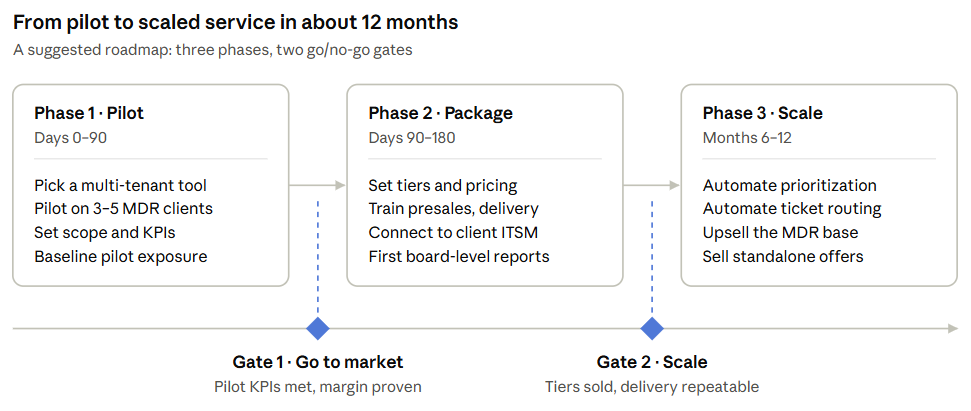
Each gate is a go/no-go decision. Move to packaging only once the pilot proves both customer value and service margin. Scale only once the tiers sell and delivery is repeatable without adding analysts for every new customer.
Conclusion: from watching the doors to closing them
MDR remains the foundation of the modern MSSP. Customers will keep needing someone to watch their environment around the clock. But detection alone no longer differentiates, and it no longer grows margins.
The next wave of growth belongs to providers who can show measurable risk reduction: fewer exploitable exposures, faster remediation, and a trend line that goes down month after month. Exposure management delivers that evidence. It builds on the trust, data and relationships MDR has already created. And it changes the conversation from "how many alerts did you handle?" to "how much safer are we than last quarter?"
The direction of travel is also clear. AI-assisted prioritization and automated remediation workflows will make exposure programs faster and cheaper to run. Detection, exposure and response data will keep converging. MSSPs that build the practice now will be ready to lead that convergence instead of being squeezed by it.
A practical first step: go through your MDR customer base this quarter. Identify the five accounts with the most scanner data, the most recurring incidents or the closest regulatory deadline. They are your first exposure management customers, and they probably already know they need it.
Build your exposure management practice with Hackuity
Hackuity works with MSSPs that want to add a managed exposure service to their MDR offer, or make the one they have profitable at scale. Talk to our partner team to map your first five candidate accounts.
About Hackuity
Hackuity is an exposure management platform that helps security teams and MSSPs consolidate findings from their existing security tools, prioritize the exposures that really matter and drive remediation at scale. Learn more about our solutions here.
Sources
- Verizon, 2026 Data Breach Investigations Report, as reported by SecurityWeek and Infosecurity Magazine, May 2026
- Gartner, Implement a Continuous Threat Exposure Management (CTEM) Program, October 2023
- Gartner, Magic Quadrant for Exposure Assessment Platforms, November 2025
- Directive (EU) 2022/2555 (NIS2), Article 21
- Regulation (EU) 2022/2554 (DORA), Article 25
- European Commission, Cyber Resilience Act: reporting obligations



VR-1 | Property |
|---|---|
Model type | Post-trained cyber reasoning model |
Primary specialization | Multi-domain enterprise attack-chain discovery |
Starting condition | A scoped foothold and a concrete objective |
Operating surfaces | Cloud, identity, runtime, code, CI/CD, SaaS, and organizational context |
Success signal | Execution-verified completion of the objective |
Primary evaluation | IntrusionBench |
Preliminary result (preview) | More than 2× black-box pass@3 over the strongest evaluated frontier baseline |
Trajectory budget | Two-hour wall-clock limit per trajectory, or 250 agent turns (whichever comes first) |