



















Article
Blog
Insights, research, and practical guidance to help security teams prioritize risk, accelerate remediation, and stay ahead of modern threats.
Most recent

Article
Expert View
5 minutes
read
PHP2Shell: The Patch Was Scheduled. The PoC Came First.
Two critical PHP flaws, CVE-2026-109618 and CVE-2026-109619, were patched on October 21. Thirteen and a half hours earlier, an independent researcher had already published a reconstruction of them, apparently built from a handful of public clues.

October 21, 2026
Library
Thank you! Your submission has been received!
Oops! Something went wrong while submitting the form.

Hackuity in the News
4 minutes
read
The vulnerability volume trap: Why security teams are still falling behind
Security teams have never been busier. Dashboards are full of activity – patch counts climbing, remediation tickets being closed week after week. On paper, organisations are doing the work. And yet the teams running these processes will....

August 25, 2026
Article
Expert View
8 minutes
read
From SOC to VOC: Why Vulnerability Management Needs Its Own Operating Model
Your team found 5,000 vulnerabilities last quarter. How many did you actually fix? If the answer makes you slightly uncomfortable, you're in good company. And it's not because your team lacks competence or tools. It's because the way most organizations approach vulnerability management was never designed for the reality we're facing today. Here's what keeps me up at night: vulnerabilities aren't just one threat vector among many. They are the primary way attackers get in. Yes, social engineering plays a role, but exploiting vulnerabilities is how the vast majority of successful breaches actually happen. And here's the part that should bother every security leader, most of these breaches rely on vulnerabilities that have been publicly known for years. Not zero-days. Not sophisticated nation-state exploits. Known, unpatched weaknesses that we simply haven't gotten around to fixing. So if we all know this, why are we still drowning?

August 25, 2026
Article
Expert View
8 minutes
read
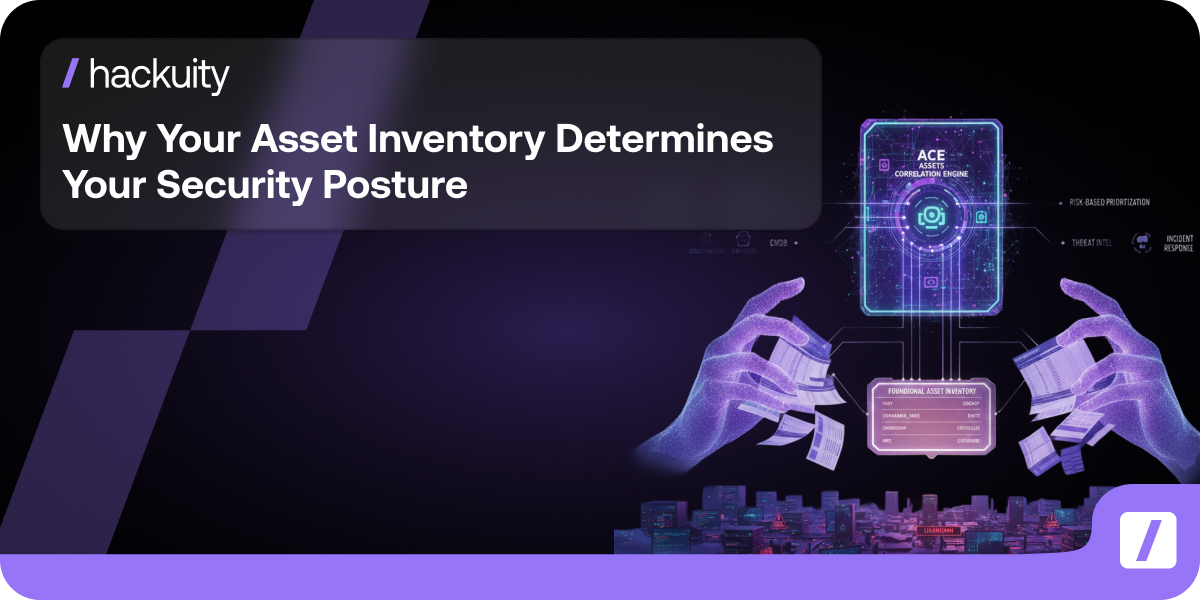
Why Your Asset Inventory Determines Your Security Posture (And How Most Teams Get It Wrong)
You just got an alert about a critical vulnerability. CVSS 9.8. Sounds urgent, right? But here's the question that actually matters: Is that vulnerability on an internet-facing production server handling customer data, or is it on an air-gapped test machine that gets rebuilt every week? If you can't answer that question in seconds, you have an asset inventory problem. And that problem is affecting every security decision you make.

August 25, 2026
Article
Expert View
8 minutes
read
Preparing for the AI-Driven CVE Tsunami: Why Transparent Prioritization Matters
A tale of two forces — and why neither cancels the other out. This week, Anthropic launched Claude Code Security, an AI tool that autonomously scans entire codebases for vulnerabilities, suggests human-reviewed fixes, and reportedly uncovered 500+ high-severity vulnerabilities in production open-source projects during internal testing, some of which had gone unnoticed for years. The reaction was immediate. CrowdStrike and Cloudflare dropped 8%. A total of $15 billion was erased from cybersecurity stocks in a single session on February 20th. Markets interpreted the launch as a disruption signal: if AI can replace vulnerability scanners, what happens to the industry?But that reading misses the real story and the real risk.
August 25, 2026

Article
Hackuity in the News
5 min
read
Why defenders must act faster than ever to outpace vulnerability exploitation
Traditional vulnerability management has been designed for a world of steady streams - patch cycles, database updates, and predictable timelines. Processes are built to handle a steady stream of new CVEs to patch. But every day now...
August 25, 2026
Article
Hackuity in the News
3 min
read
Security teams are struggling to stay afloat in the vulnerability flood
Security teams are scrambling to keep up with the ever-greater volume and sophistication of threats, with the active and continual exploitation of CVEs (Common Vulnerabilities and Exposures) having become the source of major headaches.
August 25, 2026